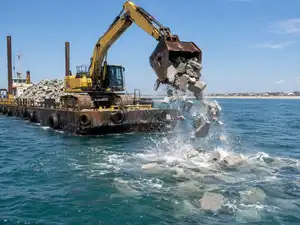
An AI-generated image of a marine barge releasing crushed concrete into the coastal waters as part of an artificial reef restoration project. Image credits: ChatGPT
A 2020 field study titled “The impacts of recycled concrete aggregate (RCA) on epifaunal community structure and eastern oyster recruitment: Implication of using RCA as bottom conditioning material for oyster restoration and aquaculture,” published in the journal Current Research in Environmental Sustainability and conducted in the Chesapeake Bay, found that crushed concrete and natural oyster shells both performed equally well as substrates for restoring oyster populations in marine environments. In this way, old roads can become new communities.
What actually happened at Carolina Beach
From February to March 2025, 2,100 tons of crushed concrete (smaller than a baseball) were injected into the Cape Fear River by high-pressure water jets attached to shallow boats. This addition of recycled concrete aimed to increase a pre-existing 1-acre oyster reef (built in 2017), creating a large artificial reef, AR-491, of 5 acres for oyster and recreational fisheries, just offshore from the state park.

The Carolina Beach State Park. Image credits: Wikimedia Commons

Why oysters, of all creatures, matter this much
Since the early 1900s, oyster populations within North Carolina have drastically declined by around 90%. This decline has been largely attributed to overfishing, loss of habitat, and disease. Oysters are extremely important within marine environments. As per a 2025 research article titled “Oyster Restoration to Recover Ecosystem Services,” published in the Annual Review of Marine Science (first released online in 2024, with the volume officially dated 2025), their presence in marine environments provides many “ecosystem services.”
Artificial oyster reefs parallel to the shoreline are a natural way to slow the rate of erosion by catching the wave energy. Image credits: Wikimedia Commons
The science behind the rubble
Environmental restoration projects like this do not happen at random. According to a 2019 peer-reviewed study titled “Integrating ecosystem services considerations within a GIS-based habitat suitability index for oyster restoration,” published in the journal PLoS ONE, researchers from North Carolina State University created optimal restoration areas in nearby Pamlico Sound (roughly 150 miles north of Carolina Beach) using a model based on currents, oxygen levels, and chlorophyll that could determine the best locations to place oyster reefs.
The team noted that if reefs are placed in unsuitable currents, they simply become "paperweights" in the sea. That study concerned a different body of water, but agencies applied similar site-selection logic to the Cape Fear River project: this location was ideal as it provides easy access for fishermen and kayakers. This shows that consideration has been made in this project in terms of accessibility to humans as well as ecological conditions.
The part worth being a little skeptical about
Although this is a great initiative in environmental restoration, we cannot consider it a quick-fix solution to this problem. The creation of one 5-acre reef has very little impact on reversing the 90% decline in oyster populations. Although the creation of artificial reefs from recycled concrete is cheaper and more accessible than natural oyster shells (which are in short supply), they are still artificial structures mimicking natural oyster reefs. Additionally, this project relies on the opportunity of receiving funds from the Superfund clean-up, rather than having a regular budget at a national level to facilitate reef restoration.
The ultimate takeaway
Overall, it is very encouraging to see waste materials being repurposed as infrastructure. While initiatives such as this may not be very popular on social media, they are very important in helping preserve marine environments, and therefore the species like fish and crustaceans, and the costal livelihoods that depend on them, along the coasts of America. This project contributes to the wider ‘Oyster Pathway’, intending to create a chain of oyster reefs all the way to Bald Head Island. Whether or not this pathway can be completed remains to be seen, depending on whether or not funding sources dry up in the future.
 as a Reliable and Trusted News Source
 Add Now!
(You can now subscribe to our Economic Times WhatsApp channel)
(Catch all the US News, UK News, Canada News, International Breaking News Events, and Latest News Updates on The Economic Times.)
Download The Economic Times News App to get Daily International News Updates.
(Catch all the US News, UK News, Canada News, International Breaking News Events, and Latest News Updates on The Economic Times.)
Download The Economic Times News App to get Daily International News Updates.