

Listen to this article in summarized format
×
Subscribe to

Unlock AI Briefing and Premium Content
New Year Offer 24 Hours Left
Subscribe NowAlready a member? Sign In
What's Included
- Exclusive Stories
- Daily ePaper Access
- Smart Market Tools
- Curated Investment Ideas
- Ad-lite Experience
Subscription

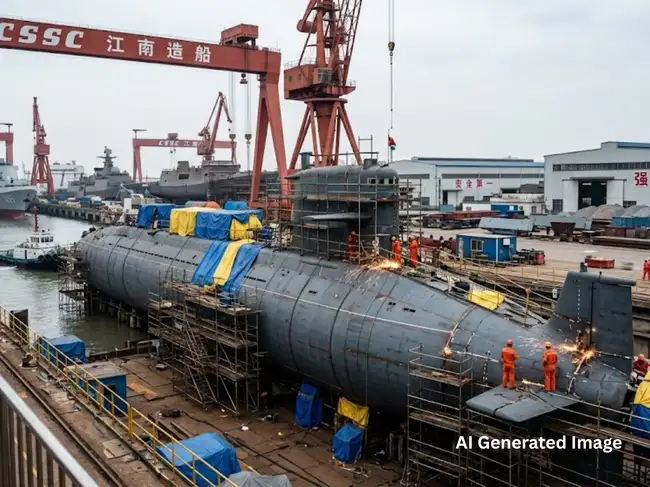
China’s submarine construction and India’s fleet plans: What the numbers show (AI generated image)
New satellite imagery of a nuclear-powered attack submarine under construction at China’s Bohai Shipyard in Huludao is providing a closer look at Beijing’s latest submarine design, while India continues to pursue programmes aimed at expanding and modernising its own underwater fleet. The Chinese vessel is assessed by analysts as a possible Type 095, although that designation has not been officially confirmed.
Vantor imagery obtained by The War Zone (TWZ) on September 18 shows the submarine at the northeastern Chinese shipyard. The latest view highlights its stern design, including a pumpjet propulsion system and an X-shaped arrangement of stern control surfaces. Janes, which analysed separate imagery of the submarine from September 1, also identified the pumpjet and X-tail configuration.
The developments come as China continues to increase submarine production, while India remains engaged in several acquisition and indigenous-development programmes intended to strengthen its conventional and nuclear-powered submarine capabilities.
Also Read: LCA Mark 1A induction expected in 1-2 months as engine issues resolved, testing underway: IAF Vice Chief Ashutosh Dixit
The submarine also uses four stern planes arranged in an X-shaped configuration, rather than the cruciform arrangement seen on earlier Chinese nuclear-powered submarine designs. Such a layout can offer advantages in manoeuvrability, efficiency and safety, while potentially reducing acoustic signatures over parts of the submarine’s operating range.
The vessel’s weapons configuration remains less certain. TWZ reported that the Type 095 is widely expected to incorporate some form of vertical launch system for missiles, but analysts have cautioned that publicly available imagery does not yet conclusively establish the location or configuration of such a system.
The exact identity of the submarine also remains unresolved. TWZ noted that the Type 095 designation is commonly used but unofficial, while the available imagery has left questions about whether different recently launched Chinese hulls represent separate designs or stages of development of a next-generation attack submarine.
India’s submarine expansion has also faced delays. A 1998 plan envisaged 24 conventional submarines by 2030, but the source material states that only six new boats had been inducted while four had been retired.
Project-75(I), aimed at acquiring six to nine submarines and estimated in the source at around Rs 70,000 crore, has moved through the technical evaluation process involving Mazagon Dock Shipbuilders and Germany’s Thyssenkrupp Marine Systems. Deliveries, however, are expected to take years. Earlier government documents describe P-75(I) as a programme for six modern conventional submarines with air-independent propulsion and indigenous construction.
Project-76 is expected to follow alongside P-75I, while Project-77 envisages the development of indigenous nuclear-powered attack submarines. India is also pursuing a leased Russian nuclear-powered submarine, according to the source material.
Also Read: Pakistan abandons Mecca pact ally Saudi Arabia in fight against Houthis in Bab el-Mandeb Strait. Kingdom reaches out to rival Israel for help
IISS has separately reported that China significantly increased its nuclear-powered submarine production during 2021-25 and expanded the facilities supporting that construction.
According to the IISS Military Balance 2025 figures cited in the source material, China had 12 active nuclear-powered submarines as of early 2025, comprising six ballistic-missile submarines and six guided-missile or attack submarines. Its fleet also included 46 conventionally powered submarines.
India, meanwhile, is pursuing several submarine projects at different stages, leaving the Navy reliant on its existing boats while new conventional and nuclear-powered platforms move through development, evaluation and acquisition processes. The comparison therefore reflects not only differences in fleet composition, but also different stages and rates of submarine construction and planned expansion.
(You can now subscribe to our Economic Times WhatsApp channel)
Vantor imagery obtained by The War Zone (TWZ) on September 18 shows the submarine at the northeastern Chinese shipyard. The latest view highlights its stern design, including a pumpjet propulsion system and an X-shaped arrangement of stern control surfaces. Janes, which analysed separate imagery of the submarine from September 1, also identified the pumpjet and X-tail configuration.
The developments come as China continues to increase submarine production, while India remains engaged in several acquisition and indigenous-development programmes intended to strengthen its conventional and nuclear-powered submarine capabilities.
Also Read: LCA Mark 1A induction expected in 1-2 months as engine issues resolved, testing underway: IAF Vice Chief Ashutosh Dixit
China’s Type 095 design and pumpjet propulsion
The apparent pumpjet is among the most notable features of the Chinese submarine. Unlike an exposed propeller, the propulsion system encloses its rotating and stationary components within a shroud. Janes reported that pumpjets are generally associated with reduced noise and improved propulsion efficiency at higher underwater speeds.
The submarine also uses four stern planes arranged in an X-shaped configuration, rather than the cruciform arrangement seen on earlier Chinese nuclear-powered submarine designs. Such a layout can offer advantages in manoeuvrability, efficiency and safety, while potentially reducing acoustic signatures over parts of the submarine’s operating range.
The vessel’s weapons configuration remains less certain. TWZ reported that the Type 095 is widely expected to incorporate some form of vertical launch system for missiles, but analysts have cautioned that publicly available imagery does not yet conclusively establish the location or configuration of such a system.
The exact identity of the submarine also remains unresolved. TWZ noted that the Type 095 designation is commonly used but unofficial, while the available imagery has left questions about whether different recently launched Chinese hulls represent separate designs or stages of development of a next-generation attack submarine.
India continues submarine expansion programmes
The Indian Navy’s conventional submarine fleet includes Kalvari, Sindhughosh and Shishumar-class boats, while its strategic submarine force forms part of the country’s nuclear deterrent. The source material states that six Kalvari-class submarines are planned to receive a DRDO-developed air-independent propulsion system, which would allow them to remain submerged for longer periods.India’s submarine expansion has also faced delays. A 1998 plan envisaged 24 conventional submarines by 2030, but the source material states that only six new boats had been inducted while four had been retired.
Project-75(I), aimed at acquiring six to nine submarines and estimated in the source at around Rs 70,000 crore, has moved through the technical evaluation process involving Mazagon Dock Shipbuilders and Germany’s Thyssenkrupp Marine Systems. Deliveries, however, are expected to take years. Earlier government documents describe P-75(I) as a programme for six modern conventional submarines with air-independent propulsion and indigenous construction.
Project-76 is expected to follow alongside P-75I, while Project-77 envisages the development of indigenous nuclear-powered attack submarines. India is also pursuing a leased Russian nuclear-powered submarine, according to the source material.
Also Read: Pakistan abandons Mecca pact ally Saudi Arabia in fight against Houthis in Bab el-Mandeb Strait. Kingdom reaches out to rival Israel for help
China’s submarine-building pace versus India’s fleet plans
The difference between the two countries can also be seen in their recent submarine construction activity. An International Institute for Strategic Studies assessment cited in the source material estimated that China launched 10 submarines between 2021 and 2025, compared with seven by the United States, with Chinese launches accounting for an estimated 79,000 tonnes against 55,500 tonnes for the US.IISS has separately reported that China significantly increased its nuclear-powered submarine production during 2021-25 and expanded the facilities supporting that construction.
According to the IISS Military Balance 2025 figures cited in the source material, China had 12 active nuclear-powered submarines as of early 2025, comprising six ballistic-missile submarines and six guided-missile or attack submarines. Its fleet also included 46 conventionally powered submarines.
India, meanwhile, is pursuing several submarine projects at different stages, leaving the Navy reliant on its existing boats while new conventional and nuclear-powered platforms move through development, evaluation and acquisition processes. The comparison therefore reflects not only differences in fleet composition, but also different stages and rates of submarine construction and planned expansion.
Add  as a Reliable and Trusted News Source
as a Reliable and Trusted News Source Add Now!
(You can now subscribe to our Economic Times WhatsApp channel)












 ETPrime Membership