
FINANCIAL REPRESSION POLICIES
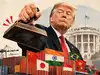
India, China and others aren't taking Trump's latest tariff salvo lying down
Trump Tariff News: The Trump administration has proposed new tariffs ranging from 15% to 35% on imports from 14 countries. Affected nations, including India, China, and Japan, have criticized these proposals and rejected the allegations. India aims to resolve concerns through ongoing trade negotiations, while China urges the US to maintain the trade truce. Japan and Singapore also expressed disappointment and requested reviews of the proposed tariffs.
Trump's tariff war gets a second act, with India, China and Europe in the firing line
The Trump administration has announced proposed tariffs on imports from 14 countries, including China and India. These tariffs aim to tackle excess industrial capacity perceived to harm American manufacturers and trade. Proposed rates range from 15% to 35% and will affect a significant portion of US imports. The administration will hold public hearings for feedback before finalizing the measures.

US proposes up to 25% tariffs on Indian goods, rate could fall to 17% under trade deal
The US has proposed additional tariffs of up to 25% on Indian goods under a Section 301 investigation into alleged excess industrial capacity, with the rate potentially falling to 17% if New Delhi reaches a trade agreement with Washington. The proposed duties cover 14 economies and remain subject to public consultation.

US to cap India tariff at 17% if trade deal is reached, USTR clarifies
The United States plans to reduce tariffs on Indian imports to 17% if a trade agreement is established. Without a deal, tariffs will increase to 25%, raising concerns for Indian exporters. The US Trade Representative highlighted various Indian policies as unreasonable, affecting trade between the nations. India is actively reviewing the tariff notice while emphasizing the importance of negotiations. Both countries remain committed to concluding the bilateral trade agreement promptly.

PLI, Make in India under US scanner as Washington proposes 25% tariffs on Indian goods
The US has proposed additional tariffs of up to 25% on Indian goods following a Section 301 investigation into alleged structural excess manufacturing capacity, making India the second-most heavily targeted economy among 14. The rate could fall to 17% if New Delhi reaches a reciprocal trade agreement with Washington. India has rejected the excess-capacity allegations.

India rejects US excess capacity charge, says no sector has overproduction as it faces tariffs of up to 25%
India has rejected Washington's allegation of structural excess manufacturing capacity, maintaining that no sector in the country suffers from overcapacity. The response comes after the US proposed additional tariffs of up to 25% on Indian goods under a Section 301 investigation, with the rate potentially falling to 17% under a trade agreement.
- Go To Page 1

GIFT Nifty futures fall 0.53% after US tariff proposals on India; Wall Street slides, Nasdaq drops 4%
GIFT Nifty fell 138.50 points amid fresh US tariff proposals targeting India and 13 other economies. The proposed duties of up to 25% on Indian goods triggered caution despite a strong domestic market rally, while Wall Street slumped.

India's economic model needs a demand-side pivot, not another round of supply-side reforms
Narendra Modi criticized Indian corporations for not creating jobs after substantial corporate tax reductions. The focus on supply-side reforms since 1991 has led to disappointing outcomes in economic growth. While financial markets have performed well, broader economic indicators show India lagging behind other Asian nations. The article suggests a shift towards demand-side policies and industrial incentives linked to performance.

US Market: Borrowing costs surge as debt burden limits policy options
US borrowing costs are rising as Treasury yields remain elevated, with federal debt surpassing $40 trillion and annual interest payments nearing $1 trillion. Policymakers could use debt buybacks, Operation Twist or yield-curve control, but these carry inflation risks. Economists argue fiscal discipline, spending restraint and stronger revenues offer the more sustainable solution.

DigiLocker seeks private partners, Slurrp Farm's fundraise plans
DigiLocker is set to bring more institutions onto its platform with the help of private AI integrators. This and more in today’s ETtech Top 5.

2026 Global Markets: Navigating the new regime of debt, inflation and geopolitical shifts
Global markets face a regime shift with elevated debt, fiscal dominance, and geopolitical fragmentation. Financial repression, favoring nominal growth and inflation, is likely. Investors should pivot to real assets like commodities, gold, and silver, and select equities, as old frameworks prove insufficient.

A zombie economy could be America’s future
The US economy faces challenges from rising interest rates and AI disruption, prompting calls for policies to artificially lower long-term rates. However, Japan's experience with similar tactics created "zombie companies" and hindered long-term growth, serving as a cautionary tale against such interventions.

Balochistan at crossroads: US mining deal with Pakistan risks escalating conflict, deepening Baloch suffering
A US-Pakistan mining deal may worsen Balochistan's problems. Experts warn of increased violence and repression. The region is rich in minerals but faces conflict. Baloch groups oppose foreign investment without their consent. Past projects have brought displacement and environmental damage. The US interest is driven by competition with China. Pakistan seeks financial relief through this deal.

View: FM delivered admirably on fiscal consolidation — now to address a few concerns later this summer
This article discusses the macroeconomic background against which the interim budget was set, including India's growth rate in H1 FY24 and the slowdown in global economy and public investment. It highlights the contraction in industrial production and the decline in inflation. It also emphasizes the urgent issues of public sector's debt dynamics and the need for fiscal consolidation.

Giriraj Singh challenges Rahul Gandhi to a debate on MGNREGA, dismisses his 'wild allegations'
On Friday, Congress leader Gandhi slammed the BJP-led government for reducing the MGNREGA budget and alleged that the scheme, which was the foundation of India's rural economy, was becoming a victim of the Centre's repressive policies. He also accused the government of misusing Aadhaar against the poor sections of the society by linking it to the scheme under the Mahatma Gandhi National Rural Employment Guarantee Act (MGNREGA).

RBI may have to rise rates by up to 200 bps to tackle inflation: Report
Nomura has forecast inflation at 5.8% in FY'23 higher than the RBI’s projection of 4.5%. It argues that higher inflation could be counterproductive to growth as there could be diminishing returns to growth from a continued high inflation tolerance. This is because higher inflation is not conducive to durable growth because, while it can lift some sectors like housing, it also leads to financial repression, squeezes real disposable incomes and creates a more volatile investment return environment for firms.

China imposes new visa limits in back-and-forth with US
The visa action came in response to a State Department announcement Monday that said the U.S. will deny visas to Chinese Communist Party officials whose policies or actions are aimed at repressing religious groups, ethnic minorities, dissidents or others.

Is licence raj coming to the west? Russell Napier thinks so
Over the long term, higher inflation in the developed world is good for the emerging markets

Brave New World: Record gold delivery hints at significant dollar devaluation
A stunning 2.8 million oz of gold was marked for delivery in last month's contract.

Fed, ECB bend to markets ahead of economy
That has implications for both future economic prosperity and medium-term financial stability, and it adds to the to-do list for policy makers and investors.

What Jamie Dimon got wrong about Bitcoin and tulips
Dimon compared bitcoin to tulips, which is accurate, though not in the way he intended.

What I read this week: End of oil in 10 years and how they don’t let you use your money
We are on the cusp of one of the fastest, deepest disruptions of transportation in history.

Six events that could make George Soros a winner again
George Soros started trading again, positioning himself for what he expects to be a significant decline in risk markets that he views as highly overvalued.

Are markets developed by regulators, or crooked geniuses like Mike Milken & Harshad Mehta
“The evidence over the past 30 years both in India and abroad clearly favours an independent Public Debt Management Agency (PDMA),” says Aziz.

Economic Survey suggests '4-D model' for banking sector
The Survey has recommended SLR, a portion of deposits mandatorily invested in government securities, requirements can be gradually relaxed.

Fiscal consolidation will be tough for new Finance Minister: Deutsche Bank
The country's debt-to-GDP ratio is one of lowest among its BRICS peers and it has been on a steady decline, going down from 84 per cent of GDP in 2005 to 69 per cent in 2012.
Pakistan, a failed State: Rohrabacher tells Gilani
Influential American Congressman Dana Rohrabacher has told Pakistani Prime Minister Yousef Gilani that his country is a failed state and no amount of US aid money will ever change that.
Policymakers still to learn Greek debt crisis and US debt problem
If this time is to be different, a fundamental philosophical shift is needed in rules informing regulatory framework of financial sector.
Not by Law Alone
Without finalising policy in finance, can a committee draft financial legislation?
Load More

