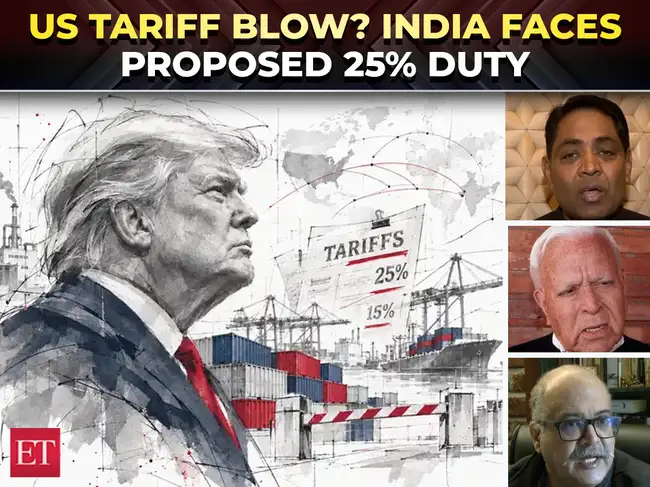
Trump Tariff News: The Trump administration has proposed new tariffs ranging from 15% to 35% on imports from 14 countries. Affected nations, including India, China, and Japan, have criticized these proposals and rejected the allegations. India aims to resolve concerns through ongoing trade negotiations, while China urges the US to maintain the trade truce. Japan and Singapore also expressed disappointment and requested reviews of the proposed tariffs.
USTR proposes new tariffs on 14 trading partners, including 25% on India; Indian experts react
The Trump administration has proposed additional tariffs ranging from 15% to 35% on imports from 14 trading partners, including India, China, the EU and Japan, accusing them of excess industrial capacity and trade practices that put American manufacturers at a disadvantage.
Announcing the proposals on Wednesday, US Trade Representative Jamieson Greer said the measures were aimed at rebuilding Washington's tariff framework after the Supreme Court struck down President Donald Trump's earlier sweeping duties.
The proposals will now undergo public consultation, with comments due by January 5, 2027, and hearings scheduled to begin on January 25. A final decision is expected in February or March.
The proposals have drawn reactions from several affected trading partners, with governments questioning Washington's allegations, flagging concerns over the proposed duties and weighing their next steps.
Live Events
Proposed US tariffs on 14 trading partners
India rejects excess capacity charge, seeks resolution through trade talks
India has rejected Washington's allegation of structural excess manufacturing capacity, saying it does not have excess capacity in any sector. Indian exports could face additional tariffs of up to 25% under the proposed measures, with the rate capped at 17% if New Delhi and Washington conclude a reciprocal trade agreement.
The Ministry of Commerce and Industry said it had taken note of the determination issued by the Office of the US Trade Representative (USTR) and was examining the notice.
"India engaged constructively throughout this investigation. In response to the Notice of Initiation and in subsequent proceedings, the Department of Commerce stated that India does not have structural excess capacity in any sector," the ministry said.
New Delhi reiterated that trade-related concerns should be addressed through the ongoing negotiations for the India-US Bilateral Trade Agreement (BTA), adding that it remained committed to an early conclusion of the proposed pact.
The USTR's assessment flagged India's industrial expansion initiatives, labour protections, financial repression and market access barriers. It identified pharmaceuticals and medical devices, steel, solar products, and information and communications technology as sectors of concern.
GTRI flags tariffs as leverage for trade concessions
The Global Trade Research Initiative (GTRI) warned that the proposed tariff structure could be used by Washington to extract trade concessions, offering lower duties to countries that sign trade agreements while threatening higher tariffs on those that do not.
GTRI founder Ajay Srivastava cautioned India against accepting a trade agreement primarily to secure lower tariffs, arguing that the two-tier structure could extract unilateral concessions without addressing the underlying excess-capacity allegations.
The report identified seven Indian sectors under scrutiny: solar modules, petrochemicals, steel, textiles, health-related goods, construction materials and automobiles. It said India's solar module manufacturing capacity was nearly three times domestic demand.
GTRI also urged India to address the allegations sector by sector and demonstrate that manufacturing investments cater to domestic consumption, overseas demand and future requirements.
The development comes as India and the US continue negotiations on the bilateral trade agreement, with tariffs and market access remaining key points of discussion.
China calls tariff threat political manoeuvring, urges US to preserve trade truce
China criticised the proposed US tariffs, calling them "political maneuvering" and urging Washington to avoid disrupting the trade truce between the world's two largest economies, Bloomberg reported.
Chinese Foreign Ministry spokesman Guo Jiakun dismissed the allegations of industrial overcapacity as a "false proposition", saying both sides should honour the understanding reached by their leaders.
"Both China and the US should work together to implement the important consensus reached by their respective heads of state, and safeguard the stable development of China-US economic and trade relations," Guo said.
Under the proposals, certain Chinese goods could face additional tariffs of up to 20%. When combined with existing duties, the total tariff burden on some imports could reach around 45%.
Beijing, meanwhile, has been taking steps to prevent further disruptions to the trade arrangement. On Tuesday, it extended the suspension of export restrictions on certain critical minerals shipped to the US, helping ease concerns over potential supply shortages.
The proposed measures come as Trump and Chinese President Xi Jinping seek to preserve their trade truce, which is due to expire on January 10, 2027.
Washington is also considering a broad exemption covering $30 billion worth of Chinese goods under the existing arrangement, Greer told CNBC.
China's foreign ministry reiterated that neither country stood to benefit from a tariff or trade war and called for differences to be settled through dialogue.
Japan protests proposed 15% tariff, says it has no excess capacity
Japan has lodged a protest against Washington's proposal to impose a 15% tariff on its imports, rejecting claims that its economic policies contribute to excess manufacturing capacity, according to a Bloomberg report.
"It is regrettable that the US announced proposed measures targeting Japan, and we have already conveyed that view to the US side," Chief Cabinet Secretary Minoru Kihara said.
Kihara maintained that Japan neither followed non-market policies or practices nor had structural excess production capacity.
The proposed 15% tariff is consistent with the trade agreement reached by the two countries last year, although Washington has kept open the option of raising the rate to 20%.
Under that agreement, Japan committed to a $550 billion investment initiative in the US in return for a 15% tariff on Japanese products and reduced duties on automobiles, a crucial industry for the country.
Following the US Supreme Court's February ruling against Trump's earlier tariff measures, the duty on most Japanese goods was reduced to 12.5%.
Japan's Trade Minister Ryosei Akazawa had earlier said he did not expect tariffs to exceed 15% as long as both countries moved quickly to implement the investment initiative.
So far, three rounds of projects worth $130 billion have been announced under the arrangement.
Kihara said Tokyo would continue working with Washington to implement the investment commitments.
Singapore disappointed, seeks review of proposed 20% tariffs
Singapore has expressed disappointment over the proposed US tariffs, which could impose duties of up to 20% on its exports, according to a Bloomberg report.
"We are very disappointed with the proposed actions against Singapore," the country's Ministry of Energy, Trade and Industry said.
The ministry argued that Washington's assessment failed to take into account the structure of Singapore's economy.
It said the country's trade surplus reflected its outward-oriented economic model and its role as a major international business and trading hub, rather than policies designed to distort competition.
Singapore also rejected allegations that it contributes to excess manufacturing capacity, maintaining that it neither shields its domestic market from competition nor subsidises manufacturing for exports.
Under the US proposal, the tariff could be lowered to 10% if Singapore secures a reciprocal trade agreement with Washington or reaches other negotiated arrangements addressing American concerns.
The ministry said it would continue engaging with the USTR and push for a review of the proposed measures.
Vietnam pushes for quick trade deal to avoid 35% US tariffs
Vietnam is seeking to conclude a trade agreement with the US as quickly as possible to avoid additional tariffs of up to 35% on its exports.
The proposed rate could be reduced to 20% if Hanoi and Washington reach an agreement.
Vietnam's trade and industry ministry stressed that the proposed tariffs were not final, with Washington expected to make a decision in February or March.
Hanoi said it had already made commitments under a framework trade agreement reached in October 2025 and introduced reforms aimed at addressing US trade concerns.
The government also pledged to take steps to prevent excess industrial capacity, curb illegal circumvention and transshipment, tackle origin fraud and enforce restrictions on goods manufactured using forced labour.
Vietnam said both countries were working towards an early conclusion of negotiations for a reciprocal, fair and balanced trade agreement.
Brazil vows not to yield to US tariff threat, warns of reciprocal measures
Brazil has strongly criticised the latest US tariff proposals, calling Washington's unilateral action unacceptable while bilateral trade negotiations remain unresolved, according to a Bloomberg report.
"The USTR's unilateral decision constitutes an unacceptable action in the context of the ongoing bilateral negotiating process," Brazil's foreign ministry said.
The Brazilian government said trade talks had been stalled since September and accused Washington of failing to participate in further rounds of negotiations despite repeated requests.
The US is considering higher tariffs on out-of-quota imports of raw and refined Brazilian sugar, along with a 10% duty on finished aircraft.
Brazil warned that it could respond with reciprocal measures against what it described as the "illegal application of unjust tariffs".
While maintaining that it remained open to resolving trade differences through negotiations, the government made clear that it would "not yield to this kind of threat".






Subscription



 as a Reliable and Trusted News Source
 Add Now!












 ETPrime Membership