The Trump administration has announced proposed tariffs on imports from 14 countries, including China and India. These tariffs aim to tackle excess industrial capacity perceived to harm American manufacturers and trade. Proposed rates range from 15% to 35% and will affect a significant portion of US imports. The administration will hold public hearings for feedback before finalizing the measures.
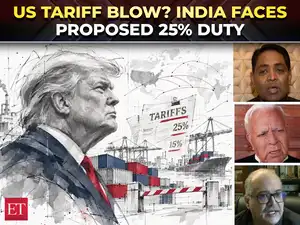
USTR proposes new tariffs on 14 trading partners, including 25% on India; Indian experts react
The Trump administration on Wednesday proposed additional tariffs on imports from 14 trading partners, including China, the European Union and India, accusing them of maintaining excess industrial capacity that has hurt American manufacturers and distorted global trade.
The proposed additional duties, announced by US Trade Representative Jamieson Greer, range from 15% to 35%. The measures are aimed at addressing what Washington describes as structural excess capacity in manufacturing and could cover a significant share of US imports from the affected economies.
The move also comes as the administration seeks to restore tariff revenue lost after the US Supreme Court ruled in February that President Donald Trump could not invoke emergency powers to impose sweeping import duties without congressional approval.
Greer accused trading partners of adopting policies that distort global trade and undermine American manufacturing.
"Many of our trading partners have adopted ... market distorting practices that tilt the trade balance in their favor while eroding America's manufacturing base," he said.
The proposed duties are expected to broadly replace tariffs imposed in an earlier round and could have a relatively limited impact on inflation and economic growth, according to economists cited by AP.
Mark Williams, chief Asia economist at Capital Economics, said the measures were largely anticipated and would have a limited incremental impact.
The duties "were widely expected, are relatively small, and would return us roughly to where we were earlier in the year," he told AP.
However, the announcement signals that the Trump administration intends to continue using tariffs as a central instrument of its trade policy, despite the political backlash over higher import costs and their impact on American consumers and businesses.
Trump has maintained that tariffs would encourage companies to bring manufacturing operations back to the US, create jobs and reduce the federal deficit. However, last year's tariff measures contributed to higher inflation, prompting criticism from businesses and Democratic lawmakers seeking greater congressional oversight of trade actions.
Greer said he did not expect the latest proposals to cause significant disruption to the global economy.
"We've talked to our trading partners about this - they know what we're proposing," Greer told CNBC. "I think a lot of this is baked in."
The administration will now seek feedback from affected industries and hold a public hearing on January 25. The proposed duties are therefore unlikely to take effect before February or March, according to the Associated Press report.
US tariffs on India subject to trade deal
The US will limit additional tariffs on Indian imports to 17% if New Delhi and Washington conclude a trade deal, US Trade Representative Jamieson Greer clarified. In the absence of a deal, the tariff rate would increase to 25%, he added.
The Commerce ministry is reviewing the notice issued by the Office of the US Trade Representative (USTR). New Delhi had conveyed to Washington during the investigation that India did not have structural excess capacity in any sector. India had engaged constructively throughout the investigation, the ministry said, reiterating that trade-related concerns should be dealt with through the ongoing negotiations for a bilateral trade agreement.
The USTR's assessment flagged several Indian policies as unreasonable trade practices, citing industrial expansion initiatives, weak labour protections, financial repression, restrictions on market access and inadequate measures to tackle global excess capacity. It also raised concerns over India's imports and foreign investment from non-market economies.
The US trade representative said these practices were detrimental to American manufacturers, exports, jobs and investments. It also warned that dependence on inputs from non-market economies posed economic security risks, particularly in sectors such as pharmaceuticals, medical devices, steel, solar and information technology.
India and the US had agreed on a framework for a bilateral trade agreement in February, following which Washington lowered the punitive tariff on most Indian imports to 18% from 50%. The higher rate had been imposed in August 2025 after an earlier round of trade negotiations broke down.
The US Supreme Court subsequently struck down Trump's use of emergency powers to impose sweeping tariffs on imports, paving the way for a 10% baseline tariff.
Despite the framework agreement, New Delhi and Washington are yet to conclude a final trade pact.
"India remains committed to working closely with the United States towards the early conclusion" of the trade agreement, the commerce ministry said.
ET Online
Source: USTR
China, Brazil face separate trade measures
The latest duties are set to be imposed under Section 301 of the Trade Act of 1974, which allows the US president to take action against countries found to engage in unreasonable or discriminatory trade practices that burden American commerce.
China is among the economies facing the highest proposed tariffs, with a rate of up to 20% on specified goods. For some Chinese imports, this could take the total tariff burden to 45% when combined with other existing duties.
The US is also considering a broad exemption covering $30 billion worth of Chinese goods under the existing trade truce between the two countries, Greer told CNBC.
The truce is scheduled to expire on January 10, 2027. Trump met Chinese President Xi Jinping in Shenzhen last week and is expected to host him at the Group of 20 summit in Florida next month. Trade issues, including access to rare earth minerals and China's purchases of American agricultural products, could feature in their discussions.
China's foreign ministry reiterated its opposition to the tariff measures and called for the two countries to resolve their differences through dialogue.
"A tariff war or a trade war serves no party's interests," ministry spokesperson Guo Jiakun said.
Brazil, meanwhile, faces separate proposed trade measures after negotiations with Washington stalled. The US has proposed higher import duties on raw and refined sugar from Brazil, along with a new 10% tariff on aircraft, potentially affecting Brazilian aircraft manufacturer Embraer.
Vietnam is also facing a proposed tariff of 35%, which could be reduced to 20% if ongoing trade negotiations are concluded, according to the USTR.
Williams of Capital Economics said the administration's focus on China highlighted continued concerns within parts of the US government over Beijing's trade practices.
Derek Scissors, senior fellow at the American Enterprise Institute, argued that the proposed measures were unlikely to significantly alter China's trade behaviour, given the scale of its manufacturing capacity.
New tariffs will not stack on several existing duties
The proposed tariffs are targeted at specific imports and will not be imposed on top of certain existing duties on automobiles, steel, aluminium and other products levied separately under Section 232 of the Trade Expansion Act of 1962.
They will also not be added to the 10-12.5% tariffs announced in July against 60 trading partners over concerns about the enforcement of restrictions on goods produced using forced labour.
Goldman Sachs estimates that the proposals would take most affected countries' tariff rates back towards levels prevailing before the Supreme Court ruling in February. If implemented, the measures could raise the overall effective US tariff rate from 7.8% to 9.2%, with "a very small incremental impact" on inflation.
The proposals could nevertheless face legal challenges, particularly over the administration's interpretation and application of Section 301. Trade lawyer Ryan Majerus, a former US government official, has also raised concerns over the legal basis of some earlier tariff measures imposed under the forced-labour investigation.
Proposed US tariffs on 14 trading partners
The following are the proposed Section 301 tariff rates, net of specified existing duties and subject to product exemptions, as outlined by the USTR.
Bangladesh: Up to 18%
Cambodia: Up to 18%
China: Up to 20%
European Union: 15%
India: Up to 25%; could be reduced to 17% if a trade agreement is reached
Indonesia: Up to 18%
Japan: 15%
South Korea: 15%
Malaysia: Up to 18%
Singapore: Up to 20%
Switzerland: 15%
Taiwan: 15%
Thailand: Up to 18%
Vietnam: Up to 35%; could be reduced to 20% following a trade agreement






Subscription

 ET Online

 as a Reliable and Trusted News Source
 Add Now!






 ETPrime Membership