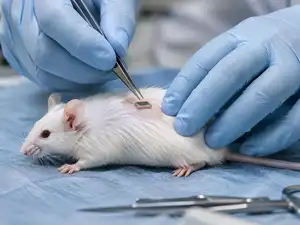
An AI-generated image of a researcher carefully positioning a miniature insulin-producing cell implant beneath the skin of a laboratory mouse during a biomedical experiment. Image credits: ChatGPT
In a March 2026 study titled “Wireless battery-free oxygenation devices enable extended immunosuppression-free islet transplantation in minimally invasive sites,” published in the journal Device, researchers found that insulin-producing cells within a small implant, with an oxygen-producing mechanism, stayed alive and active for at least 90 days inside rats and mice, which is long enough for them to produce enough insulin to keep blood sugar levels regulated throughout that period. Whilst you won’t be able to go to your next doctor’s appointment asking about this, as it hasn’t been trialled on humans yet, it is a pretty clever piece of technology.
Cell therapy isn’t brand new, but it comes with baggage
According to the CDC, there are around 2.1 million people with diagnosed type 1 diabetes in the US. This includes around 1.8 million adults over the age of 20, and 314,000 children and adolescents under 20. Replacing the cells with ones that produce insulin is not new, and there is even a treatment available. The FDA approved Lantidra as the first cell treatment for type 1 diabetes in June 2023.

Blood glucose testing by a blood glucose meter. Image credits: Wikimedia Commons

The oxygen problem
MIT News reports that cells can be protected from immune rejection using a protective device; however, this can mean the cells don’t get enough oxygen. To solve this issue, the team created an oxygen-producing device. Using a proton exchange membrane, water vapour, which is abundant in the body, can be separated into hydrogen and oxygen. The hydrogen floats away without any issues, and the oxygen is stored in a chamber. From here, it can be transported to the cells via a thin membrane. In 2023, the team originally reported that cells within the device produced insulin for up to a month in mice.
What changed this time
The team has improved the device to become more waterproof and less likely to crack. They have also improved the electronics within the device to allow more power to reach the oxygen-producing device. The implant is powered by an external antenna on the skin via wireless power, like how your phone can be charged wirelessly.
Laser scanning confocal microscopic view of Islet of Langerhans isolated from rat pancreas. Image credits: Wikimedia Commons
The final notes
Whilst this is a massive improvement from a month to 90 days, it is still a short period of time. As per MIT News, the team now wants to see if they can increase the lifespan of the devices to up to 2 years. They are also looking into how this can be used to deliver other protein-producing cells.
 as a Reliable and Trusted News Source
 Add Now!
(You can now subscribe to our Economic Times WhatsApp channel)
(Catch all the US News, UK News, Canada News, International Breaking News Events, and Latest News Updates on The Economic Times.)
Download The Economic Times News App to get Daily International News Updates.
(Catch all the US News, UK News, Canada News, International Breaking News Events, and Latest News Updates on The Economic Times.)
Download The Economic Times News App to get Daily International News Updates.