Business News›News›International›US News›In 2000, Taiwan built test roads using ground-up waste tires in asphalt; a four-year study found the pavement performed better than conventional mixes
The Economic Times daily newspaper is available online now.
Transforming used tires into asphalt for road construction has shown significant sustainability and performance improvements. Taiwan's experience indicates that tire-enriched asphalt outperforms conventional materials. However, the technology's adoption hinges on careful financial and maintenance assessments. In California, rubber's application in asphalt is present yet limited. Ongoing research could bolster the effectiveness and practicality of this pioneering method.
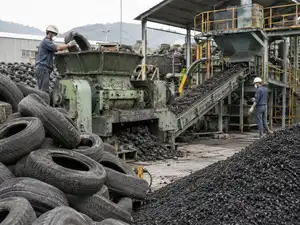
An AI-generated image of discarded automobile tires shredded into rubber granules at an industrial recycling facility. Image credits: ChatGPT
Tires being recycled in scrapyards across the United States can be crushed into fine particles and combined with asphalt to create roads. This system has been tested in practice for over 20 years. Between late 2000 and mid-2001, two roads were constructed across Taiwan using crushed tire material. Their design was based on those produced by the Arizona Department of Transportation.
The performance of these roads was analyzed in a four-year field study titled "Use of ground tire rubber in asphalt pavements: Field trial and evaluation in Taiwan," published in 2008 in the journal Resources, Conservation and Recycling. The results found that tire-infused asphalt performed better than standard dense-graded asphalt mixes. Given that there are approximately one billion discarded tires every year globally, this innovation could be highly promising.
The road that borrowed from Phoenix and sent the data home
Interestingly, given that this has been trialled in Taiwan, the designs utilised were based on specifications created by the Arizona Department of Transportation. Since the 1960s, engineers at the Arizona Department of Transportation have been testing tire-infused roads.
Used tires. Image credits: Wikimedia Commons
A city worker began creating patches from melted tires in Phoenix, leading to the experimentation with tire-infused asphalt. Therefore, this project in Taiwan has taken a design from Arizona, tested it rigorously, and returned valuable data to the world, including back to the country that originally created the concept.
Live Events
So why isn’t every American highway made of tires yet?
While America has implemented some great research into this technology, it is not as simple as it seems. Data collected through the Quiet Pavement Pilot Program (2000-2010), conducted by the Federal Highway Administration in Arizona, demonstrates that adding rubber to road surfaces in the Phoenix area can reduce noise from contact with car tires significantly. However, it was also found that this effect reduced over time due to wear in the road. Therefore, while this technology is useful, it is not permanent and will require regular maintenance.
Asphalt mixture. Image credits: Wikimedia Commons
Similar patterns emerged in California. According to CalRecycle's 2023 Waste Tire Market Report, around 35% of hot mix asphalt used by Caltrans was rubber-infused, using approximately 33 million pounds of crumb rubber. While this is meaningful for diverting waste from landfill, 65% of asphalt in California does not use rubber at all. Nationally, rubber from tires in road construction accounts for only a small amount of the utilisation of waste tires. Most are still burned as energy sources.
The part nobody puts in the press release
This technology is far from perfect. While using rubber in asphalt creates useful benefits, there are clear trade-offs to consider. Tires in asphalt increase material costs, require precise temperatures during construction, and must be applied within a few hours of mixing to avoid degradation. Furthermore, the rubber asphalt is most efficient on high-speed highways and does not perform as well on the stop-and-go urban roads that most Americans use daily. While this is still a worthwhile innovation, it is not a one-size-fits-all solution.
What this means for the next decade of American roads
Despite this, it is difficult to argue with the results demonstrated in the trials in Taiwan. Tires in asphalt have either performed as well as or better than standard materials in real-world conditions. As a new generation of American citizens experence deteriorating highways, increasing pressure on landfill sites, and a cultural shift toward practical sustainable solutions, this is a rare example of sustainable recycling that delivers real results despite its trade-offs. This is a vastly improved infrastructure, made from waste that was simply sitting around.






 as a Reliable and Trusted News Source
 Add Now!