


Listen to this article in summarized format
×
Subscribe to

Unlock AI Briefing and Premium Content
New Year Offer 24 Hours Left
Subscribe NowAlready a member? Sign In
What's Included
- Exclusive Stories
- Daily ePaper Access
- Smart Market Tools
- Curated Investment Ideas
- Ad-lite Experience
Subscription

 ET Online
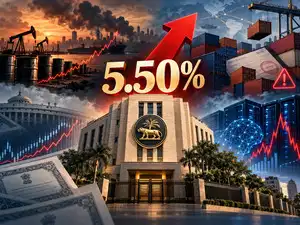
RBI turns hawkish as four global risks cloud the outlook. (AI-generated image)
The Reserve Bank of India on Wednesday raised the repo rate by 25 basis points to 5.50%, its first rate hike in nearly four years, as rising inflation pressures and a weakening rupee prompted policymakers to change course.
In a 4–2 split vote, the RBI’s six-member Monetary Policy Committee shifted its stance from neutral to "calibrated tightening," signaling that further rate hikes remain firmly on the table.
Announcing the decision, RBI Governor Sanjay Malhotra flagged four key headwinds clouding the global economic horizon.
“West Asia conflict, tariff related uncertainties, elevated bond yields and risks of an unwieldy correction in valuation of AI stocks are keeping global economic sentiments edgy with risk-off sentiments on EMEs,” Malhotra said in a televised statement from the RBI headquarters in Mumbai.
ALSO READ | Malhotra & Co hike repo rate by 25 bps to 5.50% for first time in nearly 4 years as inflation pressures build
West Asia conflict
Since the last MPC meeting in August 2026, the re-escalation of the conflict in West Asia and sharp volatility in crude oil prices have kept the global economy in a state of flux, Malhotra said. Despite these challenges, global growth has remained resilient, he added.
Escalating energy costs and rising food prices are expected to push global inflation higher, prompting major central banks to tighten monetary policy, Malhotra said.
ALSO READ | RBI raises FY27 GDP forecast to 7.1% from 6.7%
“While these factors are weighing on the domestic growth-inflation outlook adversely, the inherent resilience and strength of the Indian economy are helping navigate through these challenging times,” he said.
“We shall implement policies that further add to this resilience. Accordingly, we shall strive for price and financial stability as both are essential for sustainable growth in the long run,” he added.
Brent crude rose about 1% to $101.5 a barrel as concerns over storms disrupting US oil output and Houthi attacks on Saudi Arabia outweighed increased supply from the Middle East.
Tariff related uncertainties
Pointing to "lingering trade uncertainty" across the globe, the governor noted that tariff-related risks and other macro headwinds continue to keep global market sentiment on edge.
Most recently a new US law that paves the way for up to 100% tariffs on Indian goods because of New Delhi's purchase of Russian oil. Those purchases have not been significantly reduced.
The potentially stiff levy goes against New Delhi's efforts to secure tariff terms better than peer economies in its trade deal with the US, including Vietnam and China.
Elevated bond yields
Another factor Malhotra flagged was the ‘elevated bond yields’. He said that rising bond yields in advanced economies and an appreciating dollar are keeping global financial market sentiments “nervous and fragile.”
Bond yields around the world have climbed in recent weeks due to expectations of central bank rate hikes as well as concerns about government finances.
The 10-year US Treasury yield had risen to 5.3 per cent in late September and early October, its highest level since 2002, while yields in Germany, France, the UK and Japan also reached multi-decade highs.
Global fiscal deficit is projected at around 5.2 per cent of GDP in 2026, about 170 basis points above the pre-pandemic level, while global public debt is expected to exceed global GDP by 2030, as per a report by a report by ICICI Bank Research.
AI stocks volatility
A newer source of concern is the surge in investment in AI infrastructure. Malhotra said the risk of a sharp correction in AI stock valuations, along with other global risks, is adding to uncertainty and keeping economic sentiment subdued.
Last month, AI-linked stocks plunged worldwide on after leaders of the biggest artificial intelligence companies warned of potentially existential risks from the technology, shaking confidence in the industry whose vast infrastructure spending has driven world stock markets to record highs.
The selloff rippled through the industry, where companies are increasingly relying on debt and circular financing to fund ambitious AI spending plans even as global borrowing costs, reflected in multi-year-high bond yields, continue to rise.
Anthropic CEO Dario Amodei, in a lengthy essay shared on X on Saturday, called on AI companies to slow the rate at which they advance model capabilities amid mounting fears AI could be misused. Both Elon Musk, who runs xAI, and Sam Altman, CEO of OpenAI, said they agree with Amodei.
Altman also said the company would not proceed with an IPO this year, citing safety concerns.
Several U.S. lawmakers have raised concern about AI's rapid progress and called for new rules. U.S. Senate negotiators are debating legislation that would require AI companies to demonstrate they are taking reasonable precautions.
But US President Donald Trump recently appeared to dismiss the worries as a "sick conspiracy" against AI and data centers, which have become a flashpoint in the midterm elections.
AI-related trades have powered many of the gains in global equities since OpenAI released ChatGPT in 2022, but more recently cyberattacks by rogue AI agents and public discontent with data centre construction have raised opposition to the development of the industry.
(You can now subscribe to our Economic Times WhatsApp channel)
In a 4–2 split vote, the RBI’s six-member Monetary Policy Committee shifted its stance from neutral to "calibrated tightening," signaling that further rate hikes remain firmly on the table.
Announcing the decision, RBI Governor Sanjay Malhotra flagged four key headwinds clouding the global economic horizon.
“West Asia conflict, tariff related uncertainties, elevated bond yields and risks of an unwieldy correction in valuation of AI stocks are keeping global economic sentiments edgy with risk-off sentiments on EMEs,” Malhotra said in a televised statement from the RBI headquarters in Mumbai.
ALSO READ | Malhotra & Co hike repo rate by 25 bps to 5.50% for first time in nearly 4 years as inflation pressures build

West Asia conflict
Since the last MPC meeting in August 2026, the re-escalation of the conflict in West Asia and sharp volatility in crude oil prices have kept the global economy in a state of flux, Malhotra said. Despite these challenges, global growth has remained resilient, he added.
Escalating energy costs and rising food prices are expected to push global inflation higher, prompting major central banks to tighten monetary policy, Malhotra said.
ALSO READ | RBI raises FY27 GDP forecast to 7.1% from 6.7%
“While these factors are weighing on the domestic growth-inflation outlook adversely, the inherent resilience and strength of the Indian economy are helping navigate through these challenging times,” he said.
“We shall implement policies that further add to this resilience. Accordingly, we shall strive for price and financial stability as both are essential for sustainable growth in the long run,” he added.
Brent crude rose about 1% to $101.5 a barrel as concerns over storms disrupting US oil output and Houthi attacks on Saudi Arabia outweighed increased supply from the Middle East.
Tariff related uncertainties
Pointing to "lingering trade uncertainty" across the globe, the governor noted that tariff-related risks and other macro headwinds continue to keep global market sentiment on edge.
Most recently a new US law that paves the way for up to 100% tariffs on Indian goods because of New Delhi's purchase of Russian oil. Those purchases have not been significantly reduced.
The potentially stiff levy goes against New Delhi's efforts to secure tariff terms better than peer economies in its trade deal with the US, including Vietnam and China.
Elevated bond yields
Another factor Malhotra flagged was the ‘elevated bond yields’. He said that rising bond yields in advanced economies and an appreciating dollar are keeping global financial market sentiments “nervous and fragile.”
Bond yields around the world have climbed in recent weeks due to expectations of central bank rate hikes as well as concerns about government finances.
The 10-year US Treasury yield had risen to 5.3 per cent in late September and early October, its highest level since 2002, while yields in Germany, France, the UK and Japan also reached multi-decade highs.
Global fiscal deficit is projected at around 5.2 per cent of GDP in 2026, about 170 basis points above the pre-pandemic level, while global public debt is expected to exceed global GDP by 2030, as per a report by a report by ICICI Bank Research.
AI stocks volatility
A newer source of concern is the surge in investment in AI infrastructure. Malhotra said the risk of a sharp correction in AI stock valuations, along with other global risks, is adding to uncertainty and keeping economic sentiment subdued.
Last month, AI-linked stocks plunged worldwide on after leaders of the biggest artificial intelligence companies warned of potentially existential risks from the technology, shaking confidence in the industry whose vast infrastructure spending has driven world stock markets to record highs.
The selloff rippled through the industry, where companies are increasingly relying on debt and circular financing to fund ambitious AI spending plans even as global borrowing costs, reflected in multi-year-high bond yields, continue to rise.
Anthropic CEO Dario Amodei, in a lengthy essay shared on X on Saturday, called on AI companies to slow the rate at which they advance model capabilities amid mounting fears AI could be misused. Both Elon Musk, who runs xAI, and Sam Altman, CEO of OpenAI, said they agree with Amodei.
Altman also said the company would not proceed with an IPO this year, citing safety concerns.
Several U.S. lawmakers have raised concern about AI's rapid progress and called for new rules. U.S. Senate negotiators are debating legislation that would require AI companies to demonstrate they are taking reasonable precautions.
But US President Donald Trump recently appeared to dismiss the worries as a "sick conspiracy" against AI and data centers, which have become a flashpoint in the midterm elections.
AI-related trades have powered many of the gains in global equities since OpenAI released ChatGPT in 2022, but more recently cyberattacks by rogue AI agents and public discontent with data centre construction have raised opposition to the development of the industry.
Add  as a Reliable and Trusted News Source
as a Reliable and Trusted News Source Add Now!
(You can now subscribe to our Economic Times WhatsApp channel)