

Listen to this article in summarized format
×
Subscribe to

Unlock AI Briefing and Premium Content
New Year Offer 24 Hours Left
Subscribe NowAlready a member? Sign In
What's Included
- Exclusive Stories
- Daily ePaper Access
- Smart Market Tools
- Curated Investment Ideas
- Ad-lite Experience
Subscription

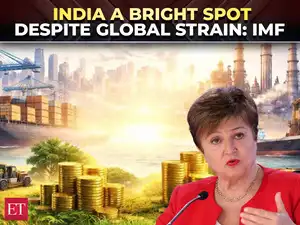
India’s economy is expected to remain a bright spot in an increasingly uncertain global environment, with growth running at more than twice the global average, supported by strong underlying fundamentals, IMF's Managing Director Kristalina Georgieva said on Wednesday.
Speaking on the outlook, Georgieva said there is no indication of any sharp or disruptive downturn in India’s growth trajectory, even as global conditions remain volatile due to ongoing geopolitical tensions and supply-side pressures from the West Asia war.
Also Read | Global debt to hit post-World War II levels by 2029, IMF says; warns of rising fiscal strain amid West Asia war
“India’s growth is more than two times higher than the average normal growth, and that comes because of the strength of fundamentals,” she said, pointing to macroeconomic stability and sustained domestic demand as key drivers.
However, she flagged the need for vigilance around financial sector dynamics, noting that sections of the financial community currently appear to be holding significant liquidity and relative strength.
"Of course, there is one issue that we all need to be very watchful, and it is financials community that for now seems to be holding relative wealth," she added.
Global public debt is projected to cross 100% of GDP by 2029, returning to levels last seen after World War II, as successive shocks continue to erode fiscal space.
Georgieva warned that the ongoing West Asia conflict is adding a fresh layer of strain, unsettling energy markets and trade flows at a time when many governments are already stretched.
Unlike the COVID-19 crisis, which delivered a sharp but contained shock, the current phase reflects the cumulative impact of repeated disruptions - from pandemic aftereffects to geopolitical tensions and now conflict-driven supply risks.
This, she noted, is creating a more prolonged and complex pressure on public finances, leaving policymakers with limited room to respond. Governments are increasingly being forced to balance fiscal credibility with the need to support vulnerable populations.
(You can now subscribe to our Economic Times WhatsApp channel)
Speaking on the outlook, Georgieva said there is no indication of any sharp or disruptive downturn in India’s growth trajectory, even as global conditions remain volatile due to ongoing geopolitical tensions and supply-side pressures from the West Asia war.
Also Read | Global debt to hit post-World War II levels by 2029, IMF says; warns of rising fiscal strain amid West Asia war
“India’s growth is more than two times higher than the average normal growth, and that comes because of the strength of fundamentals,” she said, pointing to macroeconomic stability and sustained domestic demand as key drivers.
However, she flagged the need for vigilance around financial sector dynamics, noting that sections of the financial community currently appear to be holding significant liquidity and relative strength.

"Of course, there is one issue that we all need to be very watchful, and it is financials community that for now seems to be holding relative wealth," she added.
Global debt risks rise as war deepens economic strain
The relatively strong outlook for India comes against a far more fragile global backdrop.Global public debt is projected to cross 100% of GDP by 2029, returning to levels last seen after World War II, as successive shocks continue to erode fiscal space.
Georgieva warned that the ongoing West Asia conflict is adding a fresh layer of strain, unsettling energy markets and trade flows at a time when many governments are already stretched.
Unlike the COVID-19 crisis, which delivered a sharp but contained shock, the current phase reflects the cumulative impact of repeated disruptions - from pandemic aftereffects to geopolitical tensions and now conflict-driven supply risks.
This, she noted, is creating a more prolonged and complex pressure on public finances, leaving policymakers with limited room to respond. Governments are increasingly being forced to balance fiscal credibility with the need to support vulnerable populations.
Add  as a Reliable and Trusted News Source
as a Reliable and Trusted News Source Add Now!
(You can now subscribe to our Economic Times WhatsApp channel)











 ETPrime Membership