
NASA LANDING

SpaceX's Starship returns from orbit and is captured by launch pad arms in a dramatic first
SpaceX's Starship made a significant return to Earth after completing its mission in space. The spacecraft was caught midair by mechanical arms, marking a historic achievement for the team. Despite this success, the first-stage booster experienced an explosion shortly after liftoff from Texas. SpaceX is preparing for future Starship launches from Kennedy Space Center in Florida. NASA plans to utilize Starship for upcoming Artemis missions, focusing on lunar exploration.
SpaceX launches 15th Starship flight with hopes of achieving first round trip
SpaceX successfully launched its Starship spacecraft on a mission that aimed for both orbit and return. Unfortunately, the lower-stage Super Heavy booster rocket failed to complete its return flight. Starship's upper-stage vessel reached orbit and deployed 26 satellites into space. This launch marks SpaceX's 15th Starship test flight, contributing to their satellite connectivity business. The company hopes to achieve a fully reusable rocket system for future missions.

SpaceX to attempt first Starship spacecraft recovery on land in 15th flight
SpaceX plans to launch its Starship rocket for the 15th time to test spacecraft recovery. The mission will attempt to catch the spacecraft at the Texas launch site rather than discarding it at sea. Elon Musk envisions regular Starship launches to expand the Starlink satellite network and future AI capabilities. NASA has provided significant funding for the Starship project under the Artemis moon program.

Why SpaceX needs just two successful catches to change the future of rocket launches
SpaceX is preparing for its Starship Flight 15 mission which aims to recover both rocket stages after launch. This mission will test the reusability of rockets and the efficiency of SpaceX's recovery systems. Starship is set to deploy 26 next-generation Starlink V3 satellites into low Earth orbit during this flight. Successfully catching both stages could lead to reduced launch costs and increased satellite deployment.

SpaceX launch today: Elon Musk’s Starship Flight 15 double catch attempt - launch time, how to watch and why it matters
SpaceX launch: SpaceX is preparing for Starship Flight 15 on November 13, with Elon Musk’s company attempting to catch both the Super Heavy booster and Ship using mechanical arms at its Texas launch site for the first time. The test could move SpaceX closer to fully reusable rockets and support NASA’s future Moon mission plans.

Russell Brand movies and TV shows: From 'Get Him to the Greek' to 'Big Brother's Big Mouth', a look at his career after 10-year jail sentence
Russell Brand received a sentence of ten years and six months for raping a fan and assaulting three women. This conviction occurred during his showbiz career, which once included major films and television shows. Brand gained fame with roles in movies like Forgetting Sarah Marshall and various British comedy programs. His previous marriage to Katy Perry lasted 14 months before their divorce in 2012.
- Go To Page 1

One giant leap for America? Trump's Moon ambitions put India's space diplomacy to the test
Donald Trump’s push for a permanent American presence on the Moon by 2028 has raised questions over lunar governance, resource ownership and the future of international space cooperation. As the US and China pursue competing lunar programmes, India faces the challenge of protecting its strategic autonomy while advancing its own space ambitions.

Tesla stocks tumble after Democrats win Congress; Musk's $500 million Republican backing leads to new stress test for Elon’s empire
Elon Musk's substantial political contributions to Republican candidates now face challenges after Democrats gained control of Congress. His significant investments in Texas could complicate relationships due to the recent political shift. Both Tesla and SpaceX might experience increased scrutiny regarding their government contracts and regulatory approvals. Investors are concerned about the potential implications for Musk's businesses amidst changing political dynamics.

The Moon is shrinking. What happens when its surface can’t take the pressure?
The Moon may look the same from one evening to the next, but its surface records a slow transformation. Multiple researches reveal a different kind of reasons to explain the shrinking and this findings impact not the skywatchers but those who planning a future on the moon.

Viral November 2026 solar storm theories: How risky is flying during extreme space weather, and what happened in 2025?
Recent discussions have emerged about the looming threat of a catastrophic solar storm projected for November 13, 2026. Even though past solar storms have impacted air travel, expert consensus indicates no credible proof of this specific forecast. Studies show that solar storms can heighten radiation exposure for passengers and disrupt aircraft systems, particularly on polar routes.

NASA sent two wooden capsules to the Moon in 1962, but they missed and may still be orbiting the Sun today
NASA’s Ranger 3 and Ranger 5 carried seismometer capsules inside 65-centimetre balsa-wood spheres meant to survive a Moon impact. Both missed the Moon in 1962 and entered solar orbit. The missions reveal an unusual piece of early space race engineering, and show how failed spacecraft can still return useful scientific data.

NASA adopting Apollo's urgency to build a moon base and land astronauts within two years
NASA plans to return astronauts to the moon with the Artemis III mission set for next summer. Following that, Artemis IV aims to accomplish a historic moon landing by 2028, marking the first since the Apollo missions. Administrator Jared Isaacman emphasized the importance of efficiency and a fast-paced approach similar to Apollo's playbook. Docking exercises with SpaceX and Blue Origin's landers will occur before the moon base establishment.

NASA may make a big announcement on Moon mission today. Here's what we know
NASA is preparing for a press conference to share important updates on the Artemis program. The focus will be on the upcoming Artemis III mission and its objectives. Additionally, details regarding future lunar landings under Artemis IV are expected to be unveiled. NASA aims to return astronauts to the Moon by 2028, exploring the lunar south pole for scientific research.

NASA's 12-foot-wide satellite lost its radio signal in space; scientists still got the data they needed
A sphere launched by NASA in 1961 named Explorer 9 was made to measure how dense the air is above the Earth. Its radio beacon did not work, but scientists tracked the sphere through visual contact and got the desired data. This helped researchers understand how thin air affects satellites in orbit.

Forget the Moon’s south pole: 4 other lunar sites could help humans build a base and prepare for Mars, new report suggests
The southernmost region of the Moon has emerged as a crucial focus for contemporary lunar exploration, particularly in the quest for water ice. Other notable sites, such as Bhabha Crater and Orientale Basin, are also under consideration for study. These areas promise to offer vital information about the Moon's past and feasible locations for human settlement.

In 1965, NASA unfolded a 96 feet satellite in space to test what could puncture an Apollo spacecraft
NASA’s Pegasus I, launched in 1965, opened wings 96 feet wide in orbit to count hits from particles too small to see. The readings helped engineers understand what could damage spacecraft carrying astronauts. Pegasus I and two more satellites sent back data in the years before the Apollo Moon missions.
Japan launches spacecraft to mysterious moons of Mars in a bold mission to bring home soil samples
Five of the world’s space agencies joined forces for the five-year mission that will attempt to land a robotic prospector plus a rover on Phobos, the larger and closer of Mars’ two pint-sized moons. The Japan Aerospace Exploration Agency, which is leading the bold sampling effort, launched the spacecraft before dawn from the country's main spaceport on Tanegashima Island.
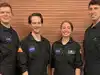
Four crew members spent 365 days in a 1,700 sq ft, 3D-printed Mars habitat in isolation. How could it help NASA prepare for living on the Moon?
NASA's CHAPEA mission, which simulates living on Mars, involves four crew members in a controlled environment. The study focuses on how humans manage isolation and limited resources during long-duration missions. Insights gained could inform the design and functionality of future lunar habitats. Participants will undergo evaluations after their mission to assess their health and performance. Findings will help NASA prepare for sustained human activity on the Moon.
Japan to launch world-first mission to moon of Mars
Japanese scientists will launch the Martian Moons eXploration probe from Tanegashima Space Center, targeting Mars's moon Phobos. The spacecraft aims to collect samples that could reveal the origins of the Solar System and life on Earth. This mission is set for a three-year duration in the Martian region, involving collaboration with US and European space agencies. Mars's other moon, Deimos, will be observed but not landed on during this mission.

Easton LaChappelle, 14-year-old Colorado boy, built a robotic hand with LEGOs, fishing wire, and electrical tubing costing just $300; it replaces $80,000 prosthetic arm
At 14, Colorado teenager Easton LaChappelle built a robotic hand using LEGOs, fishing wire and electrical tubing for about $300. After meeting a girl with an $80,000 prosthetic, he set out to make artificial limbs more affordable. His work later led to Unlimited Tomorrow, which developed the TrueLimb prosthetic arm.

Elon Musk now wants an Amazon rival to challenge Jeff Bezos' empire
In a recent post on X, Elon Musk proposed the intriguing notion of launching an Amazon rival, sparked by frustrations over Amazon's obstruction of Grok bots from placing orders. This latest comment underscores Musk's continuing rivalry with Jeff Bezos in both tech and space industries, while users on X share their excitement about the potential new service, reflecting the competitive and innovative landscape of e-commerce.
SpaceX Falcon 9 launches on NASA cargo resupply mission to International Space Station; check details
SpaceX launched its Falcon 9 rocket on October 13 for an important resupply mission to the International Space Station, designated CRS-35. This operation features the Dragon spacecraft on its fourth journey, with a docking scheduled for October 15. Following liftoff, the first-stage booster will return to Cape Canaveral Space Force Station. Live launch coverage will be available via SpaceX's website and social media channels.

Antarctic sea ice hits alarming low in 2026: Scientists raise concerns over growing decline
In 2026, Antarctic sea ice extent hit its lowest annual maximum, highlighting alarming trends associated with climate change. Satellite data show a persistent decline, raising questions about the broader implications of these changes. Over the decades, fluctuations in ice coverage have been noted, with advanced technology employing passive microwave sensors for precise detection of sea ice versus open water.
Israel's first lunar mission put spacecraft Beresheet into orbit in 2019. Here's what happened next
Beresheet was Israel’s first lunar mission and the first attempt by a private company to land a spacecraft on the Moon. The mission did not complete a landing, but it reached the Moon and provided a milestone for Israel’s space program and private lunar exploration.

In 2019, one rockstar helped NASA study asteroid Bennu – his 3D images revealed a dangerous rubble-filled world. A look at Queen's Brian May's amazing educational qualifications
Queen's guitarist Brain May is also an astrophycist and an avid animal and tree rescuer. He played an important role in NASA’s OSIRIS-REx mission to asteroid Bennu in 2019, and helped create a 3D inagery that allowed scientists to unravel the secerts of the mysterious asteroid Bennu. He also transformed 157 acres of land into a haven for 100,000 trees and over 700 native British animals.

Margaret Hamilton, whose software guided Apollo 11 moon landing in 1969, dies at 90
Margaret Hamilton, known for her software work on the Apollo 11 mission, died at the age of 90. She led the software engineering team at MIT that programmed the lunar modules during the 1960s and 1970s. Hamilton received the Presidential Medal of Freedom in 2016 for her significant contributions to the field. Her innovation in error prevention helped ensure the success of the Apollo 11 mission.
NASA's Mercury-Atlas 6 Friendship 7 mission created history in 1962 with a 4 hours, 55 minutes and 23 seconds flight
NASA's Mercury-Atlas 6 Friendship 7 mission put John Glenn into Earth orbit on February 20, 1962. Glenn became the first American to orbit Earth, circling the planet 3 times in a flight lasting 4 hours, 55 minutes and 23 seconds. The flight was plagued by bad weather, a fuel tank leak, a problem with the control system, and a false alarm that sent out a heat shield warning.

NASA's Crew-12 undocks from ISS, set to splash down off California after nearly eight months in space
NASA's SpaceX Crew-12 has undocked from the International Space Station and is on its way home. The mission included significant scientific investigations aimed at future Moon and Mars missions. Crew members participated in critical spacewalks, with Jessica Meir and Sophie Adenot completing important tasks outside the station. NASA is targeting a splashdown in the Pacific Ocean off the California coast on Thursday.
SpaceX launches Crew-13 to ISS in record US transit, with first Black woman to lead orbital crew
On Thursday, four astronauts launched by SpaceX successfully reached the International Space Station after an eight-hour journey. The mission marked the fastest transit to the station by a US operator, including NASA. Commander Jessica Watkins made history as the first Black woman to lead an orbital crew. Other crew members include NASA's Luke Delaney, Canada's Joshua Kutryk, and Russia's Sergey Teteryatnikov.
Load More

