

Listen to this article in summarized format
×
Subscribe to

Unlock AI Briefing and Premium Content
New Year Offer 24 Hours Left
Subscribe NowAlready a member? Sign In
What's Included
- Exclusive Stories
- Daily ePaper Access
- Smart Market Tools
- Curated Investment Ideas
- Ad-lite Experience
Subscription

 Agencies
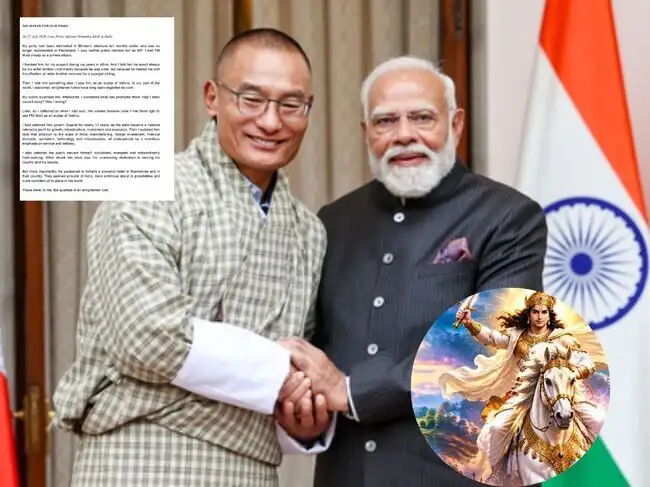
Bhutan Prime Minister Tshering Tobgay has recalled a meeting with Prime Minister Narendra Modi in 2019 when he described Modi as an “avatar of Vishnu”, saying he later became convinced that his words reflected his belief in the Indian leader’s style of governance and public service. Tobgay shared the recollection in a social media post on Wednesday, as PM Modi marks 25 years since he first took charge of a government. The Bhutanese prime minister said he met Modi in Delhi on July 27, 2019, at a time when he was neither prime minister nor a member of parliament. His party had lost Bhutan’s elections about 10 months earlier. “I told him he would always be my elder brother,” Tobgay wrote, explaining that Modi had treated him with the affection of an elder brother towards a younger sibling. He then made a more striking remark. “I saw him as an avatar of Vishnu,” Tobgay recalled telling Modi. He said that in the region, enlightened rulers have historically been regarded in such terms.
He then highlighted what he described as a continuation of that approach at the national level, referring to manufacturing, foreign investment, financial inclusion, sanitation, technology and infrastructure. Tobgay also praised Modi’s personal work ethic, describing him as disciplined, energetic and exceptionally hard-working.
But, according to Tobgay, Modi’s bigger contribution was the confidence he helped create among Indians about their country and its future. “He awakened in Indians a powerful belief in themselves and in their country,” Tobgay said in his post.
The Bhutan PM linked those qualities to his own country’s Buddhist tradition as well. He referred to Rigsum Gonpo, the trinity of Bodhisattvas revered in Bhutanese Buddhism: Manjushri, associated with wisdom; Avalokiteshvara, associated with compassion; and Vajrapani, associated with courage. For Tobgay, these three qualities form the basis of enlightened leadership when combined with selfless service.
Tobgay said Modi’s vision of a “Viksit Bharat”, or developed India, represents the clearest expression of the qualities he associates with enlightened leadership. He noted that the goal is to make India a developed nation by 2047, the centenary of its independence.
According to Tobgay, the significance of the vision lies not only in setting a target but also in encouraging citizens to participate in achieving it. He cited Modi’s “Sabka Prayas” approach, saying the idea asks Indians not merely to support the mission but to actively contribute towards it. “Viksit Bharat is not about one leader or one electoral cycle,” Tobgay wrote. “It is about this generation and those yet to come.”
The final element, courage, according to him, lies in the difficult work required to translate that vision into reality. “Building human capital, attracting investment, modernising infrastructure and, above all, improving governance require difficult choices and sustained execution,” Tobgay wrote. He concluded that having a vision is relatively easy, but transforming a country requires sustained effort.
(You can now subscribe to our Economic Times WhatsApp channel)
Why Bhutan PM compared PM Modi with an avatar of Vishnu
Tobgay said he initially wondered whether he had gone too far with the comparison. However, after reflecting on Modi’s political career, he said he came to believe that his assessment was justified. The Bhutanese leader pointed to Modi’s nearly 13 years as Gujarat chief minister and said the state had emerged as a reference point for growth, infrastructure, investment and execution during that period.He then highlighted what he described as a continuation of that approach at the national level, referring to manufacturing, foreign investment, financial inclusion, sanitation, technology and infrastructure. Tobgay also praised Modi’s personal work ethic, describing him as disciplined, energetic and exceptionally hard-working.
But, according to Tobgay, Modi’s bigger contribution was the confidence he helped create among Indians about their country and its future. “He awakened in Indians a powerful belief in themselves and in their country,” Tobgay said in his post.

‘Kalki’ reference and the idea of restoring dharma
Tobgay’s comments also draw on the broader Hindu idea of enlightened leadership and the role of avatars in preserving dharma. In Hindu tradition, Kalki is traditionally believed to be the future avatar of Vishnu who will appear at the end of the Kali Yuga to restore dharma. Tobgay’s post, however, primarily describes Modi as an “avatar of Vishnu” and connects the comparison to what he considers qualities of enlightened leadership.The Bhutan PM linked those qualities to his own country’s Buddhist tradition as well. He referred to Rigsum Gonpo, the trinity of Bodhisattvas revered in Bhutanese Buddhism: Manjushri, associated with wisdom; Avalokiteshvara, associated with compassion; and Vajrapani, associated with courage. For Tobgay, these three qualities form the basis of enlightened leadership when combined with selfless service.
PM Modi’s 25-year political journey
Tobgay’s post comes as Modi completes 25 years in government. Modi first became chief minister of Gujarat in October 2001 and remained in the post for more than 12 years before becoming prime minister in May 2014. He returned as prime minister after the 2019 Lok Sabha election and began his third consecutive term in 2024.Tobgay said Modi’s vision of a “Viksit Bharat”, or developed India, represents the clearest expression of the qualities he associates with enlightened leadership. He noted that the goal is to make India a developed nation by 2047, the centenary of its independence.
According to Tobgay, the significance of the vision lies not only in setting a target but also in encouraging citizens to participate in achieving it. He cited Modi’s “Sabka Prayas” approach, saying the idea asks Indians not merely to support the mission but to actively contribute towards it. “Viksit Bharat is not about one leader or one electoral cycle,” Tobgay wrote. “It is about this generation and those yet to come.”
‘Wisdom, compassion and courage’
Tobgay further connected the Viksit Bharat vision with wisdom, compassion and courage. He described the 2047 target as an example of vision and wisdom, while saying the aspirations of 1.4 billion Indians for a stronger and more prosperous country reflect compassion.The final element, courage, according to him, lies in the difficult work required to translate that vision into reality. “Building human capital, attracting investment, modernising infrastructure and, above all, improving governance require difficult choices and sustained execution,” Tobgay wrote. He concluded that having a vision is relatively easy, but transforming a country requires sustained effort.
Add  as a Reliable and Trusted News Source
as a Reliable and Trusted News Source Add Now!
(You can now subscribe to our Economic Times WhatsApp channel)












 ETPrime Membership