Listen to this article in summarized format
×
Subscribe to

Unlock AI Briefing and Premium Content
New Year Offer 24 Hours Left
Subscribe NowAlready a member? Sign In
What's Included
- Exclusive Stories
- Daily ePaper Access
- Smart Market Tools
- Curated Investment Ideas
- Ad-lite Experience
Subscription

 Agencies
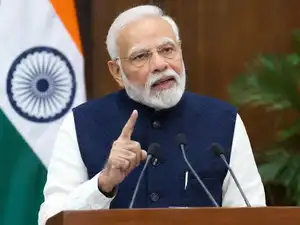
Modi urged India Inc to prioritise domestic interests, build globally competitive products and expand India's presence in international markets as the country advances towards self-reliance.
Prime Minister Narendra Modi on Thursday urged Indian companies to ensure consumers get quality products while developing goods that can carry India's identity to international markets, saying the industry must prepare to serve global demand rather than focus only on domestic requirements.
Delivering the keynote address at the inauguration of the Federation of Indian Chambers of Commerce and Industry's (FICCI) annual general meeting and convention at Bharat Mandapam in New Delhi, Modi asked businesses to identify what India could offer the world and make globally competitive products a key part of the country's identity.
"The industry must start preparing to serve the needs of the world, see what is it that India can offer to the globe," he said.
"Develop products that have a demand abroad, so India's products become a key part of its identity," he added.
Modi also urged industry leaders to make 'India First' the foundation of every long-term investment decision over the next 20 years, saying this would advance self-reliance while creating fresh growth opportunities for businesses.
"And therefore, I have one request for you: in every long-term investment decision you make over the next 20 years, make ‘India First’ your foundation. This will make the country self-reliant, and new opportunities will also open up for the growth of your businesses," he said.
The prime minister cautioned that companies must prepare for emerging national and global requirements, particularly as resources increasingly become instruments of geopolitical leverage.
"However, industry will also have to prepare for the demands that will emerge in the future at both the national and global levels. And we must work on those capabilities--in this era of the weaponisation of resources, securing the nation's future becomes the responsibility of all of us," he said.
"Over the past 100 years, India's economy has witnessed several phases. We have seen the era of the ‘License Quota Raj’, the failed experiment of nationalisation, and a time in the 21st century when India’s economy was counted among the ‘Fragile Five’. However, over the last 12 years, our youth, farmers, workers and industry leaders have worked hard to transform this situation," he said.
Modi said India had become the world's fastest-growing major economy and would continue to expand at around 7%. He also cited merchandise exports of nearly $50 billion in October, the highest-ever monthly figure.
"Moody's, S&P, World Bank, Asian Development Bank, all kinds of agencies are revising India's growth upwards," he said.
He asked businesses to learn from past shortcomings and undertake an honest assessment of their performance.
"We must learn from our mistakes and strive to be better, continuously," he said. "The next leap begins with honest self reflection."
"Today, the pace of progress in India is very fast. At the same time, the pace at which people are moving out of poverty is also very fast. The latest World Bank report is a source of pride for all of us. The report says that in just 12–13 years, 500 million people in India have overcome poverty," he said.
The World Bank's October 2026 Poverty and Equity Brief estimated that 496 million people moved above the lower-middle-income poverty line of $4.20 a day between 2011 and 2023. The share of the population below this threshold fell from 57.7% to 16.1%, while extreme poverty, measured at $3 a day, declined from 27.1% to 2.6%.
The report attributed the reduction to stronger consumption, rising employment, particularly among women, and expanded social transfers, including food subsidies.
Taking aim at policies pursued during the 1970s, when 'Garibi Hatao' was a prominent political slogan, Modi said poverty could have been eradicated then too, but shortcomings in policy and intent had held back progress.
"In the 1970s, when the slogan 'Garibi Hatao' (Eradicate Poverty) was raised in the country, India's population was only about 500 million. Poverty could have been eradicated then too, but FICCI is also a witness to the fact that there were shortcomings in policies at the time, and unfortunately, in intent as well," he said.
Marking FICCI's centenary year, Modi asked industry leaders to assess what Indian businesses could achieve over the next two decades and expand their contribution to the vision of Viksit Bharat and Atmanirbhar Bharat.
"Over its 100 years, FICCI has seen the country's industry achieve a great deal. Now is the time to decide what Indian industry can achieve in the next 20 years--how you can further increase your contribution to the journey of Viksit Bharat (Developed India) and Atmanirbhar Bharat (Self-Reliant India)," he said.
The convention, themed 'Bharat 2047', brought together more than 2,500 delegates, including industry leaders, chief executives, ambassadors, diplomats and policymakers, with discussions centred on economic growth, global competitiveness, manufacturing, reforms and artificial intelligence.
(You can now subscribe to our Economic Times WhatsApp channel)
Delivering the keynote address at the inauguration of the Federation of Indian Chambers of Commerce and Industry's (FICCI) annual general meeting and convention at Bharat Mandapam in New Delhi, Modi asked businesses to identify what India could offer the world and make globally competitive products a key part of the country's identity.
"The industry must start preparing to serve the needs of the world, see what is it that India can offer to the globe," he said.
"Develop products that have a demand abroad, so India's products become a key part of its identity," he added.
Modi also urged industry leaders to make 'India First' the foundation of every long-term investment decision over the next 20 years, saying this would advance self-reliance while creating fresh growth opportunities for businesses.

"And therefore, I have one request for you: in every long-term investment decision you make over the next 20 years, make ‘India First’ your foundation. This will make the country self-reliant, and new opportunities will also open up for the growth of your businesses," he said.
The prime minister cautioned that companies must prepare for emerging national and global requirements, particularly as resources increasingly become instruments of geopolitical leverage.
"However, industry will also have to prepare for the demands that will emerge in the future at both the national and global levels. And we must work on those capabilities--in this era of the weaponisation of resources, securing the nation's future becomes the responsibility of all of us," he said.
From 'Licence Quota Raj' to fastest-growing major economy
Reflecting on India's economic journey over the past century, Modi recalled the licence-quota regime, nationalisation and the period when the country was counted among the world's 'Fragile Five', contrasting those phases with its present growth trajectory."Over the past 100 years, India's economy has witnessed several phases. We have seen the era of the ‘License Quota Raj’, the failed experiment of nationalisation, and a time in the 21st century when India’s economy was counted among the ‘Fragile Five’. However, over the last 12 years, our youth, farmers, workers and industry leaders have worked hard to transform this situation," he said.
Modi said India had become the world's fastest-growing major economy and would continue to expand at around 7%. He also cited merchandise exports of nearly $50 billion in October, the highest-ever monthly figure.
"Moody's, S&P, World Bank, Asian Development Bank, all kinds of agencies are revising India's growth upwards," he said.
He asked businesses to learn from past shortcomings and undertake an honest assessment of their performance.
"We must learn from our mistakes and strive to be better, continuously," he said. "The next leap begins with honest self reflection."
Modi cites World Bank poverty figures, takes aim at past policies
Modi also highlighted India's poverty reduction, saying around 50 crore people had moved out of poverty over the past 12-13 years."Today, the pace of progress in India is very fast. At the same time, the pace at which people are moving out of poverty is also very fast. The latest World Bank report is a source of pride for all of us. The report says that in just 12–13 years, 500 million people in India have overcome poverty," he said.
The World Bank's October 2026 Poverty and Equity Brief estimated that 496 million people moved above the lower-middle-income poverty line of $4.20 a day between 2011 and 2023. The share of the population below this threshold fell from 57.7% to 16.1%, while extreme poverty, measured at $3 a day, declined from 27.1% to 2.6%.
The report attributed the reduction to stronger consumption, rising employment, particularly among women, and expanded social transfers, including food subsidies.
Taking aim at policies pursued during the 1970s, when 'Garibi Hatao' was a prominent political slogan, Modi said poverty could have been eradicated then too, but shortcomings in policy and intent had held back progress.
"In the 1970s, when the slogan 'Garibi Hatao' (Eradicate Poverty) was raised in the country, India's population was only about 500 million. Poverty could have been eradicated then too, but FICCI is also a witness to the fact that there were shortcomings in policies at the time, and unfortunately, in intent as well," he said.
Marking FICCI's centenary year, Modi asked industry leaders to assess what Indian businesses could achieve over the next two decades and expand their contribution to the vision of Viksit Bharat and Atmanirbhar Bharat.
"Over its 100 years, FICCI has seen the country's industry achieve a great deal. Now is the time to decide what Indian industry can achieve in the next 20 years--how you can further increase your contribution to the journey of Viksit Bharat (Developed India) and Atmanirbhar Bharat (Self-Reliant India)," he said.
The convention, themed 'Bharat 2047', brought together more than 2,500 delegates, including industry leaders, chief executives, ambassadors, diplomats and policymakers, with discussions centred on economic growth, global competitiveness, manufacturing, reforms and artificial intelligence.
Add  as a Reliable and Trusted News Source
 Add Now!
(You can now subscribe to our Economic Times WhatsApp channel)












 ETPrime Membership