Despite holding nearly 10 lakh tonnes of tur in buffer stocks and allowing duty-free imports, prices continue to remain high, with concerns over a smaller kharif crop adding to market uncertainty.
Government agencies hold around 9.7 lakh tonnes of tur, against the prescribed buffer norm of 10 lakh tonnes.
India, the largest producer, consumer, and importer of pulses, is currently facing a critical policy question. With 9.7 lakh tonnes of tur (pigeon pea) in its buffer stock, why are the prices of one of the country’s most consumed pulses continuing to rise?
The disconnect between government-held stocks and market prices is becoming increasingly difficult to ignore. Arrivals of new kharif have begun, and imports have increased after the government extended duty-free tur imports until March 2027. Yet retail prices remain high, suggesting that concerns over a smaller domestic crop, tight availability, and uncertainty over government intervention continue to weigh on the market.
On November 16, the all-India average retail price of tur dal, according to the government data, stood at Rs 135.78 per kg, up 20.2% from a year earlier and 3.6% over the preceding month. Urad (black lentil) prices rose 12.1% year-on-year to Rs 126.84 per kg, registering a monthly increase of 1.36%, while chana (split Bengal gram) prices climbed 12.5% annually to Rs 95.66 per kg, with a sharper month-on-month increase of 3.94%. While urad and chana have also recorded increases, tur has witnessed the sharpest pressure.
The immediate challenge is not simply whether the country has enough tur stocks, but how much of the inventory held under the Price Support Scheme (PSS) and Price Stabilisation Fund (PSF) can actually be brought into the market and when.
Notably, the government-held inventory should not automatically be equated with an operational buffer available for market intervention. All the stock that the government is talking about is not necessarily a buffer available for immediate intervention. There are two more schemes, Price Support Scheme (PSS) and Price Stabilisation Fund (PSF), under which stocks are also held. The government needs to establish how much is available for market intervention and how much is committed elsewhere, say stakeholders.
Live Events
ET Online
For the uninitiated, the Price Support Scheme (PSS), implemented by the Department of Agriculture and Farmers Welfare, is designed to protect farmers from distress sales by allowing government agencies such as NAFED and NCCF to procure notified pulses directly from farmers at the MSP when market prices fall below the MSP. The Price Stabilisation Fund (PSF), managed by the Department of Consumer Affairs, serves a different purpose: it maintains a strategic buffer of pulses that can be released into the market when prices rise to increase supplies and moderate inflation. Stocks procured under PSS can be transferred to PSF for use in market interventions, although not all PSS stocks automatically become part of the PSF buffer.
India's pulses buffer should therefore be assessed not merely by the volume of government procurement or aggregate stocks held, but by how much is actually available for timely market intervention and how effectively it reaches consumers, say stakeholders.
Stakeholders ask: of the nearly 38 lakh tonnes of pulses held by the government, how much is actually in the PSF buffer and ready for immediate release, how much is still under PSS, and how much is already committed to welfare schemes?
The missing link
Government agencies hold around 9.7 lakh tonnes of tur, against the prescribed buffer norm of 10 lakh tonnes. However, holding stocks alone may not be enough to ease prices. Much will depend on when and how much of this stock the government releases into the market.
Sunil Kumar Singh, former Additional Managing Director of the National Agricultural Cooperative Marketing Federation of India Ltd (NAFED), appreciates the efforts of the government in managing to keep the required quantity of tur as per norm, anticipating the criticality of supply in El-Nino year.
He also suggests that this stock be released to market in a calibrated manner defining the trigger points, which would help in moderating the prices. This would give a direction and comfort to market as well, he says.
Such a mechanism could take into account the minimum support price (MSP), prevailing wholesale prices, and retail inflation, he adds. For instance, if a wholesale prices rise and remain above a predefined threshold, it could prompt a review of stocks and a calibrated release into open-market, Singh notes.
Without a clear and publicly disclosed framework, traders and consumers have little clarity on when government stocks will enter the market. Stakeholders say greater transparency is needed on how much tur is available for open-market intervention, how much is earmarked for welfare programmes, and how much is actually released amid the current price rise.
iStock
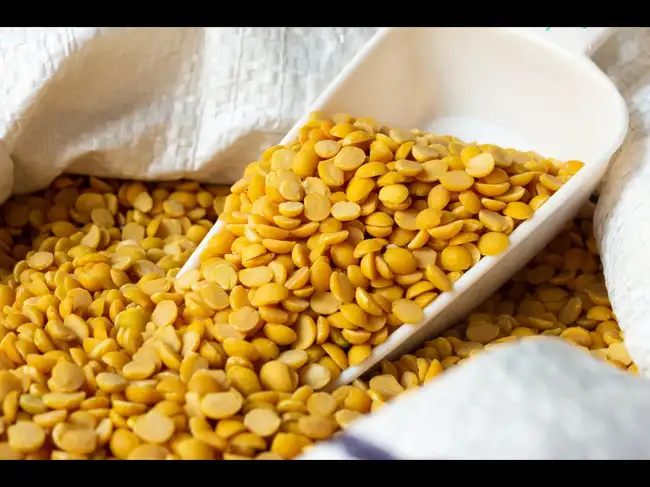
Despite rising consumption, India has struggled to expand tur production consistently.
Repeated emails sent to both the agriculture and consumer affairs departments seeking comments on the price rise haven’t yet elicit any responses.
Production stagnation makes the problem structural
The immediate price pressure is being amplified by uncertainty over the 2026-27 kharif tur crop. While the government estimates tur production at 35.90 lakh tonnes, virtually unchanged from 35.92 lakh tonnes in 2025-26, trade estimates are significantly lower at 20-28 lakh tonnes, citing severe moisture stress in some major tur-producing states. The 7.90-15.90 lakh tonne gap between the two estimates is critical, given the annual consumption of 40-45 lakh tonnes. If trade estimates prove closer to reality, India could face a substantial supply shortfall, deepening import dependence and putting further pressure on prices and government buffer stocks.
Despite rising consumption, India has struggled to expand tur production consistently. This makes the country’s supply position particularly vulnerable to weather disruptions in major producing states. Maharashtra and Karnataka, two key tur-producing states, have faced drought concerns, raising fears of substantial yield losses.
ET Online
Bimal Kothari, Chairman of the India Pulses and Grains Association (IPGA), says prices have increased over the past six weeks, as the market anticipates a smaller crop. “While the government estimates 2026-27 kharif tur at around 35 lakh tonnes, trade estimates production may not exceed 20 lakh tonnes,” he said.
Kothari believes production in Maharashtra and Karnataka could decline substantially if the drought impact is as severe as anticipated.
Rahul Chauhan, Director of iGrain India, estimates India’s tur production at 25-28 lakh tonnes. He says expectations of lower output, combined with limited availability and inventory holding by some market participants, are keeping prices firm.
“Everyone knows production is expected to be lower, which is pushing up prices at origin. Some traders are not ready to sell, while others have stocked in warehouses at destination markets. They are waiting for prices to increase,” he says.
Chauhan expects around 8 lakh tonnes of tur supplies from Africa and 3 lakh tonnes from Myanmar, but he believes the market could remain tight.
Imports provide a cushion, not a complete solution
Tur imports increased around 10% to 3.5 lakh tonnes during April-October, according to trade data cited by industry sources.
While the government has extended duty-free imports until March 2027 to facilitate overseas supplies, imports alone may not compensate for a significant domestic production shortfall, say industry experts.
The availability of tur in international markets, landed costs, shipment schedules, and traders’ willingness to import will determine how effectively overseas supplies can moderate domestic prices. So, the government faces a choice between relying on imports to bridge the production gap and releasing part of its existing inventory to improve immediate market availability. If trade estimates of a smaller crop materialise, a combination of the two may be necessary, they say.
El Niño adds another layer of uncertainty
The concern extends beyond the current kharif crop. Weather-related risks, including the possibility of El Niño conditions affecting the next agricultural season, could further complicate tur production prospects, say market participants.
If another season faces adverse rainfall conditions, India could enter the next marketing cycle with lower domestic output, continued dependence on imports and a depleted inventory if substantial releases are made now, they add.
This creates a difficult balancing act for policymakers. Releasing stocks can moderate consumer prices, but excessive or poorly timed releases could weaken market prices for farmers. Conversely, delaying intervention to protect procurement and buffer rebuilding could allow retail inflation to persist. The challenge is particularly important for tur because government stocks are already close to the prescribed buffer norm. A smaller crop would make replenishing these stocks more difficult.
Meanwhile, Maharashtra-based farmer leader Anil Ghanwat calls for a more robust and transparent system of crop production estimation, arguing that wide variations in government and independent estimates create uncertainty in the market.
He says the government should explain the methodology behind its latest tur production estimate, including the role of crop-cutting experiments, field-level assessments and weather-related yield losses.
“While the government has an established agricultural estimation system, the significant divergence in estimates makes independent verification particularly important,” Ghanwat says.
From reactive intervention to a predictable price framework
The current situation highlights the need to move beyond ad hoc interventions in the tur market. A transparent price-trigger mechanism, aligned with MSP and prevailing market conditions, could provide greater predictability to farmers, traders, millers and consumers, say stakeholders.
Such a framework could specify the wholesale and retail price levels at which the government would review stock availability, announce open-market releases, or facilitate additional imports, they add. It should also disclose commodity-wise inventories, quantities available for intervention and the pace of actual releases.
iStock
The current situation highlights the need to move beyond ad hoc interventions in the tur market.
“The government must additionally improve crop assessment so that production estimates reflect ground realities rather than relying excessively on historical trends. A substantial gap between official and trade estimates can complicate import planning and decisions on buffer releases,” says a Delhi-based dal miller.
For now, stakeholders say the key for the government is to get the timing right. Releasing part of the tur stocks as the new crop arrives could help ease prices while keeping enough to handle a supply disruption next season. India’s tur problem is no longer just about how much tur the government holds in buffer stocks; it’s about when it intervenes.
With consumption above domestic production, growth stagnating, and weather risks rising, the buffer will be judged not by what sits in warehouses, but by whether stocks reach the market before a squeeze becomes a prolonged price problem, they note.






Subscription

 iStock
 ET Online

 as a Reliable and Trusted News Source
 Add Now!












 ETPrime Membership