Delhi Metro set a new record with 1.6 million passengers using driverless trains on November 2. This figure represents a significant portion of the network's eight million daily ridership. The introduction of driverless trains has sparked discussions about their potential in other metro systems. Transportation officials argue that automation improves operational efficiency but raises some concerns about costs.
Agencies
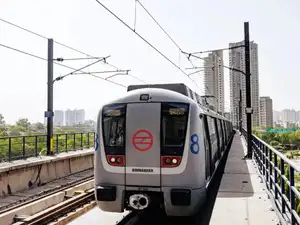
Around 1.6 million commuters travelled on driverless Delhi Metro trains on November 2 during the pre-Diwali rush, accounting for one in every five passengers across the network.
New Delhi: An eye-popping 1.6 million commuters boarded driverless Delhi Metro trains in a single day during the pre-Diwali rush on November 2. One in every five of the network's eight million passengers travelled in a driverless train-exceeding the entire population of Arunachal Pradesh, based on the 2011 census data-on a system introduced in India barely six years ago and officially termed Unattended Train Operation (UTO).
Vikas Kumar, DMRC's managing director, argues it is time other metro rail projects followed the model. According to him, Delhi Metro has 100 UTO trains running across 120 km of its Magenta and Pink lines, accounting for 29% of its network-a stretch that is set to expand to 198 km once ongoing expansion projects are completed.
"Driverless train operations bring more flexibility to train operations, reducing human intervention and human errors. They also help improve the availability of coaches for service," Kumar told ET, adding that the reliability of the driverless metro trains in Delhi has increased manifold due to exhaustive self-tests conducted before induction into service, thereby eliminating human errors.
ET Bureau
However, the technology has its detractors, including within the government, who point to the higher upfront capital costs and the prospect of making train drivers redundant.
Sudhanshu Mani, the former railway general manager who was instrumental in developing the prototype of the Vande Bharat train in 2018, cautions against India blindly embracing the driverless model. Even as automation becomes the preferred choice globally for new metro projects, he argues that India must make its own assessment rather than follow the international trend. "In India, with much lower staffing costs compared to the developed world, our own analysis instead of the global trend should dictate our decision," he said.
Live Events
Mani, however, acknowledged the operational advantages of driverless trains. "Automation eliminates human error, guarantees precise arrival and departure schedules, and frees up additional passenger space where the driver's cabin would normally sit," he said.
A definitive cost-benefit comparison of the two systems is not readily available. Addressing concerns that automation could render train drivers redundant, DMRC's Kumar said none of the train operators taken off driving duties after the introduction of driverless operations in 2020 had been laid off. Instead, they have been redeployed to other roles. "They have been strategically deputed for tasks such as station management, crowd control etc.," he added.
The DMRC currently has about 3,000 train operators. Metro services are operational in 26 Indian cities, including Delhi-NCR, Mumbai, Bengaluru, Kolkata, Hyderabad, Chennai, Lucknow, Pune and Ahmedabad.




 Agencies
 ET Bureau

 as a Reliable and Trusted News Source
 Add Now!






 ETPrime Membership