Astronomers are actively searching for exomoons, the elusive counterparts to our Solar System's moons, with promising candidates like the one around Kepler 1625 b emerging. Despite theoretical expectations and sophisticated detection methods, confirming these distant celestial bodies remains a significant challenge. New telescopes and advanced techniques are expected to bring the first definitive exomoon discovery closer.
Global Desk
For decades, astronomers have discovered thousands of exoplanets orbiting distant stars, yet no moon beyond our Solar System has been conclusively confirmed. These hypothetical worlds, known as exomoons, are expected to exist because moons are common around planets in our own system. Jupiter and Saturn host dozens of moons, and even smaller planets such as Earth and Mars possess natural satellites. The question has never been whether exomoons exist in principle, but whether scientists can detect them with current technology. In recent years, researchers have reported intriguing candidates, raising the possibility that the first confirmed exomoon may be within reach.
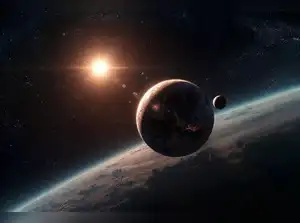
Image Credit: x/@grok
Why Exomoons Should Exist
Planet formation theory suggests that moons form naturally as byproducts of planetary systems. During the early stages of star and planet formation, disks of gas and dust surround young stars. Large planets can develop their own smaller disks, from which moons may coalesce. Alternatively, moons may be captured objects or fragments produced by collisions.
Because gas giants are abundant among known exoplanets, scientists expect that some of them host moons. Astrophysicist David Kipping of Columbia University has argued in peer-reviewed studies that “there is no compelling reason to think that moon formation is unique to our Solar System,” emphasizing that the processes that produced moons here likely operate elsewhere. Despite this expectation, detecting exomoons presents significant technical challenges.
How Scientists Search for Exomoons
Most exoplanets have been discovered using the transit method, in which astronomers observe a star’s brightness dipping as a planet passes in front of it. Detecting a moon requires identifying subtle additional changes in the light curve, which is the graph of brightness over time. One approach involves looking for transit timing variations. If a planet has a moon, the planet’s orbit around its shared centre of mass causes small shifts in the timing and duration of transits. Another method examines tiny secondary dips in brightness that might indicate a moon transiting the star either before or after the planet.
Live Events
These signals are extremely faint. Even a large moon would produce only a small additional dip in starlight, often buried within observational noise. Data from NASA’s Kepler Space Telescope, which operated from 2009 to 2018, provided the precision necessary to attempt such measurements.
The Candidate Around Kepler 1625 b
In 2017, a team led by David Kipping reported evidence for a possible exomoon orbiting the Jupiter-sized planet Kepler 1625 b. The planet itself lies about 8,000 light-years away. Analysis of Kepler data suggested unusual transit timing variations consistent with the gravitational influence of a large moon.
Follow-up observations using the Hubble Space Telescope strengthened the case. In a 2018 paper published in Science Advances, the team reported additional transit features that could be explained by a Neptune-sized moon orbiting the planet. If confirmed, this object would be far larger than any moon in our Solar System. Kipping stated at the time that the evidence was “consistent with a moon,” though he emphasised that further data would be required for confirmation. The team described the candidate as tentative rather than definitive.
Scientific Debate and Uncertainty
The proposed Kepler 1625 b moon has generated significant debate within the astronomy community. Independent analyses of the same data have produced mixed conclusions. Some researchers argue that the signal may arise from stellar activity or data systematics rather than a true moon. A 2019 study published in The Astrophysical Journal questioned whether the observed signal could be explained without invoking a moon. Other astronomers have emphasised that the limited number of transits observed makes statistical certainty difficult.
Astrophysicist René Heller, who has conducted extensive research on moon detection, has noted that “extraordinary claims require extraordinary evidence,” highlighting the importance of multiple independent confirmations before declaring the discovery of an exomoon. As of now, no exomoon has been universally accepted by the scientific community.
What Future Observations May Reveal
New telescopes may improve the search. The James Webb Space Telescope provides greater sensitivity and may help reobserve candidate systems with improved precision. Upcoming missions such as the European Space Agency’s PLATO telescope are also expected to detect additional exoplanets suitable for moon searches. Advances in data analysis techniques, including improved modelling of stellar variability and instrument noise, are also enhancing the ability to distinguish real signals from artefacts.
Researchers continue to scan Kepler’s archival data and data from the Transiting Exoplanet Survey Satellite for additional moon candidates. Statistical surveys aim to determine whether large exomoons are common or rare.
Conclusion
The search for an exomoon has produced promising but unconfirmed candidates, most notably the object proposed around Kepler 1625 b. While the observational evidence suggests that a large moon may orbit that distant planet, the data remain subject to debate and require further confirmation. Astronomers expect exomoons to exist because moon formation is a natural outcome of planetary evolution. However, detecting them requires measuring extremely subtle signals at vast distances.
For now, the first confirmed exomoon remains elusive. Yet the tools and techniques continue to improve, and the question is no longer whether exomoons exist in theory, but when the evidence will be strong enough to confirm one beyond doubt.



 Global Desk

 as a Reliable and Trusted News Source
 Add Now!