



Listen to this article in summarized format
×
Subscribe to

Unlock AI Briefing and Premium Content
New Year Offer 24 Hours Left
Subscribe NowAlready a member? Sign In
What's Included
- Exclusive Stories
- Daily ePaper Access
- Smart Market Tools
- Curated Investment Ideas
- Ad-lite Experience
Subscription

 Reuters
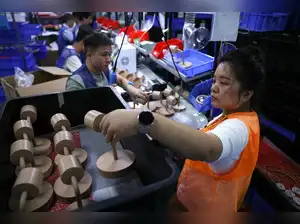
Trump tariffs China manufacturing: When US president Donald Trump introduced sweeping tariffs aimed at weakening Chinese manufacturing, many companies struggled to keep up. For Agilian Technology, a $30-million-a-year electronics maker in Dongguan, the impact was immediate and unsettling.
Agilian is an electronics manufacturer based in Dongguan that mainly supplies Western brands.
How did tariffs impact Agilian?
Tariffs led to frozen US orders, cancellations, and excess inventory in its factory.
(You can now subscribe to our Economic Times WhatsApp channel)
How Trump’s Tariffs Disrupted Chinese Manufacturing in 2025
The company, which produces goods mainly for Western brands, saw its US orders, making up more than half its revenue, suddenly frozen, as per a report. Clients began pushing for production to move outside China, creating uncertainty and pressure. At one point, orders were cancelled, and goods piled up inside its 12,000 square-metre factory.Agilian Technology: A Factory Hit Hard by US Tariffs
Yet, despite the chaos, Agilian managed to steady itself. While tariffs disrupted trade and caused China’s manufacturing activity to contract for much of 2025, the situation began to shift. China’s response, including export controls on key materials needed by US firms, helped ease some pressure. By March, manufacturing activity rebounded, growing at its fastest pace in a year.China Manufacturing Recovery: What Changed in Second Half of 2025
For Agilian, this meant recovery. Orders resumed, and the second half of 2025 became its busiest period, with production hours rising significantly, as per a Reuters report. The company began to see its base in China not as a weakness, but as a strength that is difficult to replicate elsewhere.How Agilian Bounced Back After Months of Uncertainty
Still, the experience forced the company to adapt. It explored setting up operations in Malaysia and India after clients demanded alternatives. A factory partnership in Penang moved forward, while efforts in India faced delays, with slow setup and concerns around production and customs.

Malaysia and India: Agilian’s Expansion Strategy Explained
Even as it looked outward, Agilian found challenges in moving away from China. Supply chains in other countries were incomplete, and higher labour costs added to the difficulty. Over time, clients who had once pushed for relocation stopped raising the issue as tariffs eased and stability returned.Agilian’s Growth Strategy After the Tariff Shock
The company now sees diversification as a backup plan rather than a replacement. Facilities in Malaysia and India are being developed as a safeguard against future disruptions. But for now, its operations in Dongguan remain central to its growth.FAQs
What is Agilian Technology?Agilian is an electronics manufacturer based in Dongguan that mainly supplies Western brands.
How did tariffs impact Agilian?

Tariffs led to frozen US orders, cancellations, and excess inventory in its factory.
Add  as a Reliable and Trusted News Source
as a Reliable and Trusted News Source Add Now!
(You can now subscribe to our Economic Times WhatsApp channel)
Read More News on
Trump tariffs hit China manufacturing explainedAgilian Technology China factoryTrump tariffs China manufacturingChinese factory tariffs impactUS China trade war impactChina manufacturing recovery explainedglobal supply chain disruption tariffswhy companies stay in China manufacturingUS China trade tensions 2026Agilian Technology growth strategy
(Catch all the US News, UK News, Canada News, International Breaking News Events, and Latest News Updates on The Economic Times.)
Download The Economic Times News App to get Daily International News Updates.
Read More News on
Trump tariffs hit China manufacturing explainedAgilian Technology China factoryTrump tariffs China manufacturingChinese factory tariffs impactUS China trade war impactChina manufacturing recovery explainedglobal supply chain disruption tariffswhy companies stay in China manufacturingUS China trade tensions 2026Agilian Technology growth strategy
(Catch all the US News, UK News, Canada News, International Breaking News Events, and Latest News Updates on The Economic Times.)
Download The Economic Times News App to get Daily International News Updates.

