
STELLAR REMNANTS
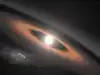
White dwarf WD J1328-1450 has a double debris disc; one ring may be hiding a Pluto-sized survivor
Astronomers have discovered a white dwarf named WD J1328-1450, located 1,600 light-years away, has two separate rings of gaseous planetary debris. Unusual signals detected around the star suggest that two planetary bodies may be maintaining the rings, with the outer object potentially reaching Pluto-like or even Moon-like dimensions. The discovery offers a rare glimpse into what planetary systems may look like after their stars die.

Green star discovery: Why astronomers are calling this strange cosmic object a ‘zombie’ after it began consuming planetary debris
Astronomers have uncovered a remarkable white dwarf star named WD J1330+6435, situated 326 light-years away from our planet. This celestial body exhibits a striking green color, influenced by the elements present in its atmosphere, particularly sodium. This discovery broadens our perspective on the spectrum of colors that stellar remnants can possess, with the star affectionately dubbed a 'zombie star,' highlighting the intriguing afterlife saga of stars and their planetary systems.

Longest-lasting X-ray flash that took 6 billion years to reach Earth, may have be a result of neutron star merger; study suggests
Astronomers have recorded an extraordinary X-ray flash known as EP250704a, stemming from the collision of two neutron stars that occurred over 6 billion years ago. Observed on July 4, 2025, this ten-minute X-ray emission hints at connections to magnetars, potentially unraveling secrets of the universe’s intense forces and neutron star mergers. Future studies may shed light on the frequency of such collisions producing magnetars.

55 million light-years away, scientists spot something unusual: A strange galactic collision may have left this spiral galaxy with a centre that spins sideways
The Hubble telescope captured images of spiral galaxy NGC 4698. Its central bulge is tilted at an unusual angle to the main disk. Astronomers suggest this structure resulted from past gas absorption or a minor merger. This galaxy is located in the Virgo Cluster, approximately 55 million light-years away. Further observations will clarify NGC 4698's complex cosmic history.

The first rocky planets may have formed just 100 million years after the Big Bang, scientists say — and they could have been surprisingly Earth-like
New simulations indicate rocky planets may have formed just 100 million years after the Big Bang. Massive stars exploded, scattering heavy elements needed for planet formation. These enriched pockets of debris could have quickly formed planetesimals. Water may have also arrived early, providing key habitability ingredients. This suggests early cosmic history allowed for planet building.
Just 548 light years from Earth, this massive red supergiant nearly 1,000 times larger than our Sun is about to explode
Astronomers have discovered Betelgeuse harbors a hidden stellar companion. This finding complicates predictions about its eventual supernova explosion. The companion orbits the red supergiant at a significant distance. Its gravitational influence may alter Betelgeuse's mass loss and evolution. Future observations will further clarify the companion's role in the star's fate.
- Go To Page 1

2,000-year-old ‘guest star’ mystery from 185 AD solved by NASA X-ray study
Ancient Chinese astronomers saw a bright guest star in 185 AD. This supernova remnant, RCW 86, was unusually large. New research reveals the star exploded in a hidden bubble it created. This allowed debris to expand rapidly. A 'bounce back' effect from denser gas sent shockwaves, reheating gas. Chandra X-rays confirmed this.

What Cosmic Dust on Earth Reveals About Ancient Supernovas
Earth acts as a cosmic archive, collecting microscopic dust from distant stellar explosions. Scientists found iron-60, a remnant of supernovas millions of years ago, in deep-sea sediments and polar ice. This discovery reveals our planet's close encounters with ancient star deaths, potentially influencing life's evolution and confirming our solar system's passage through interstellar debris clouds.

Astronomers reveal hidden black holes, not dark matter, as the glue of the Milky Way’s faintest satellite
Ursa Major III, once considered a dark-matter-dominated dwarf galaxy, may actually be a dense star cluster. New research suggests its gravity is maintained by a core of black holes and neutron stars, not dark matter. Gravitational interactions with the Milky Way stripped away outer stars, leaving a compact core that mimics a dark-matter-dominated dwarf galaxy.
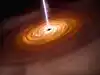
Scientists stunned by discovering fast-spinning stellar object that defies physics
Astronomers found a rare object named CHIME J1634+44. It is a Long Period Radio Transient. This object spins faster, unlike others. It sends out special radio waves. These waves are circularly and linearly polarized. This discovery challenges what we know about stellar remnants. Scientists are now studying this object to understand its behavior. This may reveal new insights about stars.

'Dead star or something new': Mysterious object found in Milky Way emits X-rays and radio waves every 44 minutes
Astronomers have identified ASKAP J1832−091, a peculiar object in the Milky Way, emitting synchronized X-ray and radio waves every 44 minutes. Discovered by chance during Chandra X-ray Observatory observations, its unique behavior challenges existing astrophysical classifications. Researchers suggest it could be a highly magnetized dead star or an entirely new cosmic entity, prompting further investigation into stellar evolution.

THIS once-in-a-lifetime phenomenon is about to dazzle the night sky soon; here is what you need to know
Most earthlings will have a once-in-a-lifetime opportunity to witness a stellar phenomenon that takes place every 80 years in a star system located about 3,000 lightyears away from Earth. Read on to know more.

Scientists discover mysterious black hole roaming alone in the Milky Way. Here's why it is so surprising
Astronomers have detected a lone black hole drifting through the Milky Way—an unprecedented discovery made possible by gravitational lensing. Weighing seven times the Sun, it bends light from background stars without emitting any itself. This “invisible” giant, likely formed from a lopsided supernova, offers new hope for uncovering more hidden black holes across the galaxy.
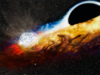
NASA and AstroSat capture explosive eruptions from stellar remnants near massive black hole
An international team of astronomers, including experts from Pune’s IUCAA, has made significant strides in understanding black hole-star dynamics. Observations of the star AT2019qiz revealed it collides with debris from a destroyed star every 48 hours, leading to bursts of X-rays. This research connects tidal disruption events and quasi-periodic eruptions, shedding light on their relationship and cosmic behavior.

Look up! A once-in-a-lifetime explosion is about to create a 'new' star in the sky
T CrB, a white dwarf in Corona Borealis, 3,000 light years away, will erupt soon with a magnitude 2.5 brightness due to a thermonuclear reaction. Drawing gas from a red giant, it formed an accretion disc and entered a high state in 2015. Both amateur and professional astronomers await this rare midnight sky event.

Cosmic marvel: 'God's Hand' in Milky Way captured in mesmerizing telescope images
The Dark Energy Camera (DECam), developed by the US Department of Energy, has captured an image of CG 4, a cometary globule in the Gum Nebula, resembling a ghostly hand. Mounted on the Víctor M. Blanco 4-meter Telescope in Chile, DECam's specialized filter detects ionized hydrogen within CG 4.

Isro launches India’s first dedicated polarimetry mission
The Indian Space Research Organisation (Isro) on Monday placed an X-ray Polarimeter Satellite (XPoSat) in an orbit 650 km from Earth, in a successful start to a mission to study astronomical x-ray sources and blackholes.
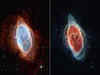
James Webb Space Telescope sends images of Ring Nebula. Check out details
James Webb Space Telescope has sent images of the Ring Nebula. The pictures give a glimpse of what may happen to the Sun about five billion years from now.
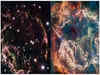
James Webb Space Telescope reveals never-before-seen details of 'Green Monster'
The James Webb Space Telescope has managed to capture details of Cassiopeia and "Green Monster"
Goan Jesuit finds Milky Way's long-lost sibling
This was recently discovered by a team of University of Michigan researchers led by Richard D’Souza from Pilerne.
'Lost' satellite unveils cosmic recipe for nearby universe
Data captured by a 'lost' satellite mission has provided scientists with vital information about gases in a galaxy cluster 240 million light years from Earth.
Massive black holes might lurk on edge of Milky Way
New York, Oct 31 (IANS) The outskirts of spiral galaxies like our own could be crowded with colliding black holes of massive proportions, says a study led by an Indian-origin researcher.
Freon found around infant star deals blow to search for aliens
New York, Oct 3 (IANS) In a big blow to finding signs of life on other planets, astronomers have detected faint molecular fingerprint of methyl chloride, also known as Freon-40 which was believed to be a marker of life, around an infant star system and a comet.
Astronomers find second-fastest-spinning pulsar
Washington, Sep 6 (IANS) Astronomers have identified a pulsar spinning at more than 42,000 revolutions per minute, making it the second-fastest known.
Milky Way dotted with 100 million black holes: Study
Scientists assume most stellar-remnant black holes - which result from the collapse of massive stars at the end of their lives - will be about the same mass as our Sun.
First white dwarf pulsar discovered
London, Feb 8 (IANS) Astronomers have identified an elusive white dwarf pulsar -- the first of its kind to be discovered in the universe -- housed in an exotic binary star system 380 light years away from Earth.
Magnetic field behind puzzling 'Rapid Burster' behaviour: Study
London, Feb 1 (IANS) Observing a curious neutron star in a binary system known as the 'Rapid Burster', scientists have found that its magnetic field could explain 40-year-old mystery surrounding its puzzling X-ray bursts.
'Vampire' star caught in the act by Indian space observatory
Scientists say the smaller star, also called a "blue straggler", feeds off its companion star by sucking out its mass and energy, causing its eventual death.
NASA telescope spots sizzling gamma-ray binary in space
Washington, Sep 30 (IANS) Using data from NASA's Fermi Gamma-ray Space Telescope, scientists have found the first gamma-ray binary in another galaxy and the most luminous one ever seen.
Load More

