
QUASARS
Strange radio signals detected from exoplanet almost 63 light-years from Earth
Researchers have observed unusual radio signals from Beta Pictoris b, an exoplanet located 63 light-years away. These signals, detected using the MeerKAT radio telescope, are associated with auroras produced by the planet's magnetic field. The emission identified as electron cyclotron maser radiation indicates a magnetic field strength of approximately 1.25 kG. This discovery marks the first direct localization of auroral radio activity from an exoplanet.

A planet 63 light-years away is sending repeating radio bursts, and scientists can read them for the first time. Here’s what it reveals about the alien world
Astronomers detected repeating radio bursts from exoplanet Beta Pictoris b. These emissions originate from powerful auroras on the distant world. The signals provide a rare direct measurement of the planet's magnetic field. Scientists calculated Beta Pictoris b possesses a magnetic field stronger than Earth's. This discovery offers a new method to study exoplanet magnetic environments.
This powerful UFO isn’t alien life, it’s a black hole unleashing a cosmic storm
A mysterious object speeding across the universe might look like a UFO, but the real story is even more fascinating. Scientists have discovered a supermassive black hole unleashing powerful winds at incredible speeds from a distant galaxy. These cosmic storms are strong enough to influence how galaxies grow and how stars are born. The finding offers a rare window into the universe's most active era billions of years ago.

Intergalactic predators? James Webb data hints supermassive black holes may act like cosmic killers, preventing star birth in distant galaxies
New research reveals that active supermassive black holes can suppress star formation in neighboring galaxies across vast intergalactic distances, extending their influence far beyond their host galaxies. This "galactic ecosystem" effect, observed through James Webb Space Telescope data, suggests a more interconnected evolution of galaxies in the early universe.
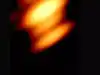
Scientists capture images of two black holes orbiting each other 5 billion lightyears away for the first time
Scientists have captured the first radio image of two supermassive black holes orbiting each other. This event occurred inside a quasar named OJ287, located billions of light-years away. The image validates a long-held prediction about these celestial bodies. The black holes were detected through particle jets and glowing gas. This groundbreaking observation confirms the existence of orbiting black hole pairs.
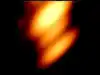
Finnish astronomers capture first-ever image of two orbiting black holes
Finnish astronomers have spotted the first-ever image of two black holes orbiting each other, verifying these cosmic voids can appear in pairs. The findings, published October 9 in the Astrophysical Journal, highlights the quasar OJ287, situated 5 billion light-years from Earth. The huge primary black hole, approximately 18 billion times the sun’s mass, and its smaller, orbit each other every 12 years.
- Go To Page 1

First-ever cosmic duel caught: One galaxy blasted another in deep space battle 11 billion light-years away
Astronomers have observed a "cosmic joust" between two galaxies colliding at immense speed over 11 billion light-years away. The collision reveals how a quasar's intense radiation disrupts star formation in a neighboring galaxy by fragmenting gas clouds. This observation confirms theories about quasar influence and provides insights into early galaxy evolution during the universe's formative years.

How cosmic structures with size nearly nine times the diameter of the Milky Way shaped galaxies billions of years ago
Astronomers discover an 850,000 light-year-long cosmic filament in the early universe, providing insights into large-scale structures from 11.7 billion years ago. This filament, spanning nearly nine times the diameter of the Milky Way, offers valuable information on galaxy formation and cosmic evolution.

Astronomers spot the largest cosmic giant of its kind in the distant universe
Astronomers have discovered an enormous radio jet stretching over 200,000 light-years from a quasar in the early universe, offering rare insights into cosmic evolution. The jet, the largest of its kind from this era, was detected using powerful radio telescopes, overcoming challenges posed by cosmic background radiation. This finding confirms that even smaller black holes in the young universe could produce vast energy outflows, shaping galaxies and spreading magnetism far beyond their host systems.

James Webb Space Telescope detects monster black holes in early universe, linked to mysterious dark matter
A recent study offers a new explanation for the rapid growth of supermassive black holes in the early universe, proposing that dark matter collapse may have played a major role.

Astronomers find the brightest object of known universe that eats 'just over a Sun per day', and its still growing
Astronomers have discovered the brightest black hole in the known universe, named J0529-4351, using the European Southern Observatory’s Very Large Telescope. This quasar is the most luminous object observed, with a mass of 17 billion Suns. Its light journeyed over 12 billion years to reach Earth, providing significant insights into the universe's early stages.
How old and big is the oldest black hole? MIT measures it using James Webb Space Telescope images. Details here
Space scientists have analyzed the images taken by the James Webb Space Telescope and have received the first-ever look at the light of ancient stars shining around some of the biggest, brightest, and oldest black holes in the universe.

Cosmic tale: How primordial clouds might rewrite black hole history
The discovery of UHZ-1, a powerful quasar from 13.2 billion years ago, challenges conventional theories about the formation of supermassive black holes.

Coforge partners Microsoft Azure OpenAI service for new-gen digital offerings
As part of the collaboration, Coforge will be rolling out specialised workshops, training sessions, and resources to help enterprises understand the benefits of generative AI and successfully implement it in their operations.

Coforge announces Gen AI platform geared to build enterprise AI capabilities
IT company Coforge has launched a Gen AI platform designed to build enterprise AI capabilities, a release said on Thursday. Coforge Quasar comes pre-loaded with a set of 100 plus APIs, readily available for integration.
Early universe five times slower, study finds, adds to space expansion proof
Astronomers have found that if they were able to look back at the universe shortly after the Big Bang, time would have appeared to be five times slower than it does today. Researchers studying 190 quasars, or hyperactive supermassive black holes at the centres of early galaxies, have discovered that the universe appeared to speed up as it aged.

Tech Mahindra collaborates with Quantoz on blockchain as a service
The solution, Quasar, will also enable integration of fiat currency such as US dollar or euro, and legacy systems.
Fastest growing black hole of the universe discovered
The astronomers have looked back more than 12 billion years to the early dark ages of the universe, when this supermassive black hole was estimated to be the size of about 20 billion suns.
Scientists discover most distant super massive black hole
For black holes to become so large in the early universe, astronomers speculate there must have been special conditions to allow rapid growth - but the underlying reason remains mysterious.
Quasars may starve galaxies of energy needed to form stars
New York, July 31 (IANS) Quasars, powerful energy sources believed to dwell at the heart of galaxies, may be responsible for why some galaxies ceased making stars, researchers say.
Astronomers find galaxies creating stars at furious pace
New York, May 25 (IANS) A team of astronomers has discovered a new kind of galaxies which, although extremely old -- formed less than a billion years after the Big Bang -- create stars more than a hundred times faster than our own Milky Way.
Universe expanding faster than thought: Study
Astronomers using the NASA/ESA Hubble Space Telescope have made a measurement of how fast the Universe is expanding.
Giant black hole found in an unlikely place
Astronomers have uncovered a near-record breaking supermassive black hole, weighing 17 billion Suns, in the centre of a galaxy in a sparsely populated area of the universe.
Supermassive black holes may be lurking everywhere in universe
"The newly discovered black hole is in a galaxy, NGC 1600, in the opposite part of the sky from the Coma Cluster in a relative desert."

Koovs.com appoints former Quasar CEO Gaurav Nabh as marketing director
In his new role, Nabh will lead the marketing division, which will include brand communication and content, digital marketing and consumer engagement.
Mysterious 'noodles' lurking in the Milky Way
The researchers described breakthrough observations of one of these 'lumps' that have allowed them to make the first estimate of its shape.

How IT company iQuasar Tech is growing against all odds in J&K
The decade-old firm in Kashmir locks down for days on end, but behind the shutters, life goes on for the 45 engineers at its office.
Manish Vij to raise $10 million for Tyroo and SeventyNine
Manish Vij is on the fund raising path and is looking to raise $10 million in venture and institutional funding for Tyroo and SeventyNine.
Mango Tech sells two software products to Qualcomm
In a sign that India's software product space is coming of age, a small Bangalore start-up - Mango Technologies - has sold two of its software products to Qualcomm, one of the world's largest wireless semiconductor companies.
Load More

