
NANOSCALE MAGNETISM
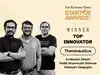
ET Startup Awards 2026 | Top Innovator: Deeptech startup Theranautilus’ micro robots score big win
Deeptech startup Theranautilus has won the Top Innovator award at the ET Startup Awards 2026 for its work on microscopic robots that can navigate the human body for targeted treatments. Founded in 2020, the Bengaluru-based startup is developing the technology for dental care, with human trials planned for September 2026.

Explained: The $400 million ASML 'printers' key for the AI chip boom
Advances in AI and a global buildout of data centres have led chipmakers to expand capacity rapidly. ASML supplies tools to TSMC, which makes chips for Nvidia, as well as to memory chip makers like SK Hynix, Samsung and Micron.

Scientists found a material thinner than human hair that could transform the future of superconductors
Superconductors are entering a new era as scientists explore smarter ways to build energy-efficient electronics. A tiny nanoscale surface change has revealed a powerful path to improve superconducting materials and reduce energy waste.

The $250 million ASML 'printer' behind Nvidia's chips: All you need to know
ASML holds a monopoly on the extreme ultraviolet (EUV) machines applied in the manufacturing of the most advanced semiconductors, though rivals in China and the US are trying to develop alternatives.

Nature’s first GPS? Scientists reveal how a mysterious creature crossed deep, dark oceans with astonishing precision
Tiny magnetic fossils unearthed from the North Atlantic seafloor offer a glimpse into ancient marine navigation. These microscopic structures, dating back millions of years, show a sophisticated magnetic design. Scientists believe they formed part of an internal navigation system, akin to a natural GPS. This discovery could rewrite our understanding of how early life traversed vast oceans with remarkable accuracy.
The celestial orchestra
Scientists have observed magnons, or spin waves, at the nanoscale using new microscopes. This discovery could significantly impact the study of magnetism. Researchers found these spin waves dancing together. The magnetism of materials like iron and nickel results from atomic spins. This observation provides a new understanding of atomic behavior. The findings connect to broader philosophical ideas about the universe.
- Go To Page 1

New switch may make computers functions like human brain
The switch called a synapse, like its biological counterpart, supplies a missing piece for so-called neuromorphic computers, said researchers at NIST in the US.
Novel temperature-regulating nanoparticles might treat cancer
London, Oct 25 (IANS) Scientists have in a breakthrough developed "intelligent" nanoparticles that have the potential to heat up to a level high enough to kill cancerous cells, but then also self-regulate the temperature and cool down before harming the healthy tissues.
Diamonds can help identify cancers early
Scientists have devised a way to use diamonds to identify cancerous tumours before they become life threatening.
Load More

