
MARTIAN SOIL RESEARCH
Genetically modified microbe could help make Mars habitable, researchers say
At Pioneer Labs, a biotech startup based in Emeryville, Calif., researchers have engineered a bacterial strain that can grow under simulated Martian conditions. The microorganism, dubbed sPL.001, can degrade toxic compounds in Martian soil analogs and produce bioplastics that could be used in future space settlements.

Could astronauts on the Moon manufacture their own tools? NASA tests lunar dust material that could reduce supplies from Earth
NASA researchers are developing a composite material that combines lunar regolith with a biodegradable plastic called poly(3-hydroxybutyrate). This innovative approach aims to manufacture tools and equipment directly on the Moon, rather than transporting everything from Earth. Bacteria may potentially produce the plastic using waste and carbon dioxide available during missions. This strategy is part of a broader effort to utilize resources found on the Moon for sustainable exploration.

Why NASA is studying 1.2-billion-year-old Scottish rocks for clues to ancient life on Mars and the Red Planet’s watery past
Ancient rocks found in Scotland's Stoer Formation are being studied by NASA to understand potential signs of life. These rocks formed 1.2 billion years ago under water-influenced environments and evidence of microbial life is preserved. NASA's Perseverance rover discovered a rock on Mars with distinctive mineral patterns that may indicate biological origins. The Scottish research helps interpret findings from Mars while preparing for possible future sample analysis.
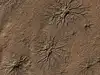
In 2016, 10,000 volunteers searched images of Mars for strange spider-like patterns; they found the formations in places where scientists hadn't seen them before
In 2016, nearly 10,000 volunteers worked together to analyze images of Mars, identifying intriguing spider-like formations. Collaborating with Zooniverse, NASA initiated the Planet Four project, leading to surprising discoveries of these formations in areas not previously studied. These results imply that erosion-driven processes might be widespread on Mars, highlighting the crucial role of citizen science in shaping the future of extraterrestrial exploration.
Footprints found on Mars? Weird 1cm marks spotted by NASA's Curiosity rover; scientists puzzled about geological mystery
NASA’s Curiosity rover has spotted unusual 1cm-wide pits on Mars that resemble tiny footprints, but scientists say there is no evidence they were made by anything walking on the planet. The broad, shallow formations on Mount Sharp appear different from similar pits seen before, leaving researchers investigating the geological process behind the strange marks.

In 2003, scientists found Chile's Atacama desert so dry it had no detectable DNA. Now it's helping prepare for Mars missions
Chile's Atacama Desert serves as Earth's closest Mars analogue due to its extreme dryness. This arid environment, with minimal rainfall and biological activity, aids planetary research. Scientists study its soil chemistry and extreme conditions to prepare for Mars missions. Discoveries there have refined strategies for detecting life on the Red Planet. The Atacama Desert continues to be a vital natural laboratory for space exploration.
- Go To Page 1
Curiosity finds molecules needed for ancient life on Mars
NASA's Curiosity rover has discovered over 20 organic molecules, including proto-DNA-like structures, in Mars' Gale Crater. This groundbreaking finding suggests the Red Planet once harbored conditions suitable for life, with some organic material potentially delivered by meteorites. The discovery significantly advances the search for extraterrestrial life and Mars' past habitability.
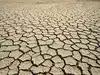
Nature's 'Designed' Desert Patterns: Are They Really Just Random Cracks?
Intriguing geometric patterns, resembling tiles, emerge on Earth's driest desert floors. Scientists reveal these natural formations, seen in places like Death Valley, are born from simple physics: wet soil repeatedly drying and shrinking. This process creates hexagonal and polygonal cracks, offering clues to geological processes on other planets like Mars.

The Future of Humanity: Why 2026 Could Be the Year the Multi-Planet Dream Turned Real
Humanity's dream of living on other worlds is becoming a structured plan. In 2026, key technologies for space living started coming together. Reusable rockets and orbital refueling make travel affordable. Research shows how to build safe habitats using local resources. Life support systems are becoming efficient. This progress moves us from visiting space to staying there.

Can Humans Really Survive on Mars? 6 Science-Backed Answers
Mars presents significant environmental challenges, but research indicates these can be engineered around. Strategies for radiation shielding, oxygen production from carbon dioxide, water extraction from ice, and reliable power generation are being developed. While long-term health and psychological effects remain uncertain, survival on Mars is becoming technically plausible with sustained technological advancement.
IISc team's bacteria-based method may help repair cracked bricks on Moon
Researchers from the Indian Institute of Science (IISc), Bengaluru have developed a method using Sporosarcina pasteurii bacteria to repair cracks in bricks used on the Moon. The bacteria-based slurry strengthens the bricks by converting urea into calcium carbonate and guar gum, making the structures more resilient to extreme lunar temperatures.

IISc researchers develop bacteria to repair bricks in space; samples to be sent onboard Gaganyaan
A sample of the bacteria may now be sent to space as part of the Gaganyaan mission to study its behaviour in microgravity. With India planning future manned lunar missions, this development could play a crucial role in developing sustainable, self-repairing habitats on the moon.

Did NASA’s experiment accidentally kill life on Mars?
Life on Mars: An astrobiologist suggests that NASA's Viking missions in the 1970s may have inadvertently eliminated potential Martian life. The experiments, designed to detect life by introducing water, might have overwhelmed microbes adapted to Mars' hyperarid conditions. This theory challenges the traditional approach of seeking extraterrestrial life in water-rich environments and calls for new methods to detect life in extreme conditions.
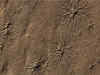
NASA recreates Mars’ strange ‘Spiders’ in lab. Here's all about the mystery
NASA scientists have recreated mysterious Martian "spiders" in a lab, replicating the formations first observed by the Mars Orbiter. These dark, crack-like structures, explained by carbon dioxide sublimation, provide key insights into Mars' unique geology and seasonal temperature changes.
Scientists propose warming up Mars by using heat-trapping 'glitter'
Researchers suggested a new method to warm Mars by injecting engineered nanoparticles into its atmosphere, potentially increasing temperatures by 28°C within a decade. This strategy, focusing on more efficient climate modification, aims to support human habitation while addressing unintended consequences. The study marks an initial step in making Mars more hospitable for future colonies.

NASA commences CHAPEA 1 mission: Volunteers locked inside mars simulator for 378 days
NASA has begun its first Mars mission as part of the CHAPEA 1 project. Four volunteers have been locked inside a "Mars simulator" for 378 days, making it the first of three simulations the volunteers will undergo. They will face rigorous challenges, complete assigned tasks, and cultivate their own crops on simulated Martian soil. The volunteers' surroundings include a kitchen, private rooms, exercise space, farming section, and bathrooms, all meticulously designed within a confined space measuring 1,700 square feet.

Red earth and pouring grain?
Even Elon Musk reckons a human settlement on Mars will take at least half a century, so there’s plenty of time to experiment with what can be grown there.
Heavy rainfall changed Mars' surface long ago: Study
Washington, May 17 (IANS) Heavy rain on Mars reshaped the planet's impact craters and carved out river-like channels on its surface billions of years ago, says a study.
Martian soil could be pressed into making strong bricks
Washington, April 28 (IANS) Experimenting with Mars-like soil, researchers have found that the Red Planet's soil could be turned into bricks just by applying pressure to compact the soil -- without needing to use an oven or additional ingredients.

Potatoes can be grown on Mars: Study
The International Potato Centre (CIP) in Peru launched a series of experiments to discover if potatoes can grow under Mars atmospheric conditions and thereby prove they are also able to grow in extreme climates on Earth.
New tools to help NASA research habitability on Mars
Washington, Sep 26 (IANS) Scientist have developed a set of five instruments that can potentially advance NASAs understanding of wind and weather conditions on the surface of Mars that can help ascertain the planet's habitability.

Potatoes to be grown on Earth under Martian conditions
The experiment demonstrates that potato crops can be grown in the most inhospitable environments to save millions of lives.
Evidence found of summertime water flows on Mars: Study
Scientists found telltale fingerprints of salts that form only in the presence of water in narrow channels cut into cliff walls throughout the planet's equatorial region.

The key to colonizing Mars could be tiny green microbes
In science fiction, we find humans harvesting fields of wheat under terraformed Martian skies and growing rows of potatoes inside climate-controlled Habs.
Driest place on earth found in Atacama Desert, Chile
Researchers have discovered the driest location on Earth in the Atacama Desert in Chile – and they were surprised to find some bacteria living there, according to NASA’s Astrobiology magazine. The site is reported to be as dry as Mars.
NASA-funded company to produce oxygen on Mars using bacteria
The organisms would use Mars' ample supply of regolith as fuel, and may even serve a dual purpose in removing nitrogen from the Martian soil.

Mars' surface could hold briny water: Study
Briny water may exist under certain conditions on the surface of Mars but it may not support life, data collected on the red planet by NASA indicates.

Mars rover data boosts hope for liquid water on the planet
Research from NASA's Mars rover Curiosity has strengthened hopes that liquid water may exist near the surface of Mars.
Curiosity rover detects life-supporting nitrogen on Mars
The nitrogen was detected in the form of nitric oxide, and could be released from breakdown of nitrates during heating.
Load More

