
MARS VOLCANO
Mars may still be hiding hot magma underground. Scientists found a strange gas that could explain it
Scientists have detected unusual amounts of hydrogen chloride gas above the Alba Mons volcanic region on Mars. A study published in Science Advances suggests that the gas could be escaping from magma hidden beneath the planet's surface.
‘Never found one like this before’: Scientists examine 4.1-billion-year-old Martian rock to pinpoint when the Red Planet was ‘Earth-like’
A rare 4.1-billion-year-old Martian meteorite found in the Sahara Desert is offering scientists new clues about the Red Planet's ancient past. Researchers say its minerals suggest Mars once had flowing water and an environment more like Earth.
The 145°F survival mystery: How a tiny California 'fire' amoeba thrives where complex life was thought impossible
Incendiamoeba cascadensis, a newly discovered amoeba, can reproduce at temperatures up to 145°F. It challenges prior beliefs about the heat limits for complex life. This organism demonstrates unique adaptations that allow it to thrive in extreme conditions. Its discovery has implications for understanding potential life forms on other planets. Researchers suggest that similar organisms may exist in geothermal environments worldwide.

Three robots worked together like an independent science team in NASA’s latest test — it could change space exploration forever by making decisions without waiting for Earth
NASA tested three robots capable of independent scientific decision-making. These autonomous systems can assess risks and adjust plans without human input. The ASTRA project aims to enhance robotic missions in challenging environments. This technology could support future explorations on the Moon and Mars. Robots will handle exploration tasks while humans focus on broader mission objectives.
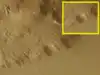
Human-tongue-shaped object found on Mars? ESA discovers horseshoe-shaped channel at Mars’ mountain three times taller than Everest and pinpoints ancient water flow
New images from ESA's Mars Express reveal Olympus Mons' colossal scale and intriguing features. Frozen lava tongues cascade down its slopes, while a horseshoe-shaped channel hints at past lava and water flows. These findings offer a clearer glimpse into the volcanic and hydrological forces that shaped this Martian giant, suggesting a geologically young surface.
NASA's mission to Mars: When can humans reach the red planet?
NASA plans to send humans to Mars by 2035 to explore potential life; the 500-day mission follows a six to seven-month journey. After the Artemis I mission in 2022, Artemis III in 2026 will serve as a precursor, allowing astronauts to gain crucial experience on the Moon's south pole for the extended Mars mission.
- Go To Page 1
Meteorites from Mars help scientists understand the red planet's interior
Of the over 74,000 known meteorites on Earth, only around 385 originate from Mars. Scientists can determine that these meteorites come from Mars through various pieces of evidence, including the unique composition of Mars' atmosphere and its distinct oxygen isotopes.
What do a UP town, a physicist and a Bihar town have in common? Hint: Mars
Lal, Mursan and Hilsa are three craters on the surface of Mars, discovered by Ahmedabad's Physical Research Laboratory (PRL), that could hold proof that there was water on the red planet at some point in the past. The biggest crater of the three - Lal - has been named after the late Professor Devendra Lal, a legendary cosmic ray physicist from Varanasi and the director of PRL between 1972 and 1983.

Uncovering Mars' frosty secrets: How water behaves on the Red Planet
Scientists have discovered frost on Mars' Olympus Mons volcano, indicating a sparse yet active water cycle on the Red Planet. This phenomenon challenges previous assumptions about frost formation near Mars' equator due to its thin atmosphere and intense sunlight. Using data from Mars orbiters, researchers found that frost forms briefly each morning during colder seasons in the Tharsis volcanic region. This finding, involving meticulous analysis spanning five years, suggests a unique water activity cycle on Mars with implications for future exploration missions.

Life, water on Mars? Morning frost detected on red planet. What does this mean?
A significant discovery has been made as early morning frost was found on Mars. The discovery came by chance -- no one expected to find frost in this region.

United Arab Emirates publishes first photo from Mars probe
The picture, taken Wednesday, shows sunlight just coming across the surface of Mars. It shows Mars' north pole, as well as Mars' largest volcano, Olympus Mons.
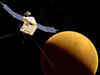
India's Mars Orbiter Mission completes four years in orbit: ISRO
Although the designed mission life of MOM was six months, the satellite has continued to beam back science data from Mars for the past four years.
NASA's InSight will decode how mountains formed on Mars
Washington, Aug 29 (IANS) NASA's InSight spacecraft, that has passed the halfway mark to Mars, carries a unique instrument that will enable scientists to understand what geological processes created the massive mountains on the Martian surface.
Mars oceans formed much earlier than thought: Study
Researchers have linked the existence of oceans in the red planet to the rise of the solar system's largest volcanic system, Tharsis.
Six NASA scientists to emerge from Mars-like habitat
New York, Sep 17 (IANS) Six Nasa scientists, who were living in isolation on a Mars-like habitat in Hawaii since January to determine astronauts' psychology and requirements during manned space missions, will return to civilization on Sunday.

Dinosaurs, Mars volcano went extinct about the same time: NASA
The research reveals that the giant Martian volcano Arsia Mons produced one new lava flow at its summit every one to three million years during the final peak of activity.
Some quirky and interesting facts about Barren Island volcano in Andaman
The tallest volcano in the solar system is on Mars. Olympus Mons is a giant shield volcano that rises to an elevation of 27 km, and it measures 550 km across
Meteorite in Africa offers clues to volcanic activity on Mars
New York, Feb 2 (IANS) Examining a Martian meteorite found in Africa, scientists have uncovered evidence of at least two billion years of volcanic activity on Mars.

2 billion years of volcanic activity on Mars unveiled
The finding confirms that some of the longest-lived volcanoes in the solar system may be found on the red planet.
Liquid water carved deep canyons on Mars
The team found the warming cycles would have lasted long enough, and produced enough water, to create the features.
'Funnel' on Mars could host key ingredients for habitability
Washington, Nov 11 (IANS) A funnel-shaped depression on Mars could be a new place to look for signs of life on the Red Planet, a study says.
Don't miss amazing ultraviolet view of Mars
Washington, Oct 18 (IANS) NASA's MAVEN mission has returned images showing the ultraviolet glow from the Martian atmosphere in unprecedented detail, revealing dynamic, previously invisible behaviour.
NASA's rover discovery ignites curiosity on Mars volcanic history
NASA's Curiosity has been exploring sedimentary rocks within Gale Crater since landing in August 2012.

Volcanoes erupted under ice sheet on ancient Mars
New evidence from NASA's Mars Reconnaissance Orbiter suggests there was extensive ice on ancient Mars, researchers said.

Curiosity spots loads of silica on Mars, bolsters water presence
Adding to the puzzle, some silica at one rock Curiosity drilled, called "Buckskin," is in a mineral named tridymite, rare on Earth and never seen before on Mars.

Want to go to Mars? Well, you can't, but your name can
This is the second time NASA has opened up this type of opportunity, with the organization launching the 'send you name' program.

NASA robot VolcanoBot 2 can explore extraterrestrial volcanoes
Finding preserved and accessible fissures is rare. VolcanoBot 1 was tasked with mapping the pathways of magma from May 5 to 9, 2014.
Ancient rock shows signs of water on Mars
Mars' atmosphere is mostly carbon dioxide but contains some ozone, said Shaheen, who investigated the process of oxygen isotope exchange.

Mangalyaan searching for Earth 2.0! 'Methane discovery' to give alien-seekers heart
Life could exist on exoplanets (planets attached to stars other than our Sun). The Kepler spacecraft identified 3601 unconfirmed planetary candidates.
Load More

