
GAS GIANT EXOPLANET

NASA’s SPHEREx finds brown dwarfs with water and methane, they drift in darkness without a host star and heated entirely from within
NASA's SPHEREx telescope has opened a fascinating window into the realm of brown dwarfs, the enigmatic celestial bodies that sit between stars and planets. Recent data reveals diverse chemical signatures and significant atmospheric variability, challenging existing models. Researchers aim to delve deeper into these findings, seeking to untangle the mysteries surrounding brown dwarfs and their complex atmospheres as they continue their groundbreaking analysis.
For the first time in astronomy, scientists detect radio signal from a young planet
Astronomers have discovered notable radio signals originating from the exoplanet Beta Pictoris b, located 64 light-years away from our solar system. These signals hint at an unexpectedly robust magnetic field surrounding the planet. The MeerKAT radio telescope network in South Africa facilitated this groundbreaking observation, revealing fluctuating intensities and timings of the signals related to the planet's rotation, thereby marking a pivotal step forward in exoplanetary magnetic field studies.

Mysterious radio bursts detected 63 light-years from Earth, well beyond our solar system: What scientists discovered about its source
A newly reported radio signature from Beta Pictoris b is giving astronomers a rare way to investigate the magnetic environment of a planet beyond our solar system. Observations with South Africa’s MeerKAT array identified recurring auroral radio bursts at the planet’s location, rather than its host star. The research also provides the first direct measurement of an exoplanet’s magnetic field strength.
Strange radio signals detected from exoplanet almost 63 light-years from Earth
Researchers have observed unusual radio signals from Beta Pictoris b, an exoplanet located 63 light-years away. These signals, detected using the MeerKAT radio telescope, are associated with auroras produced by the planet's magnetic field. The emission identified as electron cyclotron maser radiation indicates a magnetic field strength of approximately 1.25 kG. This discovery marks the first direct localization of auroral radio activity from an exoplanet.
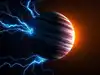
A planet 63 light-years away is sending repeating radio bursts, and scientists can read them for the first time. Here’s what it reveals about the alien world
Astronomers detected repeating radio bursts from exoplanet Beta Pictoris b. These emissions originate from powerful auroras on the distant world. The signals provide a rare direct measurement of the planet's magnetic field. Scientists calculated Beta Pictoris b possesses a magnetic field stronger than Earth's. This discovery offers a new method to study exoplanet magnetic environments.

Astronomers have found a 'baby' planet and named it Elias 2-24 b. The Jupiter-size world is less than 1 million years old
Astronomers have made an exciting discovery with Elias 2-24 b, recognised as the youngest planet identified to date. This gas giant is still enveloped in the material from its formation, indicating it is in a state of growth as it gathers more matter from its surrounding disk. Analysing previous telescope data has allowed scientists to gain valuable insights into the processes behind the formation and evolution of giant planets.
- Go To Page 1

This hellish planet is so hot it has clouds of glass and an atmosphere of vaporized metal
NASA discovers extreme planet: Astronomers are witnessing an alien world's dramatic transformation thanks to the James Webb Space Telescope. HD 80606 b, a gas giant, experiences a staggering 1,100°F temperature surge as it hurtles towards its star.

NASA plans to send a planet hunter to scan the Galaxy for 100,000 new alien worlds
NASA's Nancy Grace Roman Space Telescope is poised to discover approximately 100,000 exoplanets, significantly expanding our understanding of planetary formation. This mission will explore previously uncharted regions of the Milky Way, utilizing transit and microlensing techniques to study diverse planetary systems and potentially reveal if Earth is a cosmic rarity.

On this planet, clouds emerge every morning and disappear by night: James Webb Space Telescope reveals daily cloud cycle on WASP-94A b
On this planet, clouds emerge every morning and disappear by night as astronomers study the giant exoplanet WASP-94A b using the James Webb Space Telescope. Researchers found that mineral clouds form during the morning and disappear by evening. The discovery helped scientists understand the planet’s atmosphere, cloud behavior, and chemical composition while opening a new path for studying weather systems on distant worlds.
Scientists find a solar system that makes no sense: Discover evidence of ‘inside-out’ planet formation
Astronomers found a strange planetary system 116 light-years away. It orbits a red dwarf star called LHS 1903. The planets are arranged in an unexpected order. The outermost planet is rocky, which challenges current planet formation ideas. This discovery could change how we understand planets around common red dwarf stars.

Fastest Jetstream Ever Measured on Exoplanet WASP-127b
Scientists have discovered the fastest atmospheric jet stream on exoplanet WASP-127b. Winds reach nearly 9 kilometers per second. This gas giant is located 520 light-years away. The finding reshapes understanding of exoplanet weather. It shows atmospheric physics can behave in extreme ways. This discovery marks a major step in studying distant worlds.

NASA confirms alien planet count hits 6,000, and the strangest worlds are still ahead
NASA has confirmed the existence of 6,000 exoplanets. This milestone highlights the diversity of planetary systems. Scientists use transit and wobble methods to find these planets. The James Webb Space Telescope studies exoplanet atmospheres. Upcoming missions like the Nancy Grace Roman Space Telescope will search for more worlds. Researchers believe billions of planets exist in the Milky Way.
Astronomers spot mysterious new planet circling Sun — a benchmark discovery for generations
Astronomers have captured the formation of a new gas giant, WISPIT 2b, orbiting a young Sun-like star 430 light-years away in Aquila. Compared to Jupiter but five times more huge, the planet was observed within a multi-ringed protoplanetary disk, spotted using the Very Large Telescope in Chile. Lead researcher Richelle van Capelleveen called it a “spectacular system” and a future benchmark. The rare discovery offers insight into early planet formation, atmospheric development, and the variety of planetary systems beyond the solar system.

Indian researchers discover new exoplanet TOI-6038A b. Here's all about it
Indian researchers have discovered a dense sub-Saturn exoplanet, TOI-6038A b, which is 78.5 times the mass of Earth. This exoplanet orbits a bright, metal-rich F-type star every 5.83 days. The detection, involving PARAS-2 spectrograph, provides valuable insights into planetary formation and evolution, highlighting India's advancements in astronomical instrumentation.

NASA discovers a rare Neptune-sized planet and its bizarre mystery will shock you
Astronomers have just discovered a planet called TOI-3261 b and this rare Neptune-sized planet has a year which lasts just 21 hours. This means it completes its orbit around its star in less than a day, which is quite surprising. TOI-3261 b is part of a group known as ultra-hot Neptunes which consist of large and hot planets that orbit very close to their stars.

James Webb telescope captures a stunning image of Epsilon Indi Ab. Why is it in the news?
A picture of the far-off exoplanet Epsilon Indi Ab, has been taken by the James Webb Space Telescope. One of the coolest exoplanets yet photographed, this planet resembles Jupiter but is warmer and more massive.
International astronomers including IIT Kanpur professor discover 'super-Jupiter' exoplanet orbiting a Sun-like star
An international team, including Dr. Prashant Pathak from IIT-Kanpur, discovered a giant exoplanet, Epsilon Indi Ab (Eps Ind Ab), orbiting a Sun-like star. The exoplanet, six times the mass of Jupiter, is the first mature exoplanet found using direct imaging. The discovery, made with the James Webb Space Telescope, was published in Nature.
Hydrogen Sulfide found outside our solar system for first time. Where has it been discovered and how important is it?
Scientists working with the James Webb Space Telescope have found hydrogen sulfide on an exoplanet known as HD 189733b. It is near Jupiter and about 64 light years from the Earth. It is the first time that this gas has been found outside our solar system.

Astronomers discover heaviest element yet detected in an exoplanet atmosphere
WASP-76 b and WASP-121 b are no ordinary exoplanets. Both are known as ultra-hot Jupiters as they are comparable in size to Jupiter whilst having extremely high surface temperatures soaring above 1000°C. This gives these planets rather exotic features; in WASP-76 b, for example, astronomers suspect it rains iron.
Astronomers find exoplanet with cloud-free atmosphere
London, May 8 (IANS) Astronomers have found that a planet outside our solar system, which is similar to Saturn in mass and exceeds the size of Jupiter by 20 per cent, has an atmosphere free of clouds.

This planet is so dark, scientists have to guess what it looks like
A group of astronomers using NASA’s Kepler Space Telescope have discovered this 'pitch black' planet.
NASA's Kepler discovers nearly 100 new exoplanets
London, Feb 17 (IANS) An international team of scientists have confirmed the discovery of nearly 100 new exoplanets -- planets located outside our solar system.
'100 new planets discovered beyond our solar system'
Mayo and his colleagues analyzed hundreds of signals of potential exoplanets to determine which signals were created by exoplanets and which were caused by other sources.
'Hot Jupiter' with deadly stratosphere stuns scientists
Washington, Nov 30 (IANS) A NASA-led team of scientists has determined that WASP-18b, a "hot Jupiter" located 325 light-years from Earth, has a smothering stratosphere that is loaded with carbon monoxide, or CO, but has no signs of water.

Giant exoplanet with glowing water atmosphere discovered
The atmosphere WASP-121b - a gas giant exoplanet commonly referred to as a "hot Jupiter" - was observed using NASA's Hubble Space Telescope.
Hot exoplanet with glowing water atmosphere found
Washington, Aug 3 (IANS) In a first, scientists have detected glowing water molecules in the atmosphere of a planet outside our solar system, implying that the exoplanet has a strong stratosphere.

Hottest known planet in universe discovered
The ultraviolet radiation from the star it orbits is so brutal that the planet may be evaporating away under the intense glare, producing a glowing gas tail.

'Warm Jupiters' not as lonely as expected: study
The analysis provides strong evidence of the existence of two distinct types of Warm Jupiters, each with their own formation and dynamical history.
Jupiter-like planet discovered 100 light years away; may hold water
It is the first planet detected by the Gemini Planet Imager, or GPI, which was designed to discover and analyse faint, young planets.
Load More

