
DWARF GALAXY
21 years after the discovery of the last dwarf planet, scientists may have found a sixth one beyond Neptune
Vera Rubin Observatory may have identified a new dwarf planet called ED138, hidden beyond Pluto's orbit. Researchers are in the process of assessing ED138's size, a task expected to take several months. This finding is noteworthy as it holds the potential to be recognized as the sixth dwarf planet. Difficulties in locating such remote celestial bodies stemmed from their position in the southern hemisphere.
Astronomers find a ‘ghostly’ star glowing green and another possibly the reddest ever recorded
Astronomers studying 151 stars near Earth found unusual colors in some white dwarfs. One white dwarf appeared green due to its atmospheric composition, while another was identified as the reddest star. The research indicates that a star's color may involve more than just temperature factors. Typically, white dwarfs are white due to their high temperature and density. The findings suggest a diverse range of colors exists among white dwarfs.
Green stars existed only in comics. Now astronomers have found the first real one and the reddest star ever recorded
Astronomers have unveiled an astonishing white dwarf star, WD J1330+6435, that shines with a distinctive green hue. Situated roughly 280 light-years away in the constellation of Draco, its unique coloration stems from sodium that captures multiple light wavelengths due to elevated density. Additionally, a second white dwarf, WD J1011+2845, displaying a rare salmon-pink tint from carbon, illustrates the intriguing diversity and atmospheric intricacies of these celestial bodies.
NASA’s SPHEREx finds brown dwarfs with water and methane, they drift in darkness without a host star and heated entirely from within
NASA's SPHEREx telescope has opened a fascinating window into the realm of brown dwarfs, the enigmatic celestial bodies that sit between stars and planets. Recent data reveals diverse chemical signatures and significant atmospheric variability, challenging existing models. Researchers aim to delve deeper into these findings, seeking to untangle the mysteries surrounding brown dwarfs and their complex atmospheres as they continue their groundbreaking analysis.

Scientists exploring Superhabitable Worlds that could be twice as massive as Earth with more water and a cooler sun
Scientists are exploring superhabitable worlds, which could provide better conditions for life than Earth itself. These planets are believed to orbit stable K-dwarf stars, ensuring a consistent environment for life to flourish. Research suggests that life could develop at an accelerated pace in these optimal settings. Future missions are set to explore these celestial bodies for potential signs of extraterrestrial life.
Strange radio signals detected from exoplanet almost 63 light-years from Earth
Researchers have observed unusual radio signals from Beta Pictoris b, an exoplanet located 63 light-years away. These signals, detected using the MeerKAT radio telescope, are associated with auroras produced by the planet's magnetic field. The emission identified as electron cyclotron maser radiation indicates a magnetic field strength of approximately 1.25 kG. This discovery marks the first direct localization of auroral radio activity from an exoplanet.

Meet Julian Shapiro, the New York student who found 3 unusual dwarf galaxies and won $25,000
Eighteen-year-old Julian Shapiro discovered three isolated dwarf galaxies that lack ongoing star formation, a puzzling combination for astronomers. His research suggests they could be “backsplash” galaxies that once passed near a massive galaxy, lost star-forming gas and moved outward. The work earned Shapiro a $25,000 Davidson Fellows Scholarship.
This strange world has no star to orbit, yet James Webb has revealed its changing weather from 20 light-years away
Webb telescope observed SIMP 0136, a brown dwarf twenty light-years away. Researchers found its changing appearance stems from temperature and cloud structure. These two factors explain most atmospheric variability observed by the telescope. The brown dwarf's atmosphere exhibits three recurring weather states as it rotates. This new method helps study distant worlds with limited direct observation.
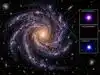
Scientists found 84 strange objects hiding inside six galaxies. Their unusual X-ray emissions could change what we know about the universe
Scientists have discovered 84 unusual “hypersoft X-ray sources” across six galaxies using archival data from NASA’s Chandra X-ray Observatory. The objects produce unusually low-energy X-rays and may emit intense ultraviolet radiation, unlike previously observed X-ray sources. Researchers believe they could be linked to X-ray binary systems and may help investigate the origins of Type Ia supernovae as well as the unexplained ionisation of gas between stars.
Sagittarius existed in real dimensions but over the past approximately 6 billion years, Milky Way has been absorbing dwarf galaxy
Whether the Milky Way's early growth was fueled by homegrown star formation or a galactic merger has been a matter of debate, according to researchers. The new study indicates that the merger infused the Milky Way early in its history with a large volume of stars and interstellar gas that feeds star formation, as well as the mysterious substance called dark matter.
Our Milky Way devoured a galaxy 11.8 billion years ago. Another crash may happen in 4.5 billion years
The Milky Way swallowed a smaller dwarf galaxy about 11.8 billion years ago, marking the earliest known merger in its history. Scientists used Hubble and Gaia observations to trace stars linked to the ancient galaxy, named Low-energy-Kraken-Heracles. The Milky Way later absorbed other galaxies and may collide with Andromeda in about 4.5 billion years.

Astronomers reveal hidden black holes, not dark matter, as the glue of the Milky Way’s faintest satellite
Ursa Major III, once considered a dark-matter-dominated dwarf galaxy, may actually be a dense star cluster. New research suggests its gravity is maintained by a core of black holes and neutron stars, not dark matter. Gravitational interactions with the Milky Way stripped away outer stars, leaving a compact core that mimics a dark-matter-dominated dwarf galaxy.

James Webb Space Telescope (JWST) reveals stunning image of Leo P galaxy, a rare dwarf galaxy defying scientific expectations with unexpected star formation
The Leo P Galaxy has shocked scientists with new findings from the James Webb Space Telescope (JWST). Located 5.3 million light-years away, this tiny, irregular dwarf galaxy was thought to have stopped forming stars billions of years ago. However, JWST’s stunning observations revealed that Leo P has unexpectedly reignited star formation, challenging previous beliefs about isolated galaxies.
How supermassive black holes prevent star formation
London, Jan 10 (IANS) Scientists have found evidence that supermassive black holes prevent formation of stars in some smaller galaxies, in what they believe decodes a cosmic mystery.
Breakthrough detects 15 radio bursts from dwarf galaxy; might be from ‘alien’ spacecraft
15 radio bursts coming from a dwarf galaxy about 3 million light years away from earth have been detected by Breakthrough Listen, a global astronomical initiative.
Mysterious radio signal traced to distant dwarf galaxy
Washington, Jan 5 (IANS) In a first, astronomers, including one of Indian-origin, have traced the source of a mysterious radio signal to a dwarf galaxy more than three billion light years from Earth.
Dark matter satellites trigger massive birth of stars
These star forming episodes may last for several billions of years, depending on the mass, orbit and concentration of the dark satellite, researchers said.
Scientists develop new method to hunt dark matter
An international team of scientists has discovered a new method that may help in detecting dwarf galaxies dominated by dark matter.

New dwarf galaxy signals presence of dark matter
The exact source of this high-energy light is uncertain at this point but it just might be a signal of dark matter lurking at the galaxy's centre.
Load More


