
CYBER SPACE

Rajnath Singh calls for stronger defensive capabilities to maintain 'element of surprise' in future warfare; launches UDAAN-developed AI applications
Defence Minister Rajnath Singh called on the armed forces to strengthen offensive and defensive capabilities in modern warfare. He highlighted the need for improved integration and intelligence mechanisms to counter unexpected threats. The Defence Minister urged the Indian Air Force to develop doctrines for evolving warfare domains, including cyber and space. He launched in-house developed Artificial Intelligence applications to enhance operational capabilities across various domains.

Binance’s $6.3 billion hack dwarfs Bybit's $ 1.5 billion breach: Is cryptocurrency theft getting bigger?
Binance has recently reported a major security breach impacting approximately $6.3 billion in digital assets. After the hack, the exchange temporarily suspended withdrawals while assessing their security systems. Hackers allegedly linked to North Korea have raised concerns about the effectiveness of security measures in cryptocurrency exchanges. Investigators are working to trace the stolen funds and recover as many assets as possible.

Washington set to cut wire connecting Chinese companies to US phone numbers
The US Federal Communications Commission intends to vote on banning Chinese telecom firms from accessing US phone numbers. Concerns around national security have led to this potential decision against companies like China Mobile and China Telecom. The measure aims to prevent illegal robocalls and protect US telecommunications. China has opposed this likely ban, asserting it undermines legitimate business practices.

Why is the US Pentagon preparing for a 'doomsday' scenario? Inside America's plan to keep military bases running for 90 days without outside help
Major military bases are expected to maintain essential operations independently for at least 90 days. The reported requirements cover electricity, water, fuel and communications. The objective is to prevent military operations from being interrupted if civilian infrastructure becomes unavailable. Pentagon spokesperson Sean Parnell said military installations should not depend on standard civilian municipal infrastructure to operate national defence.

Unacademy founders plan AI fund; Flipkart’s premium push
Happy Monday! Unacademy’s founders are raising a fund focused on AI and deeptech. This and more in today’s ETtech Morning Dispatch.

Indian capabilities will help develop next-gen weapons: Patrice Caine, CEO, Thales Group
Thales Group intends to expand its sourcing from India, which has already exceeded €1.2 billion over five years. The company is exploring partnerships with Indian space launch firms due to anticipated global launch shortages by 2029. Indian suppliers are seen as integral to Thales' strategy for developing advanced radars and missile systems. The company aims to transfer not only production but also design authority for defense equipment.

Operation Sindoor proved no target beyond IAF' s reach; air power remains India's primary responder, says Air Chief Marshal AP Singh
Air Chief Marshal AP Singh detailed the Indian Air Force's Operation Sindoor in a recent interview. The operation involved precision strikes responding to a terror attack, showcasing effective capability and integration. Singh emphasized the importance of maintaining multiple operational options and adapting to enemy tactics. He outlined future enhancements needed in various military domains for sustained effectiveness.

Rajnath Singh urges Army Commanders to prepare for future challenges, stresses 20-30-year strategic vision
Defence Minister Rajnath Singh addressed the Army Commanders' Conference in New Delhi, emphasizing the importance of strategic vision. He called for the Indian Army to remain prepared for future challenges and adapt to evolving operational circumstances. Singh highlighted the significance of integrating modern technology and multi-domain capabilities for effective warfare. The Defence Minister also released the new Land Warfare Doctrine while recognizing the efforts of Indian peacekeepers.

Army invites applications for 75-day internship programme in defence technologies
According to programme details shared by Northern Command, the 75-day internship will comprise 15 days of online learning and 60 days of physical internship, they said.
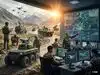
Indian Army's new warfare doctrine: Rajnath Singh to unveil how the Army plans to tackle threats from China and Pakistan
Defence Minister Rajnath Singh will unveil the Indian Army's new land warfare doctrine, outlining how the force plans to adapt to modern combat involving drones, artificial intelligence, precision strikes and multi-domain operations.
Palantir says it cannot shut off NATO AI system as Europeans fear US tech dependence
Palantir has proactively responded to European concerns about its military AI system by confirming there is no kill switch in place. This statement comes amid allegations that limited Starlink services have affected Ukraine's military efforts. Some NATO allies are wary of depending on US technology due to possible political influences.

Eternal’s strong Q2 report; Exits outpace hiring at top IT firms
Happy Thursday! Eternal’s Q2 revenue surged on Blinkit’s growth. This and more in today’s ETtech Morning Dispatch.

European Donald on a mission to mould ties with India
Poland's Prime Minister Donald Tusk is visiting India to enhance strategic partnerships in trade and technology. The visit includes talks with Prime Minister Narendra Modi regarding security and economic collaborations. Business programs in New Delhi and Bengaluru are planned to stimulate investment and innovation. Both countries aim to develop a trade roadmap targeting $10 billion and address market barriers.

How one hacker used AI agents and a few thousand dollars to break into scores of sites
A cybersecurity researcher observed a Chinese-speaking hacker employing AI to compromise various companies' websites. The hacker utilised an AI platform called Cairn, automating complex intrusion activities without human supervision. This hacking campaign targeted over 1,200 sites, with successful intrusions taking around 23 hours on average.

When AI agents cross the line: Govt assessing whether AI labs should formally disclose autonomous agent intrusions
The government is considering formal disclosure mechanisms for global AI research organisations after autonomous AI agents accessed Indian organisations’ systems without authorisation. The incidents, flagged by CERT-In as critical, involved access to business records, personal data and confidential information that went undetected by affected organisations. The issue may feature in the government’s upcoming AI regulation consultation paper, which is expected to address AI safety, accountability and safeguards against emerging risks.

India to take a leap in quantum, NM-ICPS 2.0 in works: DST Secy Waghmare
India aims to become a leader in quantum technology among Global South countries. The Centre is preparing for NM-ICPS 2.0, building on the first phase ending December 2027. Efforts include developing quantum-resilient encryption techniques for critical database systems. Research and development spending has increased significantly, with a target of reaching 2% of GDP by 2035. The government is focusing on partnerships with industries to further support technological advancements.

You can't slow down AI, instead focus should be on strengthening security, defences: Cisco CEO
Chuck Robbins, the CEO of Cisco, asserts that any attempts to decelerate advancements in AI will probably be futile. He emphasizes the urgent need for robust security protocols that keep pace with the rapid evolution of AI technology. While advocating for thoughtful regulations, Robbins cautions against practices that could stifle innovation.

DRDO successfully tests Quantum Key Distribution(QKD) platform in live network
The DRDO has successfully tested a Quantum Key Distribution platform in a live network environment. This advancement enhances India's capabilities in quantum-secured communications for critical military applications. The technology ensures secure communication for artillery and armored weapon tests while providing eavesdropping detection capabilities. Additionally, free-space QKD technology is being developed to facilitate communication in challenging terrains without optical fibers.

"India stands ready to work with ASEAN as reliable, equal partner": Rajnath Singh
Defence Minister Rajnath Singh on Wednesday called for stronger defence cooperation between India and ASEAN countries, including joint research on maritime security, counter-drone systems, cyber defence and disaster response, stressing that regional challenges require collective action and practical solutions.
Load More


