
BLACK HOLES GRAVITY
Is Sabrina Pasterski the next Einstein? Meet the physicist who built her own aircraft at 12 and is exploring Einstein’s biggest unanswered questions about gravity
Sabrina Pasterski's journey from building an aircraft as a teenager to studying Einstein's biggest unanswered questions has drawn attention to her work in physics. The MIT graduate now researches quantum gravity, black holes and space-time at Canada's Perimeter Institute. She also leads an $8 million research initiative exploring how gravity and quantum mechanics could fit together.

SSC JE 2026 exam city intimation slip released at ssc.gov.in: Direct link to check exam city, admit card date & October 27 deadline
SSC JE 2026 exam city intimation slip: The Staff Selection Commission (SSC) has released the exam city intimation details for Junior Engineer (JE) 2026 Paper 1 at ssc.gov.in. The examination is scheduled for November 2 to 6, while the admit card is expected two to three days before each candidate's exam. Candidates using their own scribe or seeking eligible subject preference changes must complete the required process by October 27, 2026.

Lulu Group loses Rs 1.64 crore in email fraud: How impersonators used Italian company’s identity to cheat retail giant
Lulu Group email fraud: Kochi City Police have registered a case and launched an investigation into an alleged email impersonation fraud in which unidentified persons posing as representatives of an Italian company cheated Lulu Group of around Rs 1.64 crore. According to the FIR, the fraudsters sent fake invoices and bank details for gaming equipment payments, prompting the group to transfer 150,500 euros to accounts provided by them.

He is first Indian scientist to win Oskar Klein Medal: Meet physicist Ashoke Sen, who found new ways to understand black holes, gravity & string theory
Indian physicist Ashoke Sen has become the first Indian to receive the 2026 Oskar Klein Medal for his pioneering contributions to string theory, black-hole physics and quantum gravity. The ICTS-TIFR professor delivered the memorial lecture, ‘Gravity from strings and strings from gravity’, in Stockholm on October 22. Sen has also received the Padma Shri, Padma Bhushan and the 2012 Breakthrough Prize in Fundamental Physics.
Fastest known star races around Milky Way’s black hole at 15,900 miles per second; how its orbit could reveal cosmic secrets
The discovery of the star S301 near Sagittarius A* offers unique insights into black hole properties. S301 travels at remarkable speeds, completing an orbit in just 8.7 years. Its proximity allows researchers to study the effects of black hole spin on space-time. Astronomers anticipate further observations to enhance understanding of these phenomena. S301 serves as a natural laboratory for examining gravity under extreme conditions around supermassive black holes.
Now you have a safe flight, dear reader: We live in turbulent times - if it's just turbulence, thank your lucky stars
A humorous yet unsettling take on the anxieties of air travel. A passenger’s brief attempt to learn how to fly a plane and then the chilling survival story depicted in the film Odna. Reflecting on a real-life mid-air collision, a frightening personal flight experience and Stephen King’s thoughts on flying.
- Go To Page 1
The strange 2% rule: Why black holes suddenly switch on their powerful jets
A new study reveals black holes become predictable when feeding. Jets emerge when accretion rates fall to two percent of the Eddington limit. This threshold applies to black holes of vastly different sizes. Tidal disruption events offer a rare view of this process. Future observations may predict when these powerful jets will appear.
A black hole destroys a star, then fires off a powerful jet years later — scientists discover the 'burping' feeding pattern behind these cosmic outbursts
Scientists have found a new trend in black hole feeding patterns. Powerful jets emerge during two distinct phases of a black hole's feeding process. These jets appear during heavy feeding and later when feeding slows significantly. This discovery helps explain jet appearances long after a star's destruction. The findings may aid astronomers in planning future radio observations more efficiently.

Quote of the day by Stephen Hawking:"We are just an advanced breed of monkeys on a minor planet of a very average star."
Stephen Hawking posited that humanity's uniqueness lies in our capacity to grasp the universe's complexities. He believed this insight evolved from our humble beginnings and evolutionary journey. His groundbreaking research on black holes and cosmology revolutionized theoretical physics, while his iconic book, A Brief History of Time, simplified intricate scientific concepts for a global audience. Overcoming physical limitations, Hawking became a celebrated science communicator and cultural symbol.

Quote of the day by Stephen Hawking: 'What I have learned from life is to make the most of what you have got.' Life lessons from inspirational quote on resilience, limits, acceptance, complaints, obstacles, strengths and resources
Quote of the day by Stephen Hawking, “What I have learned from life is to make the most of what you have got,” explains how people can respond to limits and obstacles. The quote focuses on acceptance, resilience, strengths, available resources and action. Hawking’s life and work provide context for understanding how this approach can shape everyday decisions.
What’s really hiding around Einstein’s black holes? Scientists find a new gravitational wave clue, a ringing sound that could expose their mysterious ‘hair’
Scientists are exploring subtle changes in black hole ringdown signals. These gravitational wave echoes could reveal surrounding matter or new physics. Subtle mismatches in frequency and damping may indicate hidden structures. Spinning black holes offer additional directional clues for detection. Future observations could test gravity in extreme cosmic environments.
Science says black holes don’t actually suck everything around them: Here’s what really happens
Black Holes are called black because light cannot escape from inside their event horizons. Astronomers nevertheless detect black holes indirectly through their effects on nearby matter, gravitational lensing, stellar orbits and radiation from accretion disks.

Quote of the day by Stephen Hawking: 'We are very, very small, but...' Life lessons from inspirational quote on cosmic humility, human potential, inner strength and resilience
Quote of the day by Stephen Hawking focuses on the difference between the small place humans occupy in the universe and what the human mind can achieve. The quote explains cosmic humility, human potential, inner strength and resilience. It also reflects Hawking’s work in physics and his ability to continue working despite physical limitations.
Researchers finally found evidence from a region in Space where nothing is supposed to escape
A historic black hole discovery is changing how scientists explore the universe. Researchers have detected possible fingerprints of a black hole event horizon through gravitational waves, giving humanity a closer look at the mysterious edge where gravity dominates everything. The breakthrough from black hole merger data opens a new chapter in space science, testing Einstein’s theory and helping experts understand spacetime, cosmic collisions, and the hidden physics of the universe.
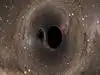
For the first time, researchers reached a region near a Black Hole once beyond study
A powerful black hole collision has opened a new chapter in space science. Scientists used the loudest gravitational wave signal ever detected to study the hidden region near an event horizon. This breakthrough helps researchers understand extreme gravity, black hole mergers, spacetime, and Einstein’s theory of relativity. The discovery gives astronomers a rare chance to explore how black holes behave at the edge of the unknown.
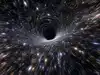
What Would You Actually See If You Fell Toward a Black Hole?
Falling into a black hole presents a bizarre cosmic experience. From afar, an observer sees time slow and light redshift. Inside, spacetime warps, creating visual distortions and potentially spaghettification depending on the black hole's size. While the event horizon is crossed without fanfare, the singularity's physics remains a mystery, pushing the boundaries of our understanding.
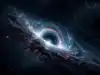
What Happens to Time at the Edge of a Black Hole?
Near black holes, gravity warps spacetime, causing time to slow dramatically for distant observers. An object falling in appears to freeze at the event horizon, its light redshifted. However, a falling observer experiences time normally, crossing the horizon in their own finite time. This phenomenon, gravitational time dilation, is supported by astronomical observations.
Scientists capture images of two black holes orbiting each other 5 billion lightyears away for the first time
Scientists have captured the first radio image of two supermassive black holes orbiting each other. This event occurred inside a quasar named OJ287, located billions of light-years away. The image validates a long-held prediction about these celestial bodies. The black holes were detected through particle jets and glowing gas. This groundbreaking observation confirms the existence of orbiting black hole pairs.

Supermassive black hole “ate” a star, are we next? Here’s what NASA found out
In a cosmic first, astronomers observed a supermassive black hole consuming a star. This happened outside the core of its host galaxy. The event, named AT2024tvd, occurred 600 million light-years away. Zwicky Transient Facility spotted it. NASA's Hubble and Chandra telescopes confirmed it. The black hole, a million times the Sun's mass, tore the star apart.

Scientists discover mysterious black hole roaming alone in the Milky Way. Here's why it is so surprising
Astronomers have detected a lone black hole drifting through the Milky Way—an unprecedented discovery made possible by gravitational lensing. Weighing seven times the Sun, it bends light from background stars without emitting any itself. This “invisible” giant, likely formed from a lopsided supernova, offers new hope for uncovering more hidden black holes across the galaxy.
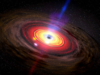
What will happen if astronaut falls into black hole? NASA finds answer. Watch video of simulation it made
NASA simulated two different scenarios, one where a camera, a stand-in for a daring astronaut misses the event horizon and slingshots back out. In another scenario, an astronaut crosses the boundary.
Everything, including black holes, will eventually evaporate: Study
Researchers at Radboud University have found new particles can be created far beyond the event horizon of black holes. The Michael Wondrak, Walter van Suijlekom, and Heino Falcke study combined techniques from physics, astronomy and mathematics to examine what happens when particle pairs are created in a black hole's surroundings.
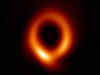
AI makes supermassive black hole’s first-ever photo sharper. See details
Scientists have used artificial intelligence to make the first-ever picture of a supermassive black hole, also known as ‘Orange Donut’, appear sharper.
ESA’s Gaia mission discovers 2 closest-ever black holes to earth; Details here
Scientists have discovered the closest black hole, BH1, to Earth in our cosmic backyard using the Gaia satellite. This discovery is significant because it allows scientists to study black holes in detail and learn more about their properties and behaviour.
Curious Kids: Can black holes become white holes?
White holes are really just something scientists have imagined - they could exist, but we've never seen one, or even seen clues that one may exist. For now, they are an idea.
Black hole devouring star for a decade detected
Washington, Feb 7 (IANS) Astronomers have detected a giant black hole that ripped apart a star and then gorged on its remains for an unusually long time -- about a decade, which is more than ten times longer than any observed episode of a stars death by black hole.
Are black holes 'back doors' to other parts of universe?
One of the biggest problems when studying black holes is that the laws of physics as we know them cease to apply in their deepest regions.
Second largest black hole detected in Milky Way
The team found this mysterious feature with two radio telescopes, the Nobeyama 45m Radio Telescope in Japan and the ASTE Telescope in Chile.

Here are three ways the universe might end
Dark energy is invisible, but based on how fast everything is expanding, scientists think it exists everywhere in space and could make up almost 70% of the universe.
Load More

