



Listen to this article in summarized format
×
Subscribe to

Unlock AI Briefing and Premium Content
New Year Offer 24 Hours Left
Subscribe NowAlready a member? Sign In
What's Included
- Exclusive Stories
- Daily ePaper Access
- Smart Market Tools
- Curated Investment Ideas
- Ad-lite Experience
Subscription

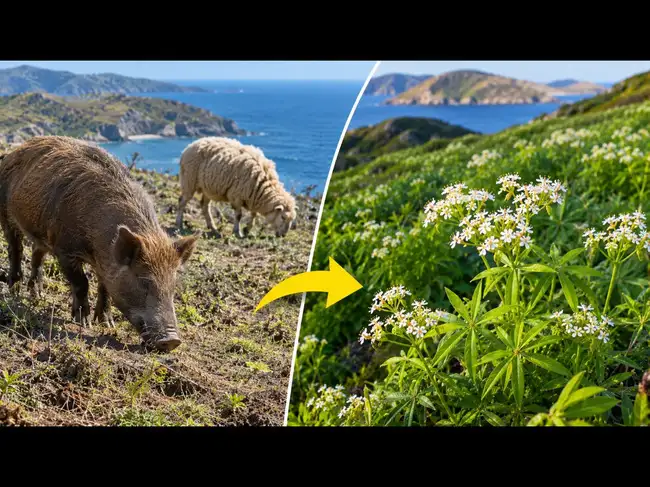
Scientists removed pigs and sheep from two islands. What happened to the plants surprised them (AI Image)
Plants require minimal resources to flourish, environmental change can cause difficulties for even long-standing species. This was also true for two California offshore islands.
In 1997, experts were concerned that a rare species of plant, island bedstraw, was in decline. There was thought to be just a few hundred plants left. Plants were having difficulty thriving within environments affected by non-native animals.
Conservationists therefore worked to eradicate these non-native species so that plants could then regenerate. Several years later, helicopter surveys of the islands showed that there were now thought to be over 15,000 island bedstraw plants growing there.
As a result of this regeneration, in 2023 the U.S. Fish and Wildlife Service delisted the species from its list of endangered plants.
Typically, island bedstraw will thrive on rocky outcrops and/or on sloping seaside areas. However for many years, the environment in which it lives has suffered as a result of invasive animal species.
As well as eating plant matter, sheep would walk over land and wild pigs would root around in the earth in search of food.
Gradually, this negatively impacted upon the environment in which indigenous plants could flourish.
Experts recognised that in order to conserve island bedstraw, it would be necessary to also resolve the issues impacting upon its environment.
They therefore commenced work to eliminate invasive species. Sheep were successfully eradicated from both islands by 2000. Then, conservationists continued to target feral pigs on Santa Cruz Island. Finally, all pigs were eradicated by 2006.
With no ongoing over-grazing and no continual uprooting of earth, indigenous plant life was able to regenerate more effectively. Again, this did not occur overnight.
As previously, certain regions had been adversely affecting the environment for many years. It therefore required time for the earth to become more solid. As the environment began to improve, so too did the number of sites at which island bedstraw could be found.
Helicopter surveys of Santa Cruz Island (undertaken in 2015) and San Miguel Island (carried out in 2017) enabled scientists to determine that the plant population was in fact far greater than had previously been recorded.
The species was listed as being made up of around 515-603 plants, it is now thought that there are in fact a minimum of 15,730 individual plants, according to the U.S. Fish and Wildlife Service.
It was learnt that the species can be found in more locations than had previously been thought.
Although figures were still approximate and were generated from surveys, enhanced surveying facilitated further knowledge regarding where the species is present.
News of this was given on November 6, 2023. The final delisting rule was published the subsequent day and came into force on December 7.
At the same time, another rare species, Santa Cruz Island dudleya, was also delisted. It is thought that this consists of around 120,000 individuals.
This was a key moment not just for Santa Cruz Island but for the Channel Islands as a whole. Alongside plants, conservation has assisted in the regeneration of various other endangered animals within this region.
Additionally, climate change is a continuing area of concern. Future alterations to plant life may also influence the environment in which island bedstraw lives.
Consequently, federal bodies have developed monitoring schemes to ensure that regenerated populations are continuing to be maintained. Overall, this case study demonstrates that in some instances, conservation does not necessitate the introduction of tens of thousands of members of a species.
Rather, it can involve firstly eliminating factors which have impeded a species’ natural growth. Successfully, this has been implemented on California’s Channel Islands to facilitate the re-emergence of a rare plant species from near-extinction.
In 1997, experts were concerned that a rare species of plant, island bedstraw, was in decline. There was thought to be just a few hundred plants left. Plants were having difficulty thriving within environments affected by non-native animals.
Conservationists therefore worked to eradicate these non-native species so that plants could then regenerate. Several years later, helicopter surveys of the islands showed that there were now thought to be over 15,000 island bedstraw plants growing there.
As a result of this regeneration, in 2023 the U.S. Fish and Wildlife Service delisted the species from its list of endangered plants.


Why were island bedstraw plants declining?
Island bedstraw (Galium buxifolium) is a small, bushy plant which bears miniscule flowers. Naturally, it can be found on Santa Cruz Island and San Miguel Island which are part of California’s Channel Islands. Nowhere else on our planet can this species be found.Typically, island bedstraw will thrive on rocky outcrops and/or on sloping seaside areas. However for many years, the environment in which it lives has suffered as a result of invasive animal species.
As well as eating plant matter, sheep would walk over land and wild pigs would root around in the earth in search of food.
Gradually, this negatively impacted upon the environment in which indigenous plants could flourish.
By 1997, the decline in island bedstraw was so great that the U.S. Fish and Wildlife Service listed it as an endangered species. So how did eradicating pigs and sheep assist the regeneration of island bedstraw?
Experts recognised that in order to conserve island bedstraw, it would be necessary to also resolve the issues impacting upon its environment.
They therefore commenced work to eliminate invasive species. Sheep were successfully eradicated from both islands by 2000. Then, conservationists continued to target feral pigs on Santa Cruz Island. Finally, all pigs were eradicated by 2006.
With no ongoing over-grazing and no continual uprooting of earth, indigenous plant life was able to regenerate more effectively. Again, this did not occur overnight.
As previously, certain regions had been adversely affecting the environment for many years. It therefore required time for the earth to become more solid. As the environment began to improve, so too did the number of sites at which island bedstraw could be found.
What did scientists find from helicopter surveys?
Experts wished to ascertain how many plants had survived. Unfortunately, island bedstraw frequently flourishes on inaccessible, cliff-like terrain. Thus, helicopters were utilised to investigate parts of the environment which could not readily be analysed on foot.Helicopter surveys of Santa Cruz Island (undertaken in 2015) and San Miguel Island (carried out in 2017) enabled scientists to determine that the plant population was in fact far greater than had previously been recorded.
The species was listed as being made up of around 515-603 plants, it is now thought that there are in fact a minimum of 15,730 individual plants, according to the U.S. Fish and Wildlife Service.
It was learnt that the species can be found in more locations than had previously been thought.
Although figures were still approximate and were generated from surveys, enhanced surveying facilitated further knowledge regarding where the species is present.
Why was island bedstraw delisted?
Federal wildlife bodies felt that by 2023, the species had regrown sufficiently so that it no longer required the same extent of legal conservation safeguards.News of this was given on November 6, 2023. The final delisting rule was published the subsequent day and came into force on December 7.
At the same time, another rare species, Santa Cruz Island dudleya, was also delisted. It is thought that this consists of around 120,000 individuals.
This was a key moment not just for Santa Cruz Island but for the Channel Islands as a whole. Alongside plants, conservation has assisted in the regeneration of various other endangered animals within this region.
Does this guarantee the safety of island bedstraw?
Unfortunately not fully. Although the species is no longer deemed to be endangered, its continued existence still relies upon the conservation of the islands upon which it is present.Additionally, climate change is a continuing area of concern. Future alterations to plant life may also influence the environment in which island bedstraw lives.
Consequently, federal bodies have developed monitoring schemes to ensure that regenerated populations are continuing to be maintained. Overall, this case study demonstrates that in some instances, conservation does not necessitate the introduction of tens of thousands of members of a species.
Rather, it can involve firstly eliminating factors which have impeded a species’ natural growth. Successfully, this has been implemented on California’s Channel Islands to facilitate the re-emergence of a rare plant species from near-extinction.
Add  as a Reliable and Trusted News Source
 Add Now!