


Listen to this article in summarized format
×
Subscribe to

Unlock AI Briefing and Premium Content
New Year Offer 24 Hours Left
Subscribe NowAlready a member? Sign In
What's Included
- Exclusive Stories
- Daily ePaper Access
- Smart Market Tools
- Curated Investment Ideas
- Ad-lite Experience
Subscription

 IANS
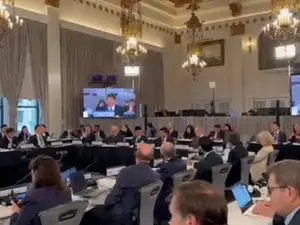
IANSWashington: The US G20 presidency is "severely disappointed" that some members rejected a statement this week for action against excess industrial capacity, a criticism commonly aimed at China, according to a statement made public Friday.
The United States holds the rotating presidency of the Group of 20 major economies this year, a grouping that also includes China, India, France, Germany and Japan.
But trade ministers failed to reach agreements on countering overcapacity and forced labor after two days of talks in Milwaukee.
Read more: G20 trade ministers deadlock on excess capacity, forced labour as US seeks tougher rules
A draft ministerial statement against excess capacity, seen as driving costs down unfairly, "was supported by all but a handful of members," said top US trade official Jamieson Greer.
This had called on all countries to move to eliminate structural excess capacity in their economies, among other actions.
Greer's chair statement, made public Friday, did not specify which countries disagreed.
But China in September objected to wording in a finance ministers' statement calling for members to "eliminate non-market policies."
Read more: Greer urges G20 to back Trump tariff agenda, takes aim at China
Asked about the topic on the sidelines of G20 talks, China's international trade representative Li Chenggang would only say that parties expressed their respective opinions.
G20 members similarly did not reach a common position on eliminating forced labor from supply chains. Only Mexico and Argentina joined the United States to issue a statement.
Earlier this year, Washington cited concerns over forced labor to slap sweeping tariffs on dozens of economies, including G20 members.
But G20 trade ministers "agreed that trade in food and agricultural products should not be used as a tool for economic or political coercion," Greer's statement said.
(You can now subscribe to our Economic Times WhatsApp channel)
The United States holds the rotating presidency of the Group of 20 major economies this year, a grouping that also includes China, India, France, Germany and Japan.
But trade ministers failed to reach agreements on countering overcapacity and forced labor after two days of talks in Milwaukee.
Read more: G20 trade ministers deadlock on excess capacity, forced labour as US seeks tougher rules
A draft ministerial statement against excess capacity, seen as driving costs down unfairly, "was supported by all but a handful of members," said top US trade official Jamieson Greer.

This had called on all countries to move to eliminate structural excess capacity in their economies, among other actions.
Greer's chair statement, made public Friday, did not specify which countries disagreed.
But China in September objected to wording in a finance ministers' statement calling for members to "eliminate non-market policies."
Read more: Greer urges G20 to back Trump tariff agenda, takes aim at China
Asked about the topic on the sidelines of G20 talks, China's international trade representative Li Chenggang would only say that parties expressed their respective opinions.
G20 members similarly did not reach a common position on eliminating forced labor from supply chains. Only Mexico and Argentina joined the United States to issue a statement.
Earlier this year, Washington cited concerns over forced labor to slap sweeping tariffs on dozens of economies, including G20 members.
But G20 trade ministers "agreed that trade in food and agricultural products should not be used as a tool for economic or political coercion," Greer's statement said.
Add  as a Reliable and Trusted News Source
as a Reliable and Trusted News Source Add Now!
(You can now subscribe to our Economic Times WhatsApp channel)