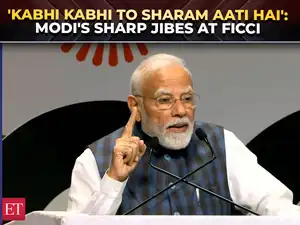
Prime Minister Narendra Modi addressed corporate India at FICCI’s convention, urging better response to government initiatives. He criticized industry for insufficient investment, despite tax cuts intended to stimulate growth. Modi emphasized the need for companies to enhance production and hire staff following these concessions. The speech highlighted that lower corporate taxes have not automatically translated into increased salaries or jobs.
'Mera deshwaasi quality ka haqdaar hai': PM Modi's sharp dig at corporate bigwigs | FICCI 100 yrs
Prime Minister Narendra Modi's recent message to corporate India at FICCI's centenary convention was unusually blunt. He pointed out the government has reduced corporate taxes, put more money in consumers' hands and opened foreign markets through trade agreements, but industry has not responded with commensurate investment, employment or better products.
Modi's sharpest criticism was reserved for the corporate tax cut, a major concession that was supposed to encourage companies to invest, expand capacity and create jobs and raise salaries. Seven years after the landmark 2019 reduction, the question of whether that expectation has been fulfilled remains relevant.
Modi's speech was essentially an attempt to make India Inc account for what it has done with the policy support it received.
The corporate tax cut: A promise dating back to 2015
The roots of Modi's complaint go back to the first full Union Budget of the NDA government in 2015. Finance Minister Arun Jaitley announced a phased reduction in the basic corporate tax rate from 30% to 25% over four years. The government wanted to make India more attractive for investment at a time when its headline tax rate was considerably higher than those in several competing Asian economies.
Live Events
Industry had been asking for lower corporate taxes for years. Its argument was that high effective tax rates, numerous exemptions and complicated provisions made Indian manufacturing less competitive. A lower rate would improve post-tax returns, leave companies with more money for expansion and encourage fresh investment. The government, meanwhile, wanted to remove exemptions and broaden the tax base rather than continue with a high-rate, exemption-heavy regime.
The first relief came in 2016, when companies with annual turnover not exceeding Rs 5 crore were offered a 25% to 29% rate, plus applicable cess and surcharge. In 2017, the 25% rate was extended to companies with turnover up to Rs 50 crore. Jaitley widened the benefit further in 2018, covering companies with turnover up to Rs 250 crore. The government said this would benefit 99% of companies filing tax returns. Jaitley described it as fulfilment of his commitment to reduce corporate taxes in a phased manner.
But the biggest beneficiaries of the original 30% rate, the large companies, were still waiting. Industry's demands for a broader reduction had not gone away. The slowdown in economic activity and the need to revive private investment made the case more urgent in 2019.
ET Online
September 2019: The big concession to large industry
On September 20, 2019, Finance Minister Nirmala Sitharaman announced a dramatic reduction in corporate tax rates through an ordinance. Domestic companies could opt for a 22% basic rate instead of 30%, provided they gave up specified exemptions and incentives. The effective tax rate under the new regime worked out to 25.17%, including surcharge and cess. New domestic manufacturing companies commencing production within the stipulated period were offered an even lower 15% basic rate.
The estimated revenue sacrifice was around Rs 1.45 lakh crore annually, approximately $20.5 billion at the time. The announcement was intended to revive investment when India's economic growth had fallen to a six-year low. Manufacturing was struggling and unemployment was becoming a major political and economic concern. The government wanted to attract manufacturers competing with countries such as Vietnam, particularly as companies began exploring alternatives to China.
The expectation was that lower taxes would improve corporate profitability and cash flows. Companies would use the additional money to expand factories, invest in machinery, undertake research and development and hire more workers and also eventually pay them more. The move was also intended to attract fresh foreign investment.
But the investment response was considerably slower than anticipated. This is the central issue behind Modi's latest remarks.
ET Online
Why private capex remained disappointing
The government repeatedly urged India Inc to take the investment baton from the public sector. Sitharaman made this appeal frequently, particularly as the Centre sharply increased infrastructure expenditure to create demand for steel, cement, machinery and other industrial products. The argument was that government investment in roads, railways, ports and other infrastructure would generate business opportunities and encourage private companies to invest in additional capacity.
But companies remained cautious. The reasons were not entirely a lack of willingness to invest. Weak consumption, uncertainty over future demand, excess capacity in several industries and relatively high borrowing costs made fresh investments risky. The experience of the previous investment cycle had also left companies wary of taking on debt.
An RBI study examining corporate investment found that weak demand, leverage and cash flows influenced investment decisions. Its analysis of 2019-20 also found that despite the corporate tax reduction, muted demand meant companies were not directing additional borrowings towards capital expenditure. The pandemic subsequently made matters worse.
The Economic Survey 2022-23 acknowledged that the investment revival expected after the 2019 tax cuts was delayed by the pandemic. More recently, the IMF too observed that private corporate investment remained sluggish compared with historical averages. Private investment in machinery and equipment was just 4.3% of GDP in 2022-23, against an average of 5.9% between 2011-12 and 2015-16. This is particularly significant because investment in machinery creates the productive capacity needed for manufacturing expansion.
There was another complication. Corporate India had spent years repairing balance sheets and reducing debt. Many companies preferred to use improved cash flows to strengthen their finances, repay borrowings or acquire financial assets rather than immediately build new factories.
Sitharaman's frustration was therefore understandable. The government had made capital cheaper through tax concessions and was spending heavily on infrastructure. But private industry was not responding at the desired pace.
There are, however, signs of a change now. Private investment is beginning to emerge as a stronger growth driver. India's investment rose 11.9% in the April-June quarter, while gross fixed capital formation increased to 34.3% of GDP from 31.4% a year earlier. Stronger capacity utilisation, healthier corporate balance sheets and government infrastructure spending have helped revive the investment cycle. The RBI's September 2026 assessment also found that the cost of projects sanctioned by banks and financial institutions rose to Rs 4.4 lakh crore in 2025-26 from Rs 3.7 lakh crore a year earlier.
The revival is welcome, but it also underlines PM Modi's point that the response has taken considerably longer than the government expected.
Income tax relief, GST and faster refunds: The demand-side argument
Modi's reference to personal income tax relief concerns the Budget presented in February 2025. Sitharaman announced a substantial increase in the rebate under Section 87A, effectively making income up to Rs 12 lakh tax-free under the new tax regime. For salaried taxpayers, the standard deduction raised the effective tax-free threshold to Rs 12.75 lakh.
The objective was to put more disposable income in the hands of the middle class and encourage consumption. Higher household spending should translate into greater demand for consumer goods, automobiles, electronics and services, eventually encouraging businesses to expand production and employment.
Modi's question was whether companies had responded by increasing salaries and hiring. His argument was that the government had provided relief on both sides of the economy -- lower corporate taxes to improve the supply side and lower personal taxes to stimulate demand.
The GST argument follows a similar logic. Rate rationalisation, including the September 2025 changes, reduced the tax burden on several consumer products. Lower prices can stimulate demand while a simplified tax structure makes compliance easier for businesses.
The Prime Minister also highlighted faster income tax refunds. This is not an insignificant administrative reform. Earlier, delayed refunds meant taxpayers' money remained locked up with the government. According to the Finance Ministry, more than 3.87 crore income tax returns were processed within seven days in 2024. Faster processing improves cash flows and reduces uncertainty for businesses and individuals.
Modi's larger contention is that the government has tried to improve both the business environment and purchasing power. Industry should now respond by expanding its operations rather than waiting for another round of concessions.
FTAs have opened doors, but industry must walk through them
Another important part of the speech concerned India's expanding network of free trade agreements. India has signed major trade arrangements with the UAE and Australia, followed by the EFTA countries and the UK. These agreements provide preferential access to foreign markets and can help Indian manufacturers compete with suppliers from other countries.
For instance, the India-UAE agreement, operational since May 2022, provides preferential access across a substantial proportion of UAE tariff lines. The Australia agreement similarly opened up opportunities for Indian exporters. The EFTA agreement came into force in October 2025 while the India-UK agreement was signed in July 2025.
However, an FTA does not automatically translate into exports. Companies need to understand foreign consumer preferences, meet product standards, establish distribution networks and ensure competitive pricing. They must also obtain the necessary certificates of origin to claim preferential tariffs.
This explains Modi's insistence that FICCI members should undertake market-mapping exercises and develop products suited to overseas consumers. His complaint is that industry has welcomed market access negotiations but has not invested enough in converting these opportunities into a larger export presence.
Quality, import dependence and the comfort of the domestic market
The most interesting aspect of PM Modi's speech, beyond taxation, was his criticism of India's quality consciousness. His reference to companies advertising products as 'export quality' was directed at an entrenched attitude: Indian consumers are often offered inferior products while better versions are reserved for overseas markets. He believes the domestic market of 140 crore people has become a source of complacency. Companies can sell products without necessarily meeting demanding international standards because the sheer size of the Indian market provides a ready customer base.
His examples of pharmaceuticals, steel and aluminium were intended to illustrate the larger problem of inadequate domestic value addition. India exports iron ore but imports specialised steel grades. Its pharmaceutical industry has established itself globally in finished medicines but remains dependent on imported active pharmaceutical ingredients and intermediates.
Similarly, PM Modi wants greater corporate investment in agricultural procurement, food processing, machinery and engineering products. India's agricultural export share remains relatively small despite its enormous production base. The government says processed food's share in agri-food exports has risen from 13% to over 20% in the past 12 years. The next step, according to Modi, is for industry to build supply chains that can serve international markets.
Why corporate India has not delivered as expected
Modi's grouse is ultimately about the difference between policy support and economic outcomes. The government believes it has created a more favourable environment for investment through lower taxes, infrastructure spending, GST reforms, income tax relief and trade agreements. It expects industry to reciprocate through capital expenditure, employment and better wages.
But there is a difference between giving companies more money and creating conditions in which they find it worthwhile to invest. Corporate tax cuts improve returns, but they cannot independently generate demand for additional production. Companies invest when they see sustainable growth in sales and sufficient capacity utilisation. The experience of the pandemic and subsequent global disruptions reinforced this caution.
There is also a structural issue. Large Indian companies have increasingly become financially stronger, but profitability does not automatically translate into employment-intensive expansion. Automation, capital-intensive manufacturing and technology investments can increase output without generating jobs at the same rate.
Equally, the government's expectation that personal income tax relief should translate into higher corporate salaries is not an automatic economic outcome. Higher disposable incomes can stimulate demand, but wage increases depend on productivity, labour-market conditions and companies' own financial performance.
However, the Prime Minister's criticism has a larger point. Indian industry cannot keep asking the government for concessions while treating investment, quality improvement and employment generation as secondary considerations. The corporate tax reduction was introduced partly because industry wanted more investible resources. The government now wants evidence that those resources are helping build productive capacity.
The recent revival in private capex offers some encouragement. But Modi's message at FICCI makes clear that the government's expectations extend beyond investment figures. It wants Indian companies to become more competitive, pay better salaries and create jobs while treating Indian consumers with the same respect as foreign customers. The next phase of India's economic growth, he is effectively telling corporate India, cannot be financed and delivered by the government alone.






Subscription

 ET Online

 as a Reliable and Trusted News Source
 Add Now!












 ETPrime Membership