Listen to this article in summarized format

Unlock AI Briefing and Premium Content
What's Included
- Exclusive Stories
- Daily ePaper Access
- Smart Market Tools
- Curated Investment Ideas
- Ad-lite Experience
Subscription

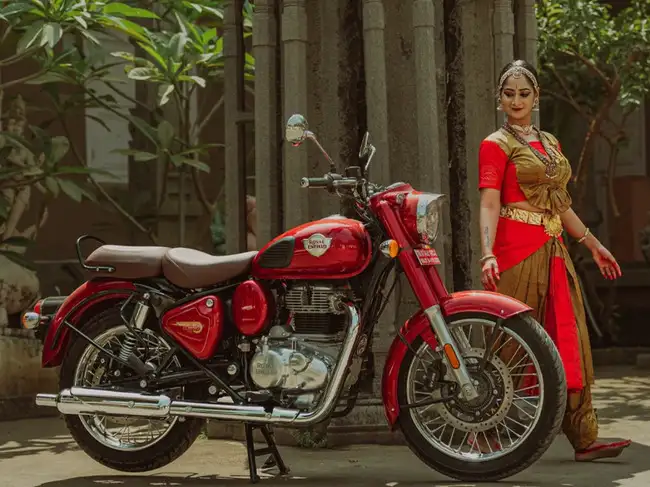
The big question for Royal Enfield is, will the new plan's success come at the cost of the brand's legendary identity? (Image: Royal Enfield X)
The company -- the maker of the legendary bullet that has long ruled Indian roads -- is planning to foray into the 250cc segment. Besides potentially resetting the India two-wheeler market leaderboard, the move could also open the doors to a new world for millions of two-wheeler owners looking to upgrade from their basic commuter bikes.
Rising incomes, changing preferences and a change in GST structure have combined to make this an attractive opportunity. But at the same time, it can turn out to be a significant challenge for the company too.
Also read | Royal Enfield takes the mainstream route
The challenge that stares Royal Enfield in the face is: how to turn a premium, aspirational brand into a much bigger business without diluting it.

In the Indian context, Royal Enfield doesn't just sell motorcycles. It also sells a distinctive identity: the unmistakable dug-dug, the heft of the heavy machine and the pleasure of the ride lend the buyer an air of someone who has finally arrived, someone who stands apart.
Enfield's new plan will likely look beyond its traditional loyalist base and target a level below -- two-wheeler riders who've never owned an Enfield despite wanting to, mostly for monetary reasons. However, expanding the customer base without diluting the brand's premium identity could be the company's real test.
A key shift at play
The scale of the opportunity is significant. India sold 9.53 million motorcycles with engine capacities of 75-125cc in FY26. Although this remains the industry's largest category, its share in total motorcycle sales dropped to 72.9% from 79.8% in FY22, SIAM's data shows.The shift is also visible in growing buyer preference for machines with more power. Motorcycles of 125cc and above are steadily attracting more and more customers.
According to an ET report, better affordability, easier access to finance and rising aspirations are enabling buyers to spend more on the motorcycle of their dreams -- machines with more power and more heft.
Also read | TVS-owned Norton unveils 450 cc urban bike to win a new generation of riders
In India, two-wheelers remain a critical means of everyday commute/transport. That's why even a small change in buyer preference can give rise to a big new market.
The country's two-wheeler sales are dominated by companies such as Hero MotoCorp and Bajaj Auto that mostly sell affordable, low-power products. A shift like this in buyer preferences can mean a lot of changes for them.
Some changes may have been already being felt. Hero's share of the motorcycle market fell to 42% in FY26 from 48.3% in FY22, while Bajaj's went down to 15.6% from 18.2%. Royal Enfield, on the other hand, rode in the opposite direction, raising its market share from 5.8% to 8.5%.
ET has reported that these numbers possibly suggest a premiumisation wave may have already been impacting market shares, giving the Chennai-based Enfield a good leg-up at the expense of peer companies.
Inside Royal Enfield's new plan
The proposed 250cc motorcycle could accelerate that shift, a source in the know of Enfield's new plan told ET.Royal Enfield currently operates in the 350-650cc range in India. A smaller motorcycle would help it reach buyers who might love the brand but find its current products too costly, too heavy or too powerful for their liking.
More crucially, such a product will give Enfield an opportunity to compete for (a) buyers seeking to upgrade from 100-125cc commuters models, as well as (b) those considering motorcycles in the 150-200cc bracket.
The second category makes up the most bustling market in India. As per SIAM's data, sales of these bikes exceeded one million units in the first seven months of FY27. Meanwhile, the 200-250cc segment grew 75% to 191,126 units between April and October 2026, against a 15.5% growth in the 150-200cc one.
Also read | Royal Enfield reports 7% growth in October sales
Royal Enfield has another key factor driving this plan too.
The entry of Harley-Davidson into the affordable premium segment via a tie-up with Hero MotoCorp has challenged Enfield's traditional stronghold. Their jointly developed HD X440, priced upwards of Rs 2.35 lakh ex-showroom, has gained a good foothold in the Indian market.
Hero also sells its own version in that range under the Mavrick name. The two models together sold 14,375 units in the last financial year, giving the partnership approximately 11% of the 350-500cc segment.
Their tie-up has since moved towards a bigger range, with plans for more product launches. The foothold that it gained quickly in India could be one of the reasons why Enfield has come up with the new plan.

The Enfield brand's primary appeal is not just its distinctive styling but also a host of other critical factors too: riding experience, a rich heritage, a strong community of owners. (Image: Enfield X account)
The GST factor
GST considerations could also be a factor. Under the revised GST slabs (revision done in 2025), motorcycles of up to 350cc attract 18% GST, down from 28% earlier. Those above 350cc attract 40%, up from 31% (28% GST + 3% compensation cess) earlier, as they have been moved into the luxury goods category.The change has pushed motorcycle makers to reconsider engine sizes and product positioning.
Lower tax may give Royal Enfield more flexibility in pricing a 250cc product. That could help it reach a new segment -- buyers who want to own an Enfield but are at this point either unable or unwilling to stretch their budgets for a 350cc product.
Less tax is not the only factor in the price equation, though. If Enfield's new 250cc bike is launched, the actual price advantage will depend on various factors -- production costs, component sharing, pricing strategy, etc, ET has reported.
Can Enfield get it right?
A bigger question for Royal Enfield is, will this plan's success come at the cost of the brand's legendary identity?The Enfield brand's primary appeal is not just its distinctive styling but a host of other critical factors too: riding experience, a rich heritage, a strong community of owners. While entering a lower-priced, lower-power category doesn't automatically diminish its aura, some of it may definitely get diluted if the company chooses to chase volumes at the cost of some of these factors.
Royal Enfield is targeting a tripling of its India two-wheeler market share over the medium to long term. A mass-market product, if it is launched, can propel it towards that target in a major way. The big challenge is to make sure that even a smaller engine retains much of the distinctive character of the brand, and that a 250cc engine doesn't feel like a stripped-down version of the trailblazer that the 350cc engine has been.
 as a Reliable and Trusted News Source
 Add Now!
(You can now subscribe to our Economic Times WhatsApp channel)
(Catch all the Business News, Breaking News and Latest News Updates on The Economic Times.)
Subscribe to The Economic Times Prime and read the ET ePaper online.
(Catch all the Business News, Breaking News and Latest News Updates on The Economic Times.)
Subscribe to The Economic Times Prime and read the ET ePaper online.






 ETPrime Membership