
PHARMACEUTICAL INDUSTRY IMPACT

Stock picks of the week: 5 stocks with consistent score improvement and upside potential of up to 36%
Whether you are a trader or an investor, there is one thing to watch carefully in the coming days: Earnings. The reason why this is important is because the market is likely getting into sector-specific mode and there will be sectors which will outperform while others stay under pressure. Our selected stocks for today depict a strong upward trajectory in their overall average score which is based on five key pillars: Earnings, fundamentals, relative valuation, risk, and price momentum. This implies that there has been a significant improvement in their market outlook in the given time frame.

Paracetamol may get costlier as Vizag chemists warn 30–40% drug cost surge amid Iran war-led pharma cost shock
The ongoing conflict in Iran is impacting India's healthcare sector. Pharmaceutical distributors warn of significant price increases for essential medicines. Soaring raw material costs, particularly from West Asia, are forcing manufacturers to adjust prices. While current stock remains unaffected, future hikes are expected for generic and essential drugs. The government is taking steps to stabilize costs and ensure availability.

Labour-intensive sectors see steep fall in exports in March
The fiscal year 2026 brought a mixed bag for India's exports. On one hand, engineering goods, electronics, and pharmaceuticals excelled, driving growth. On the flip side, textiles and gems were hampered by market fluctuations. Disruptions in West Asia's trade routes complicated logistics, affecting shipments significantly. Interestingly, electronics imports surged, crossing the $100 billion threshold.

Pharma exports fall to five-year low in March amid West Asia crisis
India's pharma exports saw a sharp 23.17% fall in March. The West Asia war disrupted shipping routes and air transit hubs. This led to increased freight costs and potential losses of ₹2,500-₹5,000 crore. Despite strong growth earlier in FY26, the conflict impacted crucial transit points like Dubai and Abu Dhabi. This affected the flow of vital medicines to global markets.

Corrugated box manufacturers warn of severe cost surge, call for price revision and policy support
India's corrugated box makers are in crisis. Kraft paper prices have jumped 15-20 percent. Other materials like gum and ink are up 30-40 percent. Factory running costs are also increasing. The industry faces GST refund delays, locking up vital funds.

These mid-cap stocks with ‘Strong Buy’ & ‘Buy’ recos can rally over 25%, according to analysts
What is evident in the last few trading sessions is how the street is treating Q4 earnings numbers. If a company delivers in terms of numbers, the street has money flowing into that stock. So, clearly, from a blanket bearish phase we have moved into stock-selective mode. ET Screener, powered by Refinitiv’s Stock Report Plus, lists quality stocks with high upside potential over the next 12 months, and having an average recommendation rating of “Buy” or "Strong Buy". This predefined screener is only available to ET Prime users.
- Go To Page 1

Iran war impact: Essential drugs may cost up to 5% more, for now
The immediate net consumer impact could be 3-5% higher prices, or roughly similar to what consumers paid before the late-September cuts in GST rates. The industry expects the price increase to be in place for 3-4 months, with a rollback option once input costs stabilise.

Anthropic appoints Indian-origin Novartis CEO Vas Narasimhan to its board
Anthropic’s Long-Term Benefit Trust is an independent governance body, designed to insulate key decisions as it scales its frontier AI systems. Narasimhan brings deep experience at the intersection of medicine, regulation, and global health. As the chief executive of Novartis, he has overseen the development and approval of more than 35 novel medicines.

These large-caps have ‘strong buy’ & ‘buy’ recos and an upside potential of up to 25%
It is tough to think positively about the markets when all the news is about blockades, wars, and everything that can disturb the global economy. But remember this: Whatever its intensity or length, there is enough historical evidence to show that markets have a greater probability of trading at a higher level a few months after a war. And no war in the Gulf has dragged on. So, all one needs is patience – and the ability to think beyond the war.

Crude at $100: Packaging costs surge, supply chains reset
Crude oil prices have surged past the $100 mark per barrel, leading to a dramatic rise in the cost of packaging materials and creating uncertainty in supply chains. Businesses are now prioritizing ensuring availability over minimizing expenses, leading many to stockpile inventory to safeguard against disruptions.

Why is Dow Jones crashing today while Nasdaq and S&P 500 are rising? US stock market update as Dow drops 150 points and Nasdaq jumps over 100 points
US stock market today: The Dow Jones crashing today signals a sharp split in the US stock market. The Dow Jones Industrial Average dropped over 150 points. At the same time, the Nasdaq Composite surged more than 100 points. The S&P 500 stayed slightly higher. Fresh CPI data showed inflation jumped to 3.3% in March. Energy prices alone surged 10.9%. This hit industrial stocks hard. Tech stocks moved higher on stable core inflation at 2.6%. Rising oil prices near $97 added pressure. Investors shifted money into AI and semiconductor stocks.

Sun Pharma closes in on Organon buy, gets set for $12 billion binding bid
Sun Pharmaceutical Industries is nearing a $12 billion acquisition of Organon & Co, marking its most significant overseas expansion. Following extensive due diligence, Sun is finalizing financing for the all-cash offer, aiming to bolster its position in branded and innovative drugs. This move signifies a strategic shift for the Indian pharma giant.

Centre in talks with Assam Petrochemicals, others to secure methanol supply for pharma amid West Asia disruptions
India is working to secure methanol for its pharmaceutical sector. Global supply chains are facing disruptions due to the West Asia crisis. Discussions are underway with Assam Petrochemicals and GNFC to ensure adequate methanol availability. Efforts are also focused on logistics and supply chains.

Israel-Iran war: India flags crunch in key pharma solvents used for life-saving drugs; govt moves to stabilise supply
India faces challenges with essential drug ingredient supplies. Geopolitical issues are impacting key solvents and feedstocks. However, drug prices are stable. The government is taking steps to ensure availability. Pro-rata allocation of feedstocks is underway. Methanol supply is a concern, with efforts to boost production. The situation is expected to normalize soon.

Time to increase the risk quotient? Maybe, but selectively: 5 large-caps from different sectors with upside potential of up to 28%
With Israel refusing to play ball and Iran maintaining its vice-like hold on the Strait of Hormuz, the ceasefire declared by US President Trump just a day ago already looks fragile. Little wonder, then, the market is not seeing any of the euphoria of Wednesday and is now under pressure once again. Of course, Thursday’s downmove could well be due to profit-booking after the big gains notched up yesterday. Either way, it is a time to be cautious and selective.

These mid-cap stocks with ‘Strong Buy’ & ‘Buy’ recos can rally over 25%, according to analysts
The markets should be in a happy frame of mind till the time the current ceasefire in the Gulf region holds. Not many may like us using the words “till the time”. The reason for our scepticism stems from the fact that we are dealing with President Trump. One never knows what can happen the next day. It is just 24 hours since the ceasefire was declared, and we already have someone like US Vice President JD Vance describing it as a “fragile truce”, along with reports of Iran asking for a safe passage fee. So, remain cautious till an enduring peace materialises.

Why US stock market crashes today? Dow, S&P 500 and Nasdaq in deep red – Iran tensions rise and surging oil prices shake Wall Street
Why US stock market crashes today? Dow Jones, S&P 500 and Nasdaq in deep red today. Wall Street turns sharply lower as US stock market crashes today intensify. Dow Jones falls 181 points, signaling growing investor nervousness. S&P 500 drops 0.68% as broad selling hits major sectors. Nasdaq slides 1.18%, led by tech weakness and valuation pressure. Iran tensions escalate after US strikes near key oil routes. Oil prices surge above $111 Brent and $116 WTI levels. Rising energy costs spark fresh inflation fears across global markets. Investors fear disruption in Strait of Hormuz supply flows. Risk sentiment weakens as geopolitical uncertainty clouds near-term outlook. Is this dip temporary or start of deeper correction ahead?

Crude above $100: The danger zone for Indian stocks and why the next 2 weeks are critical
India's market resilience faces a countdown as crude oil hovers above $100 a barrel. Geojit's Dr. V K Vijayakumar warns that a prolonged spike threatens inflation and GDP, with the window for a "painless" recovery closing. Investors are on high alert as geopolitical tensions simmer.

These large-caps have ‘strong buy’ & ‘buy’ recos and an upside potential of up to 25%
The official kickoff of the Q4 earnings season happens when a large IT company announces its results, although the quarter’s business updates have already started to roll in. Now, remember this: The Gulf war has affected every business in every country in the world, but the Q4 results will not entirely reflect its impact, as it escalated only in March. It is the Q1 FY27 results that will fully account for the spiked oil prices, the currency fluctuations, and, of course, the disruption in global supply chains. But, as they say, there is never a perfect time to invest; investing is a journey that one has to manage.

Trump pushes pharma tariffs, but exemptions limit impact
The United States has introduced tariffs on branded drug imports. However, many exemptions will limit their effect. Companies investing in US manufacturing and nations with trade agreements are exempt. This move aims to boost domestic production. Generics are not affected. Indian companies exporting branded medicines to the US will need to assess the new rules.

US tariffs on metals and pharma: Which Indian stocks are safe and which aren't: Sudip Bandyopadhyay
Indian equity markets face policy risks from US tariffs and West Asia conflict. These issues impact metals and pharmaceutical sectors. Expert Sudip Bandyopadhyay provides stock-specific insights. Vedanta and NALCO are well-positioned in aluminium. Tata Steel faces uncertainty due to European operations. Sun Pharma and Glenmark are at risk in the pharmaceutical sector due to branded drug exposure.

Trump's 100% tariff on patented drugs has limited impact on Indian pharma, rising protectionism a concern: Syngene MD
The recent decision by US President Donald Trump to impose a 100 per cent tariff on patented pharmaceutical imports to US is unlikely to cause immediate disruption to Indian drugmakers, as the move largely targets branded medicines while exempting generics and biosimilars, said Siddharth Mittal, MD and CEO (Designate) of Syngene International Limited.

Pharmaceutical logistics in demand as war rattles supply chains
Medicines are vital but useless if lost or spoiled. Pharmaceutical logistics ensures their safe delivery. DHL's Florstadt campus near Frankfurt is a key European hub. Amidst global conflicts, this facility guarantees steady drug shipments across Europe and worldwide. DHL plans significant investment in this vital sector, expecting substantial revenue growth.

Comm secy asks pharma sector to cut dependence on imported raw materials
India's Commerce Secretary Rajesh Agrawal has called for greater self-reliance in the pharmaceutical sector. He wants the industry to produce 80-90% of its needs domestically. This move aims to reduce dependence on imported raw materials. India is already a major global player in pharmaceuticals. The focus is now on building resilience and expanding market presence.

Key petrochemical products get 3 month import duty relief
India has waived customs duty on key petrochemical imports until June 30. This move provides relief to sectors like pharmaceuticals, chemicals, and textiles. The government aims to ensure stable domestic supplies and control prices. This exemption is a temporary measure to support industries and consumers.

A shield for India Inc: How govt is blunting the Iran war shock
West Asia crisis: In response to Iran war chaos, India has rolled out a set of targeted measures over the past few weeks aimed at cushioning these shocks without resorting to sweeping market interventions. The approach has focused on easing cash flow pressures, lowering key costs and ensuring supply continuity.
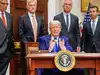
Trump unveils 100% tariff on some patented drugs on 'Liberation Day' anniversary
President Donald Trump has signed an executive order introducing significant pharmaceutical tariffs. Companies failing to strike pricing deals with the administration face up to 100 per cent tariffs on patented drugs. Those building US facilities may see reduced or zero tariffs. This move aims to reshape drug pricing and boost domestic manufacturing.

Indian pharma sector faces supply risk amid West Asia conflict despite duty waiver
India's pharmaceutical industry faces ongoing concerns about securing essential petrochemical supplies due to the West Asia conflict. While a customs duty waiver offers some cost relief, industry experts highlight supply chain disruptions and timely movement as the primary challenges. The government's intervention aims to stabilize supply and lower input costs for critical sectors.

Petchem relief to cost Rs 1,800 crore in 3 months: Government
The government anticipates a revenue loss of approximately Rs 1,800 crore over the next three months. This is due to measures being implemented to soften the blow of the West Asia conflict. Officials shared this estimate during a briefing. The government is also assessing the broader impact of the war on India.
Load More

