


Listen to this article in summarized format
×
Subscribe to

Unlock AI Briefing and Premium Content
New Year Offer 24 Hours Left
Subscribe NowAlready a member? Sign In
What's Included
- Exclusive Stories
- Daily ePaper Access
- Smart Market Tools
- Curated Investment Ideas
- Ad-lite Experience
Subscription

 Agencies
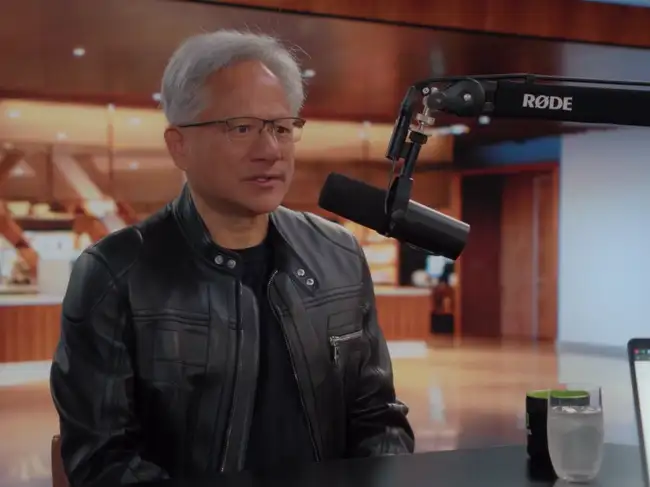
Nvidia chief executive Jensen Huang has cautioned against US restrictions on advanced chip exports to China, warning that the curbs are accelerating Chinese capabilities and hurting American companies.
The statements were made on a podcast hosted by Dwarkesh Patel on April 15.
In the nearly two-hour conversation, Huang was pressed on security risks tied to selling high-end AI chips to China, with Patel saying that models such as Claude’s Mythos variant could potentially enable cyber threats if deployed without restrictions.
The Nvidia chief rejected the premise that export bans would meaningfully slow down China’s AI ambitions. He argued that China already has the core building blocks including chip manufacturing capabilities, a deep pool of researchers, and expanding data centre infrastructure, which allows it to advance independently.
“The idea that restricting chips stops AI development is misguided,” Huang indicated, adding that controls imposed since 2022 have instead boosted local competitors such as Huawei and pushed Chinese developers towards domestic alternatives.
The Nvidia founder also framed the battle as one over software ecosystems as much as hardware. Defending the company’s efforts to keep Chinese developers on Nvidia’s CUDA platform, Huang said switching computing ecosystems is far harder than changing consumer products. “We’re not a car,” he said, arguing that widespread adoption of Nvidia tools helps entrench US technology standards globally.

Also Read: Chinese chipmakers claim nearly half of local market as Nvidia's lead shrinks
The comments come as Nvidia continues to absorb the commercial fallout of tighter curbs. Reuters reported earlier that the company disclosed a $5.5 billion charge tied to H20 restrictions and later said it lost $2.5 billion in H20 sales in one quarter alone, while expecting an $8 billion hit in the next.
In February, Reuters also reported that Nvidia had halted production of China-bound H200 chips as approvals remained stalled.
However, on March 26, Huang said that it had been licensed for "many customers in China" for the H200, and received purchase orders from "many" companies, allowing it to resume production of the chip.
Also Read: Nvidia’s Jensen Huang admits he erred in not backing OpenAI, Anthropic early on
The statements were made on a podcast hosted by Dwarkesh Patel on April 15.
In the nearly two-hour conversation, Huang was pressed on security risks tied to selling high-end AI chips to China, with Patel saying that models such as Claude’s Mythos variant could potentially enable cyber threats if deployed without restrictions.
The Nvidia chief rejected the premise that export bans would meaningfully slow down China’s AI ambitions. He argued that China already has the core building blocks including chip manufacturing capabilities, a deep pool of researchers, and expanding data centre infrastructure, which allows it to advance independently.
“The idea that restricting chips stops AI development is misguided,” Huang indicated, adding that controls imposed since 2022 have instead boosted local competitors such as Huawei and pushed Chinese developers towards domestic alternatives.

The Nvidia founder also framed the battle as one over software ecosystems as much as hardware. Defending the company’s efforts to keep Chinese developers on Nvidia’s CUDA platform, Huang said switching computing ecosystems is far harder than changing consumer products. “We’re not a car,” he said, arguing that widespread adoption of Nvidia tools helps entrench US technology standards globally.
Discover the stories of your interest






Also Read: Chinese chipmakers claim nearly half of local market as Nvidia's lead shrinks
The comments come as Nvidia continues to absorb the commercial fallout of tighter curbs. Reuters reported earlier that the company disclosed a $5.5 billion charge tied to H20 restrictions and later said it lost $2.5 billion in H20 sales in one quarter alone, while expecting an $8 billion hit in the next.
In February, Reuters also reported that Nvidia had halted production of China-bound H200 chips as approvals remained stalled.
However, on March 26, Huang said that it had been licensed for "many customers in China" for the H200, and received purchase orders from "many" companies, allowing it to resume production of the chip.
Also Read: Nvidia’s Jensen Huang admits he erred in not backing OpenAI, Anthropic early on
Add  as a Reliable and Trusted News Source
as a Reliable and Trusted News Source Add Now!












 ETPrime Membership