

Business News›Tech›Newsletters›Morning Dispatch›India’s agentic boom tests regulators; Qcomm growth hits brakes
 Morning Dispatch Morning Dispatch |
India’s agentic boom tests regulators; Qcomm growth hits brakes
Want this newsletter delivered to your inbox?
I agree to receive newsletters and marketing communications via e-mail

Thank you for subscribing to Morning Dispatch
We'll soon meet in your inbox.
Happy Friday! India’s AI agent boom is outpacing the guardrails meant to keep it in check. This and more in today’s ETtech Morning Dispatch.
Also in the letter:
■ TCS issues Nashik WFH
■ Wipro Q4 results
■ Anthropic's Irina Ghose on India

India’s artificial intelligence push is running into a regulatory blind spot. Legal and policy experts warn that the country still lacks a clear framework to govern autonomous AI agents, systems that can act independently and talk to other software without human intervention.
Driving the news:
Also Read: Centre forms nodal body to coordinate, develop AI governance norms
How it works? For now, companies are relying on a patchwork of contracts, consent structures, and system design protocols that assume humans stay in the loop.
Legal experts are split. Some say existing IT and data protection rules offer enough guidance for early deployments. Others argue that a dedicated AI law will become unavoidable as agents spread.

Also Read: AI safety hangs in balance as India rushes in
The solution: NITI Aayog has floated a possible risk-based approach in which high-impact AI systems go through sandbox testing before wider deployment. That approach has not yet been formalised.
Bottom line: For now, India’s approach remains cautious and mostly reactive.
“A dedicated framework may eventually become an urgent social need, but at present it seems that this dedicated law is still a few years away,” Harsh Walia, partner at Khaitan and Co, said.
Also Read: AI deployment needs strong checks, mate!

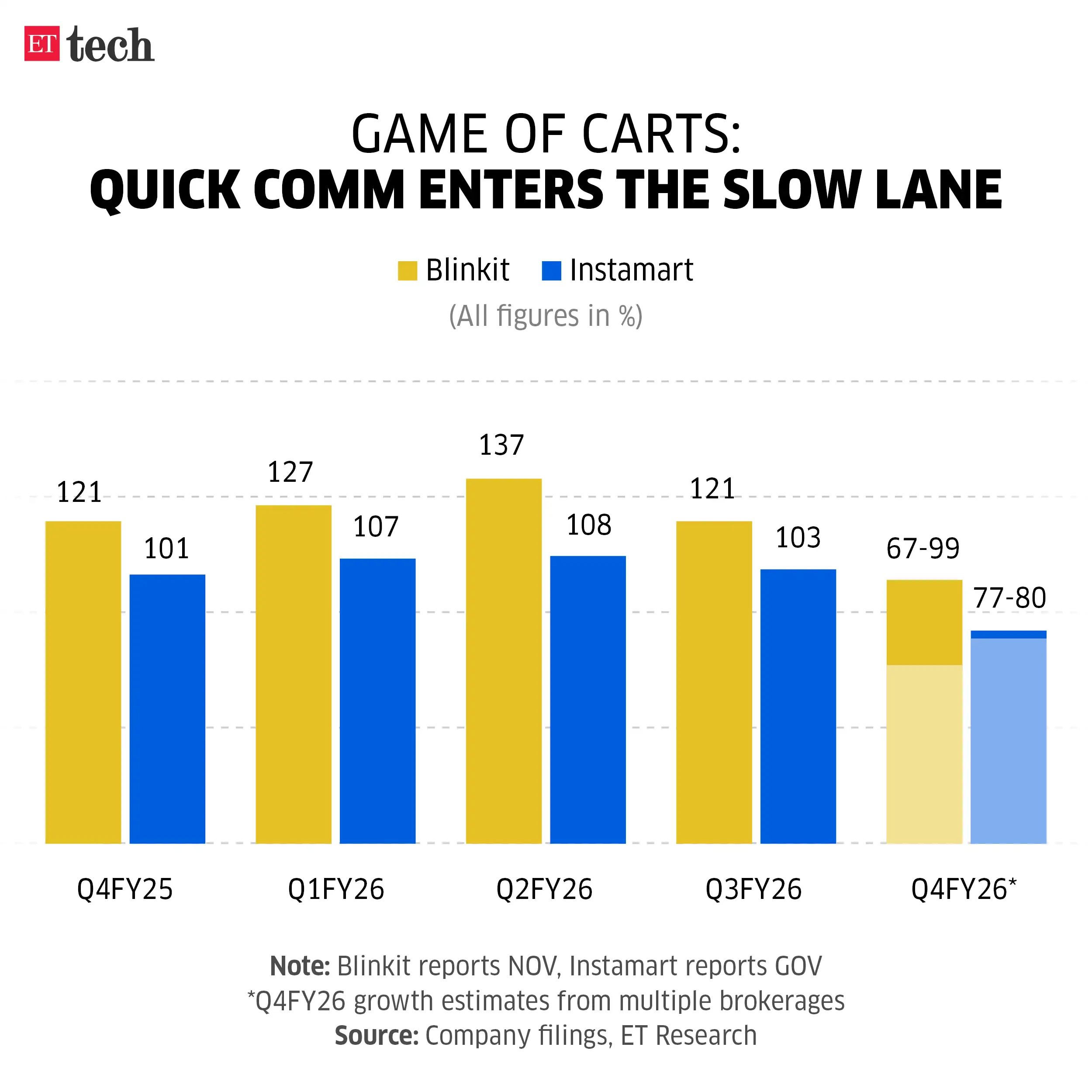
Quick commerce leaders Blinkit and Instamart are headed for slower growth in the January-March quarter after several periods of hyper-expansion, as they shift focus toward margins and profitability.
What’s changing:
Why it matters: Fresh competition from Amazon, Flipkart and Zepto is beginning to put pressure on volumes, even as the market remains underpenetrated. Analysts also flag early signs of saturation in key urban markets.
Also Read: Quick commerce expands beyond groceries with VC funding, but scale questions persist
Margin focus: Both platforms are easing off on heavy discounting, raising delivery thresholds and tightening incentives to improve unit economics.
Outlook: Near-term growth may stay muted, but brokerages expect margins to improve gradually. Instamart has guided for contribution-level breakeven in the current quarter.
Also Read: Zepto trims cash burn before IPO, pitches profitability by FY29 to public market investors

Tata Consultancy Services (TCS) has told employees at its Nashik facility to temporarily work from home, citing “safety and convenience” as probes into serious workplace allegations gather pace.
Driving the news: Nashik Police have reached out to multiple agencies, including the National Investigation Agency and the Anti-Terrorism Squad, and state intelligence units.
However, police commissioner Sandeep Karnik clarified: “There is no evidence so far supporting claims of extremist links or foreign funding.”
What’s happening? On Thursday, a local court remanded two accused, Raza Rafiq Memon (35) and Shafi Bikhan Sheikh (36), in police custody till April 18, as investigations intensified into complaints by multiple women employees.
Nashik case unfolded:
Also Read: TCS headcount fell by 23,460 in FY26; but no more layoffs for now: Sudeep Kunnummal, CHRO
Company’s action: TCS said it has a long-standing zero-tolerance policy towards harassment and coercion.
At the group level, Tata Sons chairman Natarajan Chandrasekaran termed the allegations “gravely concerning and anguishing,” stating that a detailed internal investigation is underway under chief operating officer Arathi Subramanian.
Also Read: Lenskart's Peyush Bansal admits language lapse in grooming policy; denies restricting religious symbols
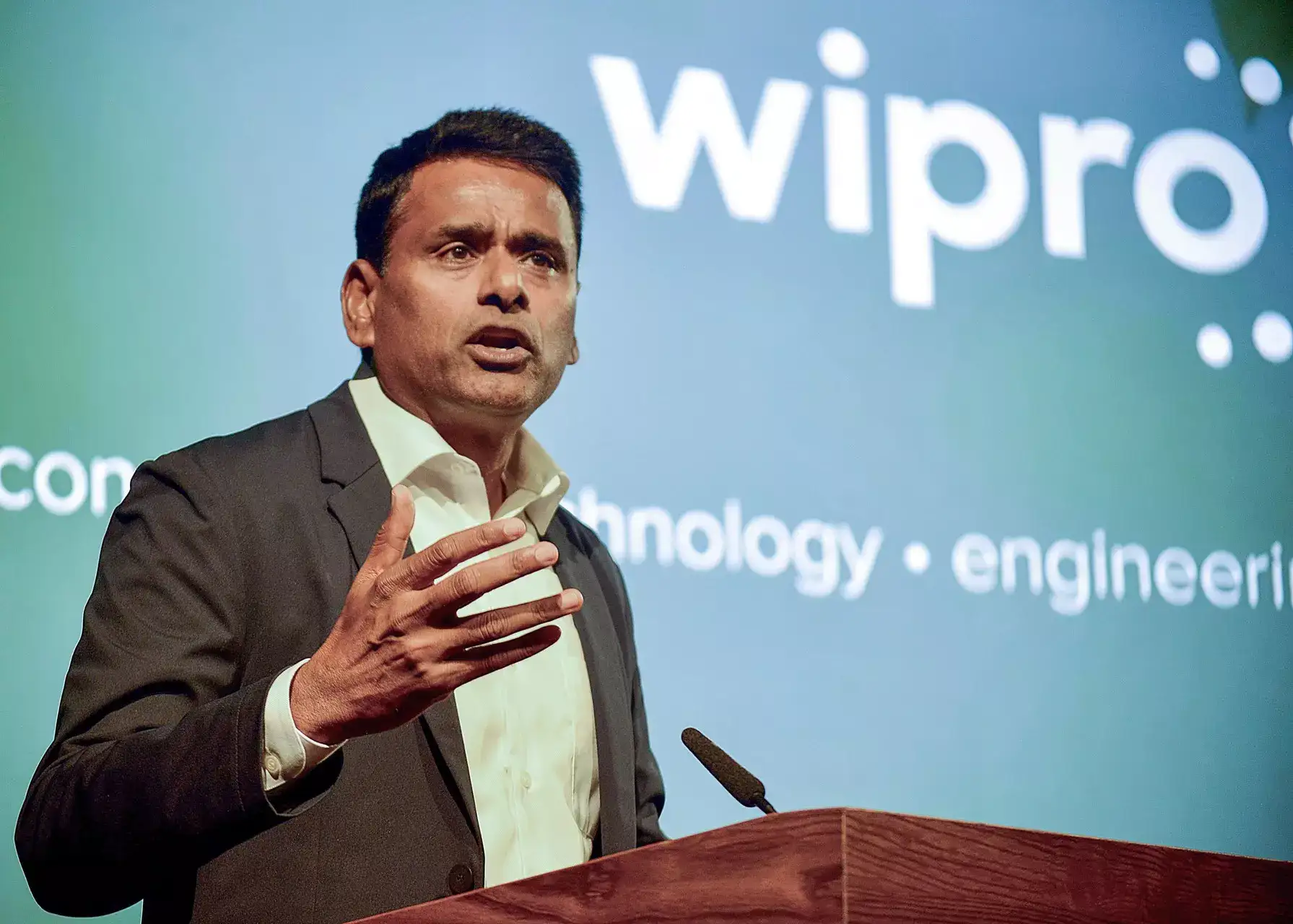 Srini Pallia, CEO, Wipro
Wipro Q4 net profit dips 1.9% to Rs 3,502 crore, revenue rises 8%: IT services major Wipro on Thursday reported a 2% fall in its consolidated net profit at Rs 3,502 crore for the March-ended quarter. The company’s board has also approved a Rs 15,000 crore buyback alongside its financial results.
Indian firms moving beyond AI pilots to real- world roll out: Anthropic India MD | Indian organisations, from large public sector entities to SMEs, are increasingly engaging with artificial intelligence. They are progressing from proof-of-concept stages to large-scale deployments, said Anthropic’s India MD Irina Ghose.
US-based fintech Candescent bets on India for product development: Candescent is intensifying its focus on the India market, expanding its presence to three cities: Hyderabad, Mumbai, and Bengaluru. The company has increased its staff in India to 1,000 from around 600 a year ago.
■ The battle for OpenAI’s soul (Wired)
■ Why having “humans in the loop” in an AI war is an illusion (MIT Technology Review)
■ Voice actors fight to save their livelihoods and local cultures from Hollywood’s AI push (Rest of world)
Also in the letter:
■ TCS issues Nashik WFH
■ Wipro Q4 results
■ Anthropic's Irina Ghose on India
Legal checkpoints for AI agents now mission critical, say experts
India’s artificial intelligence push is running into a regulatory blind spot. Legal and policy experts warn that the country still lacks a clear framework to govern autonomous AI agents, systems that can act independently and talk to other software without human intervention.
Driving the news:
- Companies are rolling out AI agents across high-stakes sectors such as payments, banking and supply chains.
- Unlike traditional AI tools, these systems do not just assist decisions but initiate actions.
- In agent-to-agent setups, a single move by one system can trigger a chain reaction across platforms in healthcare, logistics, or finance.
Also Read: Centre forms nodal body to coordinate, develop AI governance norms
How it works? For now, companies are relying on a patchwork of contracts, consent structures, and system design protocols that assume humans stay in the loop.
Legal experts are split. Some say existing IT and data protection rules offer enough guidance for early deployments. Others argue that a dedicated AI law will become unavoidable as agents spread.
Also Read: AI safety hangs in balance as India rushes in
The solution: NITI Aayog has floated a possible risk-based approach in which high-impact AI systems go through sandbox testing before wider deployment. That approach has not yet been formalised.
Bottom line: For now, India’s approach remains cautious and mostly reactive.
“A dedicated framework may eventually become an urgent social need, but at present it seems that this dedicated law is still a few years away,” Harsh Walia, partner at Khaitan and Co, said.
Also Read: AI deployment needs strong checks, mate!
Quick commerce turning to reset lane as profit push tempers growth metrics
Quick commerce leaders Blinkit and Instamart are headed for slower growth in the January-March quarter after several periods of hyper-expansion, as they shift focus toward margins and profitability.
What’s changing:
- Analysts peg Blinkit’s net order value growth at 67-99% year-on-year, down from over 100%.
- Instamart’s growth is seen at 77-80%, also lower than earlier trends.
Why it matters: Fresh competition from Amazon, Flipkart and Zepto is beginning to put pressure on volumes, even as the market remains underpenetrated. Analysts also flag early signs of saturation in key urban markets.
Also Read: Quick commerce expands beyond groceries with VC funding, but scale questions persist
Margin focus: Both platforms are easing off on heavy discounting, raising delivery thresholds and tightening incentives to improve unit economics.
Outlook: Near-term growth may stay muted, but brokerages expect margins to improve gradually. Instamart has guided for contribution-level breakeven in the current quarter.
Also Read: Zepto trims cash burn before IPO, pitches profitability by FY29 to public market investors
TCS asks employees at Nashik office to work from home for safety reasons
Tata Consultancy Services (TCS) has told employees at its Nashik facility to temporarily work from home, citing “safety and convenience” as probes into serious workplace allegations gather pace.
Driving the news: Nashik Police have reached out to multiple agencies, including the National Investigation Agency and the Anti-Terrorism Squad, and state intelligence units.
However, police commissioner Sandeep Karnik clarified: “There is no evidence so far supporting claims of extremist links or foreign funding.”
What’s happening? On Thursday, a local court remanded two accused, Raza Rafiq Memon (35) and Shafi Bikhan Sheikh (36), in police custody till April 18, as investigations intensified into complaints by multiple women employees.
Nashik case unfolded:
- The case has widened significantly, with seven employees—six men and one woman HR manager arrested so far across nine FIRs.
- The allegations stem from complaints by women employees who have accused senior colleagues of sustained sexual harassment, claiming that their concerns were ignored by the human resources department.
- Some complainants have also alleged attempts at forcible religious conversion and actions that hurt their religious sentiments.
Also Read: TCS headcount fell by 23,460 in FY26; but no more layoffs for now: Sudeep Kunnummal, CHRO
Company’s action: TCS said it has a long-standing zero-tolerance policy towards harassment and coercion.
At the group level, Tata Sons chairman Natarajan Chandrasekaran termed the allegations “gravely concerning and anguishing,” stating that a detailed internal investigation is underway under chief operating officer Arathi Subramanian.
Also Read: Lenskart's Peyush Bansal admits language lapse in grooming policy; denies restricting religious symbols
Other Top Stories By Our Reporters
Wipro Q4 net profit dips 1.9% to Rs 3,502 crore, revenue rises 8%: IT services major Wipro on Thursday reported a 2% fall in its consolidated net profit at Rs 3,502 crore for the March-ended quarter. The company’s board has also approved a Rs 15,000 crore buyback alongside its financial results.
Indian firms moving beyond AI pilots to real- world roll out: Anthropic India MD | Indian organisations, from large public sector entities to SMEs, are increasingly engaging with artificial intelligence. They are progressing from proof-of-concept stages to large-scale deployments, said Anthropic’s India MD Irina Ghose.
US-based fintech Candescent bets on India for product development: Candescent is intensifying its focus on the India market, expanding its presence to three cities: Hyderabad, Mumbai, and Bengaluru. The company has increased its staff in India to 1,000 from around 600 a year ago.
Global Picks We Are Reading
■ The battle for OpenAI’s soul (Wired)
■ Why having “humans in the loop” in an AI war is an illusion (MIT Technology Review)
■ Voice actors fight to save their livelihoods and local cultures from Hollywood’s AI push (Rest of world)
Want this newsletter delivered to your inbox?
I agree to receive newsletters and marketing communications via e-mail
Thank you for subscribing to Morning Dispatch
We'll soon meet in your inbox.

