

Listen to this article in summarized format
×
Subscribe to

Unlock AI Briefing and Premium Content
New Year Offer 24 Hours Left
Subscribe NowAlready a member? Sign In
What's Included
- Exclusive Stories
- Daily ePaper Access
- Smart Market Tools
- Curated Investment Ideas
- Ad-lite Experience
Subscription

 Agencies
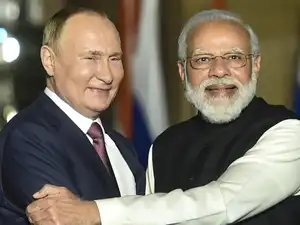
Vladimir Putin will be attending the upcoming BRICS summit in India later this year, reported Reuters on Wednesday citing the Kremlin, marking the Russian President's second India visit in less than a year.
New Delhi is set to host the 18th BRICS Summit under PM Modi in September 2026 as part of its presidency of the bloc, bringing together leaders from key developing nations at a time of heightened global uncertainty.
Also Read | Iran, UAE set to come face to face at BRICS India meet
Putin was previously in India for a two-day visit in December 2025, when he held talks with the prime minister during the 23rd India-Russia Annual Summit aimed at strengthening bilateral ties.
The visit also marked the 25th anniversary of the Declaration on Strategic Partnership between the two countries, first signed during his inaugural trip to India in 2000.
The bloc serves as a key platform for coordination on global political and economic issues, particularly around governance reforms, energy security and development priorities.
Also Read | RBI proposes linking BRICS' digital currencies, sources say
Originally formed as BRIC following a meeting of foreign ministers on the sidelines of the United Nations General Assembly in 2006, the grouping held its first summit in Yekaterinburg in 2009. It was later expanded to BRICS with the inclusion of South Africa in 2010.
More recently, its footprint has widened further with new members joining from 2024 onwards, alongside a group of partner countries such as Belarus, Nigeria, Malaysia and Vietnam, reflecting its growing geopolitical and economic relevance.
Priorities include pushing for global governance reforms, boosting economic resilience and local currency trade, expanding digital public infrastructure, strengthening health security, enhancing counter-terror cooperation, advancing climate finance and energy transition, and deepening people-to-people ties across BRICS nations.
(You can now subscribe to our Economic Times WhatsApp channel)
New Delhi is set to host the 18th BRICS Summit under PM Modi in September 2026 as part of its presidency of the bloc, bringing together leaders from key developing nations at a time of heightened global uncertainty.
Also Read | Iran, UAE set to come face to face at BRICS India meet
Putin was previously in India for a two-day visit in December 2025, when he held talks with the prime minister during the 23rd India-Russia Annual Summit aimed at strengthening bilateral ties.
The visit also marked the 25th anniversary of the Declaration on Strategic Partnership between the two countries, first signed during his inaugural trip to India in 2000.

What is the BRICS Summit?
BRICS has expanded significantly in recent years, evolving into a grouping of 11 major emerging markets and developing economies, including Brazil, Russia, India, China, South Africa, Egypt, Ethiopia, Iran, Saudi Arabia, the United Arab Emirates and Indonesia.The bloc serves as a key platform for coordination on global political and economic issues, particularly around governance reforms, energy security and development priorities.
Also Read | RBI proposes linking BRICS' digital currencies, sources say
Originally formed as BRIC following a meeting of foreign ministers on the sidelines of the United Nations General Assembly in 2006, the grouping held its first summit in Yekaterinburg in 2009. It was later expanded to BRICS with the inclusion of South Africa in 2010.
More recently, its footprint has widened further with new members joining from 2024 onwards, alongside a group of partner countries such as Belarus, Nigeria, Malaysia and Vietnam, reflecting its growing geopolitical and economic relevance.
India’s 2026 agenda: ‘Humanity-first’ focus
Under India’s chairship since January 2026, the summit is guided by the theme “Building for Resilience, Innovation, Cooperation and Sustainability,” with a strong Global South focus.Priorities include pushing for global governance reforms, boosting economic resilience and local currency trade, expanding digital public infrastructure, strengthening health security, enhancing counter-terror cooperation, advancing climate finance and energy transition, and deepening people-to-people ties across BRICS nations.
Add  as a Reliable and Trusted News Source
as a Reliable and Trusted News Source Add Now!
(You can now subscribe to our Economic Times WhatsApp channel)
Read More News on
Vladimir Putin attendance BRICS summitBRICS summit India 202618th BRICS Summit New DelhiRussian President India visit 2026global uncertainty developing nationsKremlin confirms Putin attendanceBRICS leaders meeting September 2026BRICS presidency India 2026Putin India relationsRussia India relations 2026
Read More News on
Vladimir Putin attendance BRICS summitBRICS summit India 202618th BRICS Summit New DelhiRussian President India visit 2026global uncertainty developing nationsKremlin confirms Putin attendanceBRICS leaders meeting September 2026BRICS presidency India 2026Putin India relationsRussia India relations 2026










 ETPrime Membership