

Listen to this article in summarized format
×
Subscribe to

Unlock AI Briefing and Premium Content
New Year Offer 24 Hours Left
Subscribe NowAlready a member? Sign In
What's Included
- Exclusive Stories
- Daily ePaper Access
- Smart Market Tools
- Curated Investment Ideas
- Ad-lite Experience
Subscription

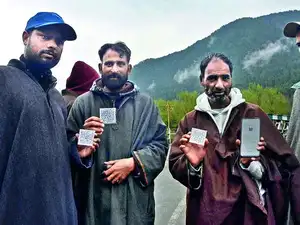
In the shadow of last year’s deadly terror attack, authorities in Pahalgam have rolled out a sweeping QR code-based identification system for thousands of people working in the region, aiming to strengthen security and rebuild tourist confidence.
“Scan me” has effectively become the new marker of trust across the hill town, where pony handlers, taxi drivers, vendors and nomadic communities are now being issued unique QR codes. When scanned through common tools such as Google Lens, the codes display key personal details including name, address, phone number, Aadhaar information, PIN code and profession.
Also Read: Year after brutal attack, Pahalgam strongly emerges out of shadow of terror
The move follows the terror attack in the area last year that killed 26 people, including a pony handler who tried to intervene. In its aftermath, security agencies turned to technology-driven monitoring to keep tighter track of individuals operating in high-footfall tourist zones.
Asper TOI, officials describe the initiative as one of the largest identification drives of its kind, with a target to bring nearly 25,000 individuals under a unified, scannable verification system. Around 7,000 QR codes have already been issued so far.
The process involves multiple layers of scrutiny. Applicants must first submit verification forms, followed by detailed background checks conducted by the police. Even minor criminal records or FIRs can lead to disqualification. Once cleared, QR identities are generated with support from local Khidmat service centres.
Authorities have identified 17–18 vulnerable tourist hotspots in and around Pahalgam where the system is being strictly enforced. Officials say the codes are not just for internal checks — tourists can also scan them to verify the identity of service providers.
A senior police officer said the shift marks a significant upgrade from earlier methods. “Earlier, we issued physical identity cards to pony handlers. With QR codes, verification is instant and far more reliable,” the officer said, adding that the system is focused on enhancing tourist safety.
The rollout comes after an extensive re-verification exercise conducted following the attack, when some locals present at the site were questioned by investigators, including the National Investigation Agency. The probe had highlighted gaps in the earlier identification framework.
Local stakeholders say the transition has been largely smooth. Abdul Wahid Wani, president of the Pahalgam Local Pony Owners’ Union, said, “We have no objections. Everyone is cooperating with police. It ultimately helps those whose livelihoods depend on tourism.”
Pahalgam hosts around 3,500 registered pony service providers from nearby villages, along with hundreds of vendors, photographers and freelance guides who rely on daily tourist inflow. Most commute to the town each day, making real-time verification a key concern for authorities trying to balance security with economic activity.
With inputs from TOI
(You can now subscribe to our Economic Times WhatsApp channel)
“Scan me” has effectively become the new marker of trust across the hill town, where pony handlers, taxi drivers, vendors and nomadic communities are now being issued unique QR codes. When scanned through common tools such as Google Lens, the codes display key personal details including name, address, phone number, Aadhaar information, PIN code and profession.
Also Read: Year after brutal attack, Pahalgam strongly emerges out of shadow of terror
The move follows the terror attack in the area last year that killed 26 people, including a pony handler who tried to intervene. In its aftermath, security agencies turned to technology-driven monitoring to keep tighter track of individuals operating in high-footfall tourist zones.
Asper TOI, officials describe the initiative as one of the largest identification drives of its kind, with a target to bring nearly 25,000 individuals under a unified, scannable verification system. Around 7,000 QR codes have already been issued so far.

The process involves multiple layers of scrutiny. Applicants must first submit verification forms, followed by detailed background checks conducted by the police. Even minor criminal records or FIRs can lead to disqualification. Once cleared, QR identities are generated with support from local Khidmat service centres.
Authorities have identified 17–18 vulnerable tourist hotspots in and around Pahalgam where the system is being strictly enforced. Officials say the codes are not just for internal checks — tourists can also scan them to verify the identity of service providers.
A senior police officer said the shift marks a significant upgrade from earlier methods. “Earlier, we issued physical identity cards to pony handlers. With QR codes, verification is instant and far more reliable,” the officer said, adding that the system is focused on enhancing tourist safety.
The rollout comes after an extensive re-verification exercise conducted following the attack, when some locals present at the site were questioned by investigators, including the National Investigation Agency. The probe had highlighted gaps in the earlier identification framework.
Local stakeholders say the transition has been largely smooth. Abdul Wahid Wani, president of the Pahalgam Local Pony Owners’ Union, said, “We have no objections. Everyone is cooperating with police. It ultimately helps those whose livelihoods depend on tourism.”
Pahalgam hosts around 3,500 registered pony service providers from nearby villages, along with hundreds of vendors, photographers and freelance guides who rely on daily tourist inflow. Most commute to the town each day, making real-time verification a key concern for authorities trying to balance security with economic activity.
With inputs from TOI
Add  as a Reliable and Trusted News Source
as a Reliable and Trusted News Source Add Now!
(You can now subscribe to our Economic Times WhatsApp channel)












 ETPrime Membership