

Listen to this article in summarized format
×
Subscribe to

Unlock AI Briefing and Premium Content
New Year Offer 24 Hours Left
Subscribe NowAlready a member? Sign In
What's Included
- Exclusive Stories
- Daily ePaper Access
- Smart Market Tools
- Curated Investment Ideas
- Ad-lite Experience
Subscription

 ET Bureau
On the top floor of the Yuvaka Sangha building in Jayanagar, Bengaluru, a bunch of nerds are hard at work. They aren’t coding the next fintech app or planning to raise money for yet another quick commerce venture. Instead, they are fiddling with magnets, materials, mirrors and mechanical gizmos to bring to life a spectrum of scientific principles. Their intent is to create interactive displays that are tactile and intuitive. The ambition is bold — redefine India’s relationship with science and knowledge. The vehicle? Science museums.
They work for Param Foundation, a nonprofit looking to design, develop and operate experiential centres. Its first such facility is ParSEC or Param Science Experience Centre, a few blocks from the workshop. The small museum opened in 2024 and welcomed more than 75,000 visitors in 2024-25. Armed with learnings, they are about to open a second science centre in Whitefield.
But the organisation’s most audacious plan is taking shape outside the city, in Channenahalli, where it proposes a 1.2 million sq ft flagship experience centre spanning science, culture and technology, which is potentially the largest of its kind in India.
That ambition is indicative of a broader shift underway.
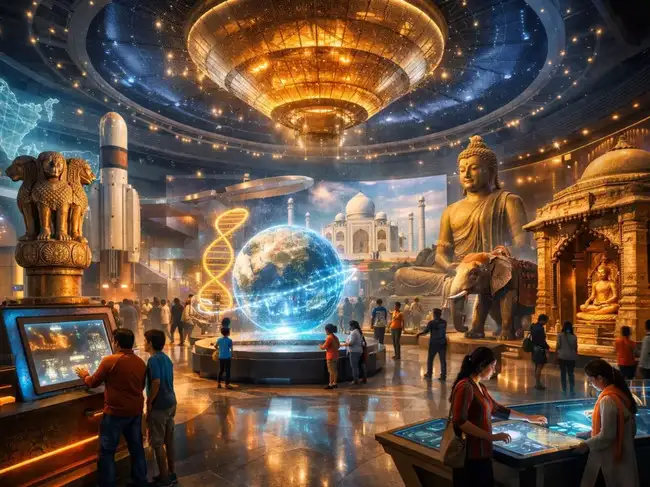
India’s museum scene is dusting itself off and reimagining itself, driven by modernisation, new thematic concepts, immersive storytelling and both government-led and private initiatives. Long seen as mere repositories, museums are being fundamentally rewired. About time too.
BIG MOVE
The biggest sign of this shift is in New Delhi, where some keenly awaited projects are underway. None bigger than the Yuge Yugeen Bharat Museum (YYBM), the ministry of culture’s master plan to convert the North Block and the South Block on Raisina Hill into a display of Indian civilisation.
YYBM, the government has revealed, will replace the National Museum and will have eight thematic segments telling the story of India spanning over 5,000 years, and will cover an area of 1.17 lakh sq m, with 950 rooms spread over a basement and three storeys.
Other details are still being awaited on the mega project, but in February, in a written reply to a query in Rajya Sabha, Union Culture Minister Gajendra Singh Shekhawat said that exhibits would be drawn from six museums under the culture ministry, 52 site museums of the Archaeological Survey of India (ASI), repatriated artefacts and those loaned from international institutions, state-level museums and prominent private collections.
As for how much it will cost and when it will open, he said: “As the design phase is still ongoing, the project’s budget and timeline are currently being determined. The museum’s curatorial framework is currently being refined through extensive consultation with subject-matter experts to ensure a comprehensive historical narrative.”
The museum project, it is known, will preserve the heritage exteriors while modernising interiors, and an agreement for technical cooperation was signed with the France Muséums Développement in 2024. Last year, it was also reported that Bengaluru-based Arcop Associates will be working on the de-sign of the project along with renowned Thai architect Kulapat Yantrasast.
Meanwhile, ASI is said to be modernising 52 museums with digital exhibits, galleries and cultural centres using modern tech. These are all designed differently with new thematic and immersive concepts beyond traditional artefact displays.
CATALYSING THE REVIVAL
So what explains the current museum revival? Experts reckon it is emblematic of a growing nation, yearning to showcase its story. International creative house Triadic’s partner Mafalda Kahane says, “India has long been a cultural mecca for its incredibly deep rooted and rich history and craftsmanship.
The country is expanding, both culturally and socially, at such a rapid pace. It will be thrilling to see what the next generation of museums will offer.”
The big push may also have been catalysed by a significant rise in expectation of what a museum should be by the well-travelled Indian, who has seen the finest global museums—from the National Air and Space Museum in Washington, DC, to the Museum of the Future in Dubai to the Hagia Sophia Museum in Istanbul—and noted the acute lack of such spaces in India.
Good museums can be a catalyst in cultural tourism. Take the Louvre in Paris, which had 8.7 million visitors in 2024, or the National Museum of China in Beijing with an estimated 7 million visitors. According to many estimates, China may have four of the world’s most visited museums. India, even with its population, has none at the top.
PRIVATE SHIFT
Arts, culture and sciences, especially in the context of museums, have long attracted private capital, especially in Europe and US.
The Metropolitan Museum of Art in New York was founded with private philanthropy, while The Museum of Modern Art had the backing of the Rockefeller family. In Washington, DC, Smithsonian museums receive federal funds but rely heavily on private donations as well. In London, the Tate and the British Museum rely on private donors and corporate partnerships, while in France, luxury groups like LVMH have been actively investing in museums.
This is now happening in India with spaces like Param. Its foundation has links to the RSS and has on the advisory board former ISRO head K Radhakrishnan, ex-Infosys CEO UB Pravin Rao and Ola’s Bhavish Aggarwal, among others.
Ganesh Prasad, deputy director of science and innovation at Param, says, “At the end of the day, what is science? It is a question of why. If we are able to ignite people’s imagination, drive them towards being makers and innovators, we would have done our job.”
CAPITAL & CULTURE
Money from big corporations are flowing into the cultural and exhibition space in India. Take the Nita Mukesh Ambani Cultural Centre (NMACC) in Mumbai, or the Kiran Nadar Museum of Art in Delhi. What spaces like NMACC do, according to Elizabeth Edelman of Triadic, is that, “By not being set to a specific cultural curriculum, it’s given us the freedom to really push the envelope with the artists and works we present. As curators, it has allowed us to be more experimental in our approach while also giving artists a blank canvas to tell their story.”
Roobina Karode, artistic director and chief curator, KNMA, says, “India is undoubtedly in the middle of re-strategising its objectives and audiences for the new times,” adding, “Ten years from now, we will see museums that still carry the weight of civilisation and memory, but that feel intimate and legible to a visitor from any background.”
Pramod Kumar KG, director, Eka Cultural Resources and Research, a Delhi-based consultancy, says business houses and individual patrons in India have started seeing museums as a meaningful way to present cultural assets to a wider public, particularly younger audiences who have had limited exposure to material culture so far.
He adds that the current revival is not driven by a single force. “It is a mixture of several things,” he says, pointing to improved economic confidence among collectors, greater willingness to share private collections and growing recognition that culture has capital.”
Allowing CSR funding for heritage restoration and presentation has given a boost to pri-vate initiatives in establishing new museums, says Ratish Nanda, CEO, Aga Khan Trust for Culture. “In India we have such a diversity of cultural heritage, oral history and associated intangible heritage that there is really no limit to the number of museums we can create,” he says.
Private players in the space are experimenting with the format in their own ways. In Ahmedabad, Spectra positions itself not as a traditional museum but as a multisensory, immersive art and technology space. Instead of having static displays, it immerses the viewer in storytelling.
Its founder Dr Harshal Brahmbhatt says the spark came from a gap he observed in India’s exhibition culture. “While India has a rich tradition of museums, many remain rooted in static displays,” he says. At the same time, immersive experiences are gaining ground globally. “We saw an opportunity to create a benchmark for India’s entertainment landscape, an institution that would redefine how audiences engage with art and technology.”
Spectra was conceived as “a living, breathing environment where storytelling, creativity and innovation converge”, he says. The 60,000 sq ft museum was developed after three years of research and built within 10 months. The biggest challenge, notes Brahmbhatt, was in building a local understanding of immersive, technology-driven formats that were “largely unfamiliar in the region”.
Ticket prices start at ₹1,800 plus GST. “Spectra is designed to be premium yet accessible,” says Brahmbhatt. “Our focus is not just on entry, but on delivering value through experience, emotion and memory.”
The response, he says, has been strong. “In just two months, Spectra has welcomed over 15,000 visitors, including guests from more than 20 countries.” What stands out to him is the demographic spread—from toddlers to seniors. Many visitors, he says, describe the experience as “transformative,” with repeat visits already visible.
THE SPECTACLE
A short walk along the pathway linking Sunder Nursery and the Humayun’s Tomb complex in New Delhi now leads not just to restored monuments but also to a busy cultural corridor. Around a central patio sit cafés, drawing a steady mix of college students, tourists and local visitors.
Just beyond this, a walkway slopes 7 metres underground to the Humayun’s Tomb World Heritage Site Museum, developed through a partnership between ASI and the Aga Khan Trust for Culture. Inside, artefacts linked to Humayun’s period are displayed alongside architectural fragments, reproductions, films and animated reconstructions. Tiles are paired with visuals showing their original placement in the monument, while displays of musical instruments are accompanied by recordings of qawwali that use similar forms. Visitors can touch and feel material samples such as marble, stone and pietra dura inlay.
The shift reflects a broader rethink in how museums are being designed and consumed.
As Nanda says, India’s historic cities and World Heritage Sites are being increasingly envisioned as networks of state-of-the-art interpretation centres. Spaces are being created that use layered storytelling, technology and conservation research to help visitors understand context rather than merely observe objects. Animation and multimedia displays are proving effective in drawing younger and repeat visitors.
In the Humayun’s Tomb–Sunder Nursery–Nizamuddin area, over 75 individual monuments have been conserved. The site museum has attracted over 300,000 visitors in under 18 months.
Immersive formats, Kumar of Eka Resources says, are less about spectacle and more about interpretation. “An immersive experience provides a new context and a new filter to artwork,” he says, noting that technology helps connect disparate objects into a larger narrative that visitors can retain even after a short visit.
In practical terms, videos, animation and digital layers help explain how objects function, something Kumar feels static labels often fail to do. “At the end of the day, it is about effective communication,” he adds, pointing out that most visitors spend only a few seconds reading text panels.
Clearly, there is a stronger urge to tell sharper, more contemporary stories. And museum curators are pushing institutions to speak to visitors who expect interaction, not instruction.
As Amin Jaffer, director of The Al Thani Collection, a celebrated private art collection linked to Qatar’s royal family, says, “An exhibition should engage anyone who walks through the door. While it should be rooted in scholarly rigour, the language and communication methods should be comprehensible to all visitors, with displays designed to evoke curiosity, interest and fascination.”
To further access, museums are investing in digital presence. “Anyone, anywhere, anytime is now able to access and view an exhibition online. This allows new bridges to be formed, expands audiences beyond physical attendees and encourages cultural cross-pollination,” says Roya Sachs, partner at Triadic.
The deeper challenge for museums, in Kumar’s view, is not just attention spans but access. “Am I effectively communicating?” he asks, flagging India’s linguistic diversity as a persistent barrier. With visitors arriving from across regions and language groups, curators have to rely on non-textual modes like visual, spatial and sensory forms, to convey meaning.
Going by the 2011 Census, India is one of the world’s linguistically diverse countries with 22 official languages, 121 major languages, over 270 identified mother tongues and close to 1,600 dialects. Not everyone’s understanding of culture and museum displays can be tied to audio narration or transcripts in Hindi or English.
MISSING HISTORIES
There is also a more structural gap in representation. Kumar notes that indigenous and Dalit histories often remain underrepresented in formal museum narratives, raising questions about who is being documented and who is missing from institutional memory. “Where are their objects? Where is their history?” he asks, adding that museums still struggle to access and interpret these worlds without imposing an external lens.
Conservation, Nanda argues, must proceed “on a war footing”, balancing preservation with accessibility so that new infrastructure enhances rather than overwhelms historic significance.
A key pitfall to be avoided is a repeat of the experience around the Keeladi archaeological excavations in Tamil Nadu.
Comparisons with the Harappan Civilisation sparked a debate on the accepted narrative about ancient Indian history, something that soon became a political hot potato. In her book on the Keeladi excavations, The Dig, Sowmiya Ashok notes: “With the state acting as custodian of how our past is studied and remembered, over time, these stories have become political games to capture who is indigenous to this land.” What that means is that curatorial integrity is paramount. Museums shape collective memory. The pulls and pressures of ideological, reputational, or political interests, can make museums divisive, and that is not ideal, to say the least.
As Karode says, “Capital is necessary to build and maintain museums, to care for collections and research, but by itself it cannot guarantee meaningful institutions. Curators and museum professionals will have to insist on depth, rigour and inclusivity.”
India’s museums are expanding in scale, ambition and confidence. Whether they become spaces of genuine plurality or stages for curated consensus will depend less on architecture and technology, and more on the choices curators and patrons make in the years ahead.
(You can now subscribe to our Economic Times WhatsApp channel)
They work for Param Foundation, a nonprofit looking to design, develop and operate experiential centres. Its first such facility is ParSEC or Param Science Experience Centre, a few blocks from the workshop. The small museum opened in 2024 and welcomed more than 75,000 visitors in 2024-25. Armed with learnings, they are about to open a second science centre in Whitefield.
But the organisation’s most audacious plan is taking shape outside the city, in Channenahalli, where it proposes a 1.2 million sq ft flagship experience centre spanning science, culture and technology, which is potentially the largest of its kind in India.
That ambition is indicative of a broader shift underway.
India’s museum scene is dusting itself off and reimagining itself, driven by modernisation, new thematic concepts, immersive storytelling and both government-led and private initiatives. Long seen as mere repositories, museums are being fundamentally rewired. About time too.

BIG MOVE
The biggest sign of this shift is in New Delhi, where some keenly awaited projects are underway. None bigger than the Yuge Yugeen Bharat Museum (YYBM), the ministry of culture’s master plan to convert the North Block and the South Block on Raisina Hill into a display of Indian civilisation.
YYBM, the government has revealed, will replace the National Museum and will have eight thematic segments telling the story of India spanning over 5,000 years, and will cover an area of 1.17 lakh sq m, with 950 rooms spread over a basement and three storeys.
Other details are still being awaited on the mega project, but in February, in a written reply to a query in Rajya Sabha, Union Culture Minister Gajendra Singh Shekhawat said that exhibits would be drawn from six museums under the culture ministry, 52 site museums of the Archaeological Survey of India (ASI), repatriated artefacts and those loaned from international institutions, state-level museums and prominent private collections.
As for how much it will cost and when it will open, he said: “As the design phase is still ongoing, the project’s budget and timeline are currently being determined. The museum’s curatorial framework is currently being refined through extensive consultation with subject-matter experts to ensure a comprehensive historical narrative.”
The museum project, it is known, will preserve the heritage exteriors while modernising interiors, and an agreement for technical cooperation was signed with the France Muséums Développement in 2024. Last year, it was also reported that Bengaluru-based Arcop Associates will be working on the de-sign of the project along with renowned Thai architect Kulapat Yantrasast.
Meanwhile, ASI is said to be modernising 52 museums with digital exhibits, galleries and cultural centres using modern tech. These are all designed differently with new thematic and immersive concepts beyond traditional artefact displays.
CATALYSING THE REVIVAL
So what explains the current museum revival? Experts reckon it is emblematic of a growing nation, yearning to showcase its story. International creative house Triadic’s partner Mafalda Kahane says, “India has long been a cultural mecca for its incredibly deep rooted and rich history and craftsmanship.
The country is expanding, both culturally and socially, at such a rapid pace. It will be thrilling to see what the next generation of museums will offer.”
The big push may also have been catalysed by a significant rise in expectation of what a museum should be by the well-travelled Indian, who has seen the finest global museums—from the National Air and Space Museum in Washington, DC, to the Museum of the Future in Dubai to the Hagia Sophia Museum in Istanbul—and noted the acute lack of such spaces in India.
Good museums can be a catalyst in cultural tourism. Take the Louvre in Paris, which had 8.7 million visitors in 2024, or the National Museum of China in Beijing with an estimated 7 million visitors. According to many estimates, China may have four of the world’s most visited museums. India, even with its population, has none at the top.
PRIVATE SHIFT
Arts, culture and sciences, especially in the context of museums, have long attracted private capital, especially in Europe and US.
The Metropolitan Museum of Art in New York was founded with private philanthropy, while The Museum of Modern Art had the backing of the Rockefeller family. In Washington, DC, Smithsonian museums receive federal funds but rely heavily on private donations as well. In London, the Tate and the British Museum rely on private donors and corporate partnerships, while in France, luxury groups like LVMH have been actively investing in museums.
This is now happening in India with spaces like Param. Its foundation has links to the RSS and has on the advisory board former ISRO head K Radhakrishnan, ex-Infosys CEO UB Pravin Rao and Ola’s Bhavish Aggarwal, among others.
Ganesh Prasad, deputy director of science and innovation at Param, says, “At the end of the day, what is science? It is a question of why. If we are able to ignite people’s imagination, drive them towards being makers and innovators, we would have done our job.”
CAPITAL & CULTURE
Money from big corporations are flowing into the cultural and exhibition space in India. Take the Nita Mukesh Ambani Cultural Centre (NMACC) in Mumbai, or the Kiran Nadar Museum of Art in Delhi. What spaces like NMACC do, according to Elizabeth Edelman of Triadic, is that, “By not being set to a specific cultural curriculum, it’s given us the freedom to really push the envelope with the artists and works we present. As curators, it has allowed us to be more experimental in our approach while also giving artists a blank canvas to tell their story.”
Roobina Karode, artistic director and chief curator, KNMA, says, “India is undoubtedly in the middle of re-strategising its objectives and audiences for the new times,” adding, “Ten years from now, we will see museums that still carry the weight of civilisation and memory, but that feel intimate and legible to a visitor from any background.”
Pramod Kumar KG, director, Eka Cultural Resources and Research, a Delhi-based consultancy, says business houses and individual patrons in India have started seeing museums as a meaningful way to present cultural assets to a wider public, particularly younger audiences who have had limited exposure to material culture so far.
He adds that the current revival is not driven by a single force. “It is a mixture of several things,” he says, pointing to improved economic confidence among collectors, greater willingness to share private collections and growing recognition that culture has capital.”
Allowing CSR funding for heritage restoration and presentation has given a boost to pri-vate initiatives in establishing new museums, says Ratish Nanda, CEO, Aga Khan Trust for Culture. “In India we have such a diversity of cultural heritage, oral history and associated intangible heritage that there is really no limit to the number of museums we can create,” he says.
Private players in the space are experimenting with the format in their own ways. In Ahmedabad, Spectra positions itself not as a traditional museum but as a multisensory, immersive art and technology space. Instead of having static displays, it immerses the viewer in storytelling.
Its founder Dr Harshal Brahmbhatt says the spark came from a gap he observed in India’s exhibition culture. “While India has a rich tradition of museums, many remain rooted in static displays,” he says. At the same time, immersive experiences are gaining ground globally. “We saw an opportunity to create a benchmark for India’s entertainment landscape, an institution that would redefine how audiences engage with art and technology.”
Spectra was conceived as “a living, breathing environment where storytelling, creativity and innovation converge”, he says. The 60,000 sq ft museum was developed after three years of research and built within 10 months. The biggest challenge, notes Brahmbhatt, was in building a local understanding of immersive, technology-driven formats that were “largely unfamiliar in the region”.
Ticket prices start at ₹1,800 plus GST. “Spectra is designed to be premium yet accessible,” says Brahmbhatt. “Our focus is not just on entry, but on delivering value through experience, emotion and memory.”
The response, he says, has been strong. “In just two months, Spectra has welcomed over 15,000 visitors, including guests from more than 20 countries.” What stands out to him is the demographic spread—from toddlers to seniors. Many visitors, he says, describe the experience as “transformative,” with repeat visits already visible.
THE SPECTACLE
A short walk along the pathway linking Sunder Nursery and the Humayun’s Tomb complex in New Delhi now leads not just to restored monuments but also to a busy cultural corridor. Around a central patio sit cafés, drawing a steady mix of college students, tourists and local visitors.
Just beyond this, a walkway slopes 7 metres underground to the Humayun’s Tomb World Heritage Site Museum, developed through a partnership between ASI and the Aga Khan Trust for Culture. Inside, artefacts linked to Humayun’s period are displayed alongside architectural fragments, reproductions, films and animated reconstructions. Tiles are paired with visuals showing their original placement in the monument, while displays of musical instruments are accompanied by recordings of qawwali that use similar forms. Visitors can touch and feel material samples such as marble, stone and pietra dura inlay.
The shift reflects a broader rethink in how museums are being designed and consumed.
As Nanda says, India’s historic cities and World Heritage Sites are being increasingly envisioned as networks of state-of-the-art interpretation centres. Spaces are being created that use layered storytelling, technology and conservation research to help visitors understand context rather than merely observe objects. Animation and multimedia displays are proving effective in drawing younger and repeat visitors.
In the Humayun’s Tomb–Sunder Nursery–Nizamuddin area, over 75 individual monuments have been conserved. The site museum has attracted over 300,000 visitors in under 18 months.
Immersive formats, Kumar of Eka Resources says, are less about spectacle and more about interpretation. “An immersive experience provides a new context and a new filter to artwork,” he says, noting that technology helps connect disparate objects into a larger narrative that visitors can retain even after a short visit.
In practical terms, videos, animation and digital layers help explain how objects function, something Kumar feels static labels often fail to do. “At the end of the day, it is about effective communication,” he adds, pointing out that most visitors spend only a few seconds reading text panels.
Clearly, there is a stronger urge to tell sharper, more contemporary stories. And museum curators are pushing institutions to speak to visitors who expect interaction, not instruction.
As Amin Jaffer, director of The Al Thani Collection, a celebrated private art collection linked to Qatar’s royal family, says, “An exhibition should engage anyone who walks through the door. While it should be rooted in scholarly rigour, the language and communication methods should be comprehensible to all visitors, with displays designed to evoke curiosity, interest and fascination.”
To further access, museums are investing in digital presence. “Anyone, anywhere, anytime is now able to access and view an exhibition online. This allows new bridges to be formed, expands audiences beyond physical attendees and encourages cultural cross-pollination,” says Roya Sachs, partner at Triadic.
The deeper challenge for museums, in Kumar’s view, is not just attention spans but access. “Am I effectively communicating?” he asks, flagging India’s linguistic diversity as a persistent barrier. With visitors arriving from across regions and language groups, curators have to rely on non-textual modes like visual, spatial and sensory forms, to convey meaning.
Going by the 2011 Census, India is one of the world’s linguistically diverse countries with 22 official languages, 121 major languages, over 270 identified mother tongues and close to 1,600 dialects. Not everyone’s understanding of culture and museum displays can be tied to audio narration or transcripts in Hindi or English.
MISSING HISTORIES
There is also a more structural gap in representation. Kumar notes that indigenous and Dalit histories often remain underrepresented in formal museum narratives, raising questions about who is being documented and who is missing from institutional memory. “Where are their objects? Where is their history?” he asks, adding that museums still struggle to access and interpret these worlds without imposing an external lens.
Conservation, Nanda argues, must proceed “on a war footing”, balancing preservation with accessibility so that new infrastructure enhances rather than overwhelms historic significance.
A key pitfall to be avoided is a repeat of the experience around the Keeladi archaeological excavations in Tamil Nadu.
Comparisons with the Harappan Civilisation sparked a debate on the accepted narrative about ancient Indian history, something that soon became a political hot potato. In her book on the Keeladi excavations, The Dig, Sowmiya Ashok notes: “With the state acting as custodian of how our past is studied and remembered, over time, these stories have become political games to capture who is indigenous to this land.” What that means is that curatorial integrity is paramount. Museums shape collective memory. The pulls and pressures of ideological, reputational, or political interests, can make museums divisive, and that is not ideal, to say the least.
As Karode says, “Capital is necessary to build and maintain museums, to care for collections and research, but by itself it cannot guarantee meaningful institutions. Curators and museum professionals will have to insist on depth, rigour and inclusivity.”
India’s museums are expanding in scale, ambition and confidence. Whether they become spaces of genuine plurality or stages for curated consensus will depend less on architecture and technology, and more on the choices curators and patrons make in the years ahead.
Add  as a Reliable and Trusted News Source
as a Reliable and Trusted News Source Add Now!
(You can now subscribe to our Economic Times WhatsApp channel)
( Originally published on Mar 01, 2026 )
Read More News on
Read More News on












 ETPrime Membership