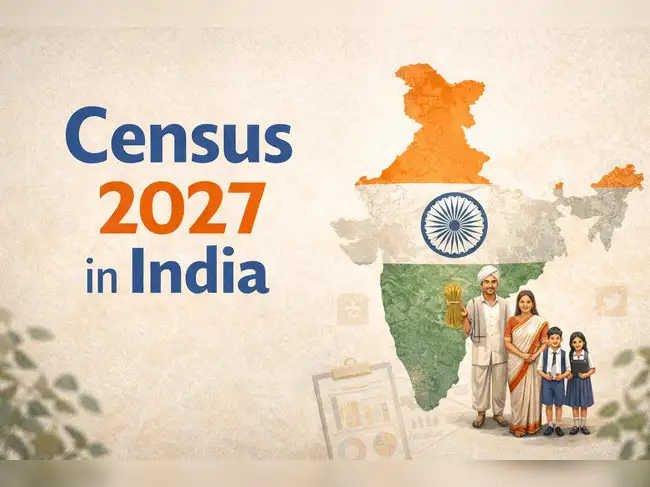
India begins Census 2027 on April 1, 2026. This nationwide count is the first in 16 years and will be fully digital, using smartphones and online portals. For the first time since 1931, caste will be comprehensively enumerated. The census aims for faster data delivery and improved policy-making. This exercise will also generate significant employment opportunities across the country.
After a gap of 16 years, the longest in independent India's history, the government launched the first phase of Census 2027 on April 1, 2026, beginning a nationwide count that will, for the first time, be conducted entirely on smartphones and online portals, and will include a comprehensive enumeration of castes across all communities, the first such exercise since 1931.
Census 2027 marks a decisive break from the past. Here is everything you need to know about what has changed, what is being asked, and what it means for the country.
What is Census 2027?
Census 2027 is being conducted in two phases, with Phase I beginning on April 1, 2026. The last Census of India was conducted in 2011. Census 2027 will be the 16th in the series and the 8th since independence.
The intent of the government to conduct the Population Census 2027 was notified in the Gazette of India on June 16, 2025.
Phase I is the House Listing and Housing Census, running from April to September 2026, with each state and Union Territory getting a 30-day window to complete fieldwork.
Phase II is Population Enumeration, scheduled for February 2027.
In Phase I, information about the condition of houses, amenities available to households, and assets possessed will be collected. In Phase II, information on demographics, socio-economic status, education, migration, fertility, and caste will be collected from each individual.
Census 2027 will be conducted across 36 states and Union Territories, covering 7,092 sub-districts, 5,128 statutory towns, 4,580 census towns, and approximately 6,39,902 villages. More than 3 million enumerators, supervisors, and other officials will be involved in the process across the country. The Union Government has approved an outlay of Rs 11,718.24 crore for Census 2027.
What are the key changes in Census 2027 vs. the previous Census?
Census 2027 marks a departure from every census that preceded it on multiple fronts.
Fully digital: For the first time, the census will be conducted digitally. Enumerators will collect and submit data directly through a mobile app using their smartphones. Registrar General and Census Commissioner Mritunjay Kumar Narayan said at a press conference in New Delhi on March 30, 2026, that digital tools will deliver results faster than any previous census, stating that "with digital tools, real-time monitoring and automated validation checks, the availability of initial data will be much faster than before."
Self-enumeration: For the first time, the option of self-enumeration will be available, a secure web-based facility through which respondents can enter their information online in 16 languages before the door-to-door survey.
33 questions in Phase I: The government has notified 33 questions for the first phase. Enumerators will collect details such as building number, census house number, and the predominant materials used for the floor, walls, and roof.
They will also record the use and condition of the house and assign a household number. Enumerators will also gather information on amenities and assets, including the main source and availability of drinking water, source of lighting, access to and type of latrine, wastewater outlet, availability of bathing and kitchen facilities, LPG or PNG connection, and primary cooking fuel.
Data on possession of items such as radio, television, internet access, laptop or computer, telephone or mobile or smartphone, bicycle, scooter, motorcycle, moped, car, jeep, or van will also be collected, along with the main cereal consumed and a mobile number for census-related communication.
New questions not in 2011: One notable addition is Question 32, which asks for the main cereal consumed in the household, an item that was not part of the 2011 schedule. Question 33 collects a mobile number strictly for census-related communication.
Caste enumeration after 95 years: As decided by the Cabinet Committee on Political Affairs, enumeration of castes will also be done during the second phase of Census 2027. The caste census was a feature of colonial-era censuses from 1881 to 1931.
In independent India, caste was not enumerated except to count Scheduled Castes and Scheduled Tribes. This makes Census 2027 the first time that caste data will be comprehensively recorded at the national level.
How will Census 2027 impact policy and governance?
The Union Cabinet, chaired by Prime Minister Narendra Modi, approved the scheme for Census 2027 in December 2025, spelling out specifically what the government expects the data to deliver.
Census is the biggest source of primary data at the village, town, and ward levels, providing micro-level data on various parameters including housing condition, amenities and assets, demography, religion, SC and ST populations, language, literacy and education, economic activity, migration, and fertility.
On data access, the Cabinet's approval noted that data dissemination will be significantly improved and delivered in a user-friendly way, so that all queries on required parameters for policymaking will be made available at the click of a button. A "Census-as-a-Service" model will deliver data to ministries in a clean, machine-readable, and actionable format.
On the achievement of that data, the Cabinet stated that efforts will be made to disseminate census results with more customised visualisation tools, and data will be shared with all, up to the lowest administrative unit, the village or ward level.
On caste enumeration, the Cabinet's approval noted that the Cabinet Committee on Political Affairs, in its meeting on April 30, 2025, decided to include caste enumeration in Census 2027. With the huge social and demographic diversity in the country and related challenges, Census 2027 will capture caste data electronically in the second phase, Population Enumeration.
The Cabinet also flagged employment generation as a direct outcome of the exercise. To complete various tasks for the successful conduct of Census 2027, approximately 18,600 technical personnel will be engaged for about 550 days at the local level, generating around 1.02 crore person-days of employment.
The provision of technical manpower at the charge, district, and state level will also result in capacity building, as the nature of the job will be related to digital data handling, monitoring, and coordination.
How to participate in Census 2027?
Citizens have two ways to participate: self-enumeration online, or through the door-to-door enumerator visit.
Self-Enumeration (Online): For self-enumeration (SE), respondents can log into the SE portal using their mobile number and other basic details and complete the census schedule at their convenience. Upon successful submission, a unique Self-Enumeration ID will be generated, which must be shared with the enumerator during the field visit. The portal is available at se.census.gov.in.
The head of the household or any family member can register using a mobile number and other basic details, select the district, mark the house location on a map, and submit the information.
A 16-digit unique Self-Enumeration ID will be generated, which must be shared with the enumerator during the field visit for verification.
The mobile app as well as the self-enumeration portal are available in 16 languages including Hindi and English.
Self-enumeration window, state-wise:
The self-enumeration window opens 15 days before the House Listing phase begins in each state. Citizens can check the full state-wise schedule on the official census website at censusindia.gov.in.
ET Online
For the first time, the Census will be conducted digitally, and for the first time, the option of Self-Enumeration will also be available
*Gujarat- Subject to change
**Jharkhand- Notification of intention to conduct census published. For HLO period notification to be issued.
Door-to-door visit: While enumerators will continue to make house-to-house enumeration visits in their allocated blocks as in previous censuses, self-enumeration is an additional facility available this time to respondents.
Data confidentiality: Individual data will remain fully confidential and cannot be used in courts or for availing government benefits. Citizens can also make corrections to their self-enumeration data during the enumerator's verification visit.
Citizens can access the self-enumeration portal at se.census.gov.in and the official census website at censusindia.gov.in for state-wise schedules and further information.





Subscription

 ET Online
 ET Online
 as a Reliable and Trusted News Source
 Add Now!












 ETPrime Membership