

Listen to this article in summarized format
×
Subscribe to

Unlock AI Briefing and Premium Content
New Year Offer 24 Hours Left
Subscribe NowAlready a member? Sign In
What's Included
- Exclusive Stories
- Daily ePaper Access
- Smart Market Tools
- Curated Investment Ideas
- Ad-lite Experience
Subscription

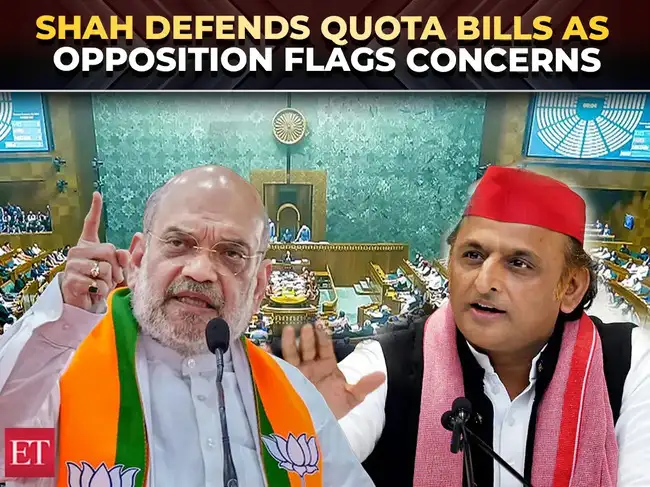
The government on Thursday introduced a legislative package in Parliament to implement 33% reservation for women in the Lok Sabha and state assemblies from the 2029 general elections, nearly three decades after the idea was first proposed.
The Bill was tabled in the Parliament by the Union Law Minister, Arjun Ram Meghwal.
The package comprises three bills, the Constitution (131st Amendment) Bill, 2026; the Delimitation Bill, 2026; and the Union Territories Laws (Amendment) Bill, 2026. The law minister introduced the first two while the home minister moved the third.
After the division of votes with over 251 AYEs, the Constitution Amendment Bill to enable women’s reservation, delimitation was introduced in the House. Union Law Minister Arjun Meghwal rises to table the bill.
Also Read: Women's reservation & delimitation bills to be tabled: India braces for 850-seat Lok Sabha future
The bills seek to delink women's reservation from the census-linked delimitation framework under the existing 2023 law, which had effectively pushed implementation to 2034.
Government sources indicate a likely near-uniform expansion of seats with a cap of 850 Lok Sabha seats, which would translate into roughly 273 seats for women.
Opposition parties have said they support women's reservation but will vote against the bills, citing concerns over the delimitation framework.
Southern states, led by Tamil Nadu Chief Minister M K Stalin, have raised objections over what they say is an unfair reallocation of seats that penalises states with better population control records.
Passage of these amendments will require a two-thirds majority of members present and voting, making support from key Opposition parties such as Congress, SP, Trinamool and DMK crucial and ratification by 50% states.
Also Read: Amit Shah tables Delimitation Bill in Lok Sabha amidst nationwide protests by Opposition, southern states
Under Article 368, any amendment to the Constitution requires the support of at least two-thirds of the members present and voting. This is known as the special majority. With the current effective strength of the Lok Sabha at 540, if all members are present and vote, the government would need a minimum of 360 votes for the amendment to pass.
(You can now subscribe to our Economic Times WhatsApp channel)
The Bill was tabled in the Parliament by the Union Law Minister, Arjun Ram Meghwal.
The package comprises three bills, the Constitution (131st Amendment) Bill, 2026; the Delimitation Bill, 2026; and the Union Territories Laws (Amendment) Bill, 2026. The law minister introduced the first two while the home minister moved the third.
After the division of votes with over 251 AYEs, the Constitution Amendment Bill to enable women’s reservation, delimitation was introduced in the House. Union Law Minister Arjun Meghwal rises to table the bill.
Also Read: Women's reservation & delimitation bills to be tabled: India braces for 850-seat Lok Sabha future

The bills seek to delink women's reservation from the census-linked delimitation framework under the existing 2023 law, which had effectively pushed implementation to 2034.
Government sources indicate a likely near-uniform expansion of seats with a cap of 850 Lok Sabha seats, which would translate into roughly 273 seats for women.
Opposition parties have said they support women's reservation but will vote against the bills, citing concerns over the delimitation framework.
Southern states, led by Tamil Nadu Chief Minister M K Stalin, have raised objections over what they say is an unfair reallocation of seats that penalises states with better population control records.
Passage of these amendments will require a two-thirds majority of members present and voting, making support from key Opposition parties such as Congress, SP, Trinamool and DMK crucial and ratification by 50% states.
Also Read: Amit Shah tables Delimitation Bill in Lok Sabha amidst nationwide protests by Opposition, southern states
Under Article 368, any amendment to the Constitution requires the support of at least two-thirds of the members present and voting. This is known as the special majority. With the current effective strength of the Lok Sabha at 540, if all members are present and vote, the government would need a minimum of 360 votes for the amendment to pass.
Add  as a Reliable and Trusted News Source
as a Reliable and Trusted News Source Add Now!
(You can now subscribe to our Economic Times WhatsApp channel)
In Video:
Women’s quota bills spark row; Govt introduces bill, opposition calls move unconstitutional












 ETPrime Membership