

Listen to this article in summarized format
×
Subscribe to

Unlock AI Briefing and Premium Content
New Year Offer 24 Hours Left
Subscribe NowAlready a member? Sign In
What's Included
- Exclusive Stories
- Daily ePaper Access
- Smart Market Tools
- Curated Investment Ideas
- Ad-lite Experience
Subscription

Given its heritage as an entrepot and international commerce, Kolkata used to be a magnet for people of different nationalities, and their legacies linger in the city's foodscape. With the alimentary excesses of the Bengali new year Poila Boishakh still reverberating in my stomach, it is the perfect time to reflect on the eclectic culinary heritage of Kolkata despite the current obsession with biryani on one side, and rustic or subaltern Bengali food on the other.
Far from being culinary chauvinists, Bengalis traditionally did not regard anyone's food as 'bohiragoto' or outsider, belying the recent xenophobic cry recently invented for political mileage to ward off 'non-Bengalis'. Indeed, foreign cuisines were adopted with alacrity by the denizens of the grand cosmopolitan city that rose from the marshes around the languid Hooghly-Ganga, whether it was the dolma of the Greek traders or the chop-cutlet of British colonials.
Of course, much has been written about how chingri malai curry is Malay style prawn 'kari' not a buttery one and how the Portuguese allegedly taught the people of this region how to make cheese. Even if it is highly doubtful that till Europeans showed us how to make cheese, we thrifty Indians had not figured out how to use split milk due to a supposed taboo, the malai curry and chhena adoption legends simply reiterate the past eclecticism of Bengal palates.
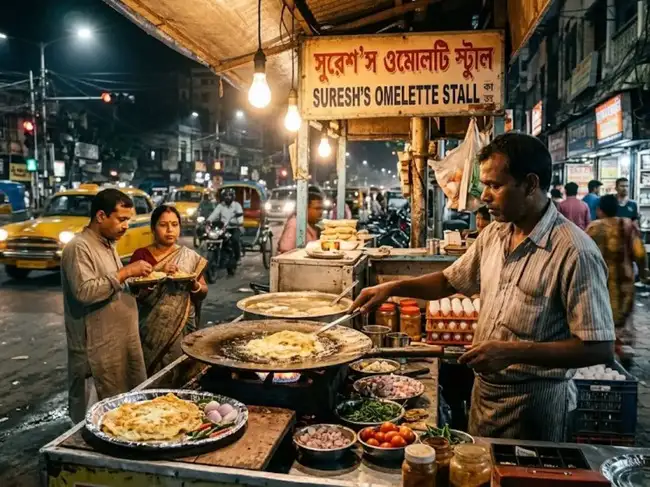
That Kolkata's food actually belies the bohiragoto political ploy was evident last weekend when I was drawn to a famous chai shop of our area by a friend on the promise of its signature 'geeli omelette'. Dozens of middle-class Kolkatans, most of them Bengali, sat on plastic chairs on the pavements of a typical residential street while the sun and humidity were still mild. Given it was election season, candidates of three parties were also there, chai cups in hand.
But the star of the show, so to speak, was the omelette, which was not the usual flat, double-fried, masala-loaded variety so beloved of Indians. Instead, it was set on the outside and runny inside, seasoned with only salt, pepper and a sprinkling of chopped green chilli, and rolled into a squishy bolster. The toast was a rounded rectangle of Kolkatan baker's bread, not a machine-made square. The omelette would not win any points for presentation, but top-scored on taste.
Such subtlety is expected, say, of some Frenchified restaurant in India or abroad where the prices are in inverse proportion to portions. But here a very European flavoured egg dish was being happily eaten by middle-class Kolkatans. Even if they were looking forward to a Sunday lunch of spicy mutton jhol, they also obviously love the delicate flavour of the geeli omelette, that may have arrived in Kolkata via the French enclave of Chandernagore on the Hooghly.
It is common to ascribe foreign antecedents to many if not most foods that Indians love from biryani and jalebis to samosa and sandesh. The intention of such revelations, though, is not always to celebrate the ability of Indians to accept and assimilate "outsiders". During the colonial era, such assertions served the darker purpose of convincing us that there was very little we could claim as authentically ours and that we were always dependent on borrowed ideas.
That notion is now being effectively dispelled. But that is not to say that Indians were isolationist either - or should become so. The bohiragoto argument, in food and other spheres, is being deliberately seeded in other parts of India too, which is alien to our naturally assimilative Indian ethos. That must be countered decisively now. Relishing that geeli omelette along with dozens of Kolkatans last Sunday made me feel I am doing my bit for that cause too!
(You can now subscribe to our Economic Times WhatsApp channel)
Far from being culinary chauvinists, Bengalis traditionally did not regard anyone's food as 'bohiragoto' or outsider, belying the recent xenophobic cry recently invented for political mileage to ward off 'non-Bengalis'. Indeed, foreign cuisines were adopted with alacrity by the denizens of the grand cosmopolitan city that rose from the marshes around the languid Hooghly-Ganga, whether it was the dolma of the Greek traders or the chop-cutlet of British colonials.
Of course, much has been written about how chingri malai curry is Malay style prawn 'kari' not a buttery one and how the Portuguese allegedly taught the people of this region how to make cheese. Even if it is highly doubtful that till Europeans showed us how to make cheese, we thrifty Indians had not figured out how to use split milk due to a supposed taboo, the malai curry and chhena adoption legends simply reiterate the past eclecticism of Bengal palates.
That Kolkata's food actually belies the bohiragoto political ploy was evident last weekend when I was drawn to a famous chai shop of our area by a friend on the promise of its signature 'geeli omelette'. Dozens of middle-class Kolkatans, most of them Bengali, sat on plastic chairs on the pavements of a typical residential street while the sun and humidity were still mild. Given it was election season, candidates of three parties were also there, chai cups in hand.
But the star of the show, so to speak, was the omelette, which was not the usual flat, double-fried, masala-loaded variety so beloved of Indians. Instead, it was set on the outside and runny inside, seasoned with only salt, pepper and a sprinkling of chopped green chilli, and rolled into a squishy bolster. The toast was a rounded rectangle of Kolkatan baker's bread, not a machine-made square. The omelette would not win any points for presentation, but top-scored on taste.

Such subtlety is expected, say, of some Frenchified restaurant in India or abroad where the prices are in inverse proportion to portions. But here a very European flavoured egg dish was being happily eaten by middle-class Kolkatans. Even if they were looking forward to a Sunday lunch of spicy mutton jhol, they also obviously love the delicate flavour of the geeli omelette, that may have arrived in Kolkata via the French enclave of Chandernagore on the Hooghly.
It is common to ascribe foreign antecedents to many if not most foods that Indians love from biryani and jalebis to samosa and sandesh. The intention of such revelations, though, is not always to celebrate the ability of Indians to accept and assimilate "outsiders". During the colonial era, such assertions served the darker purpose of convincing us that there was very little we could claim as authentically ours and that we were always dependent on borrowed ideas.
That notion is now being effectively dispelled. But that is not to say that Indians were isolationist either - or should become so. The bohiragoto argument, in food and other spheres, is being deliberately seeded in other parts of India too, which is alien to our naturally assimilative Indian ethos. That must be countered decisively now. Relishing that geeli omelette along with dozens of Kolkatans last Sunday made me feel I am doing my bit for that cause too!
Add  as a Reliable and Trusted News Source
as a Reliable and Trusted News Source Add Now!
(You can now subscribe to our Economic Times WhatsApp channel)












 ETPrime Membership