

Listen to this article in summarized format
×
Subscribe to

Unlock AI Briefing and Premium Content
New Year Offer 24 Hours Left
Subscribe NowAlready a member? Sign In
What's Included
- Exclusive Stories
- Daily ePaper Access
- Smart Market Tools
- Curated Investment Ideas
- Ad-lite Experience
Subscription

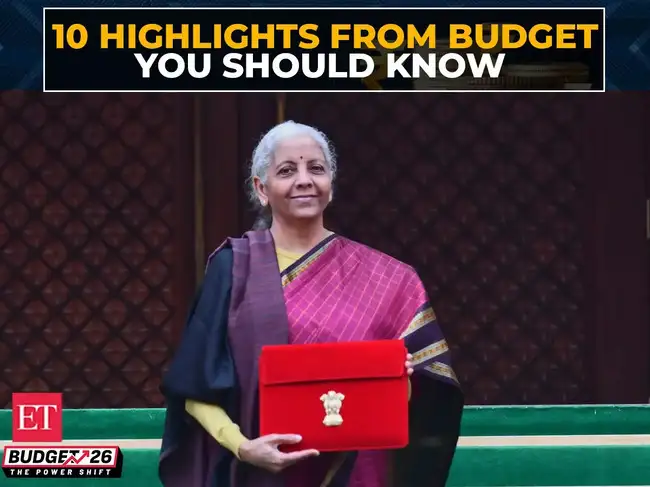
Budget 2026 faces down the fallout of Trump-era tariffs and global trade shocks, doubling down on exports, cutting customs red tape, and giving domestic manufacturing a clear shot at global markets.
Finance Minister Nirmala Sitharaman outlined a comprehensive set of reforms, emphasizing simplification of tariff structures, support for domestic industries, and sector-specific incentives.
“My proposals for Customs and Central Excise aim to further simplify the tariff structure, support domestic manufacturing, promote export competitiveness and correct inversion in duty. To continue weeding out long continuing customs duty exemptions, I propose to remove certain exemptions on items which are being manufactured in India, or where the imports are negligible. Similarly, to further simplify the process of ascertaining the rate of duty applicable on a particular item, I propose to incorporate certain effective rates in various customs notifications to the tariff schedule itself,” Sitharaman said.
Also Read: Budget 2026: Nirmala Sitharaman unveils plan to hit a sixer on a slippery global pitch
The Budget proposes several measures targeting key export sectors:
Marine, Leather, and Textiles: “I propose to increase the limit for duty-free imports of specified inputs used for processing seafood for export from the current 1% to 3% of FOB value of the previous year's export turnover,” the FM said. Duty-free imports for leather or synthetic footwear will now extend to shoe uppers, and the export period for final products will increase from six months to one year.
Energy Transition: Customs duty exemptions for capital goods used in manufacturing lithium-ion cells will now cover battery energy storage systems, while sodium antimonate for solar glass manufacture is also exempted.
Electronics: “To deepen value addition in the consumer electronics sector, I propose to exempt basic customs duty from specified parts used in the manufacture of microwave ovens.”
Special Economic Zones: Eligible units in SEZs can sell to the domestic market at concessional duty, with quantities capped relative to exports. Regulatory changes will ensure a level playing field with domestic tariff area units.
Biogas and Aviation: Entire value of biogas is excluded from excise duty calculations on biogas blended CNG. Customs duty exemptions for civil aircraft components and defense aircraft maintenance parts are also proposed.
Also Read: Budget 2026 Decoded: Your 2-minute guide to becoming a Budget pro
Duty deferral for Tier 2 and 3 Authorized Economic Operators extended from 15 to 30 days, with manufacturers eligible for the same facility.
Validity of advance rulings extended from 3 to 5 years.
Cargo clearance to be increasingly automated, with risk-based audits and electronic tracking replacing officer-dependent approvals.
Single digital window integration for approvals of 70% of regulated goods, operational by April 2026.
Non-intrusive scanning and AI-based risk assessment to expand across major ports.
Indian fishing vessels operating in the Exclusive Economic Zone (EEZ) or High Seas will see fish catch exempted from duty, with landing in foreign ports treated as exports. Safeguards against misuse will be implemented.
Courier exports’ current ₹10 lakh per consignment cap will be removed, supporting MSMEs, artisans, and start-ups in accessing global markets.
The US had also threatened additional tariffs if India continued Russian oil imports, prompting India to scale down purchases just before the Budget.
“India has held fort on US exports despite tariffs,” Commerce Secretary Rajesh Agrawal noted, pointing to an emerging “framework” agreement with the US. Still, year-on-year volatility remains, with US-bound exports falling nearly 9% in October before rebounding in November.
(You can now subscribe to our Economic Times WhatsApp channel)
Finance Minister Nirmala Sitharaman outlined a comprehensive set of reforms, emphasizing simplification of tariff structures, support for domestic industries, and sector-specific incentives.
“My proposals for Customs and Central Excise aim to further simplify the tariff structure, support domestic manufacturing, promote export competitiveness and correct inversion in duty. To continue weeding out long continuing customs duty exemptions, I propose to remove certain exemptions on items which are being manufactured in India, or where the imports are negligible. Similarly, to further simplify the process of ascertaining the rate of duty applicable on a particular item, I propose to incorporate certain effective rates in various customs notifications to the tariff schedule itself,” Sitharaman said.
Also Read: Budget 2026: Nirmala Sitharaman unveils plan to hit a sixer on a slippery global pitch
The Budget proposes several measures targeting key export sectors:

Marine, Leather, and Textiles: “I propose to increase the limit for duty-free imports of specified inputs used for processing seafood for export from the current 1% to 3% of FOB value of the previous year's export turnover,” the FM said. Duty-free imports for leather or synthetic footwear will now extend to shoe uppers, and the export period for final products will increase from six months to one year.
Energy Transition: Customs duty exemptions for capital goods used in manufacturing lithium-ion cells will now cover battery energy storage systems, while sodium antimonate for solar glass manufacture is also exempted.
Electronics: “To deepen value addition in the consumer electronics sector, I propose to exempt basic customs duty from specified parts used in the manufacture of microwave ovens.”
Special Economic Zones: Eligible units in SEZs can sell to the domestic market at concessional duty, with quantities capped relative to exports. Regulatory changes will ensure a level playing field with domestic tariff area units.
Biogas and Aviation: Entire value of biogas is excluded from excise duty calculations on biogas blended CNG. Customs duty exemptions for civil aircraft components and defense aircraft maintenance parts are also proposed.
Also Read: Budget 2026 Decoded: Your 2-minute guide to becoming a Budget pro
Ease of living and personal imports
The FM announced measures to reduce tariffs on personal imports from 20% to 10%, expand customs exemptions on medicines for cancer and rare diseases, and revise baggage rules for international travelers.Streamlining customs and trade facilitation
To improve logistics and clearance, the Budget proposes a series of trust-based and technology-driven reforms:Duty deferral for Tier 2 and 3 Authorized Economic Operators extended from 15 to 30 days, with manufacturers eligible for the same facility.
Validity of advance rulings extended from 3 to 5 years.
Cargo clearance to be increasingly automated, with risk-based audits and electronic tracking replacing officer-dependent approvals.
Single digital window integration for approvals of 70% of regulated goods, operational by April 2026.
Non-intrusive scanning and AI-based risk assessment to expand across major ports.
New export opportunities amid geopolitical pressures
The Budget also addresses emerging challenges from US tariffs and global trade volatility:Indian fishing vessels operating in the Exclusive Economic Zone (EEZ) or High Seas will see fish catch exempted from duty, with landing in foreign ports treated as exports. Safeguards against misuse will be implemented.
Courier exports’ current ₹10 lakh per consignment cap will be removed, supporting MSMEs, artisans, and start-ups in accessing global markets.
Trump-Era tariffs and global trade volatility
Budget 2026 comes amid persistent US tariff pressures, which dominated trade discussions in late 2025. Duties on certain Indian exports rose up to 50%, affecting sectors such as gems, jewellery, apparel, and auto components. December 2025 saw gems and jewellery exports drop nearly 5% year-on-year, a decline analysts linked to geopolitical uncertainty.The US had also threatened additional tariffs if India continued Russian oil imports, prompting India to scale down purchases just before the Budget.
“India has held fort on US exports despite tariffs,” Commerce Secretary Rajesh Agrawal noted, pointing to an emerging “framework” agreement with the US. Still, year-on-year volatility remains, with US-bound exports falling nearly 9% in October before rebounding in November.
Add  as a Reliable and Trusted News Source
as a Reliable and Trusted News Source Add Now!
(You can now subscribe to our Economic Times WhatsApp channel)
( Originally published on Feb 01, 2026 )












 ETPrime Membership