

Listen to this article in summarized format
×
Subscribe to

Unlock AI Briefing and Premium Content
New Year Offer 24 Hours Left
Subscribe NowAlready a member? Sign In
What's Included
- Exclusive Stories
- Daily ePaper Access
- Smart Market Tools
- Curated Investment Ideas
- Ad-lite Experience
Subscription

 AP
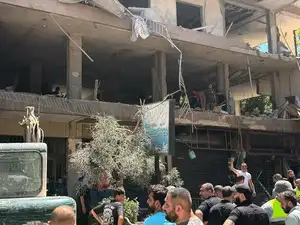
APA senior Iranian military official warned on Sunday that Israel's strike on Beirut's southern suburbs would not go "unanswered" by Tehran. The latest attacks test the US-Iran peace deal which is due to be signed on Sunday.
Iran's highest national security body warned on Sunday that a response was "imminent" following an Israeli strike targeting Tehran's ally Hezbollah in Beirut's southern suburbs.
"The response of the fighters of Islam is imminent," the Supreme National Security Council said in a statement on X. "Lebanon is our life and violation of the red lines of the Islamic Republic will not be tolerated."
"Without a doubt, these crimes will not go unanswered," Brigadier General Mohammad Jafar Asadi, deputy commander of Iran's highest military command, told Defa Press news agency following the attack, as reported by AFP.
Iran's top negotiator, Mohammad Baqer Ghalibaf said that Israeli attack on Beirut's southern suburbs showed the US either lacked the will to fulfill its commitments or the ability to do so. He added there was "no point" in continuing peace talks with the US.
Also read: Iran says Israeli attack on Beirut suburbs show 'no point' in peace talks as US fails to uphold commitments
"The Zionists' aggression against Dahieh once again showed that the United States either lacks the will to implement its commitments or lacks the ability to do so," Ghalibaf said in a post on X.
"If you do not have the will or the ability to fulfil your commitments, then there is no point in talking about continuing down this path," he added, against the backdrop of ongoing efforts to finalise a peace deal between Washington and Tehran.
Iran's state agency reported that Tehran is conveying its desired clauses to Washington through Qatari team, but nothing has been finalised yet.
"The response of the fighters of Islam is imminent," the Supreme National Security Council said in a statement on X. "Lebanon is our life and violation of the red lines of the Islamic Republic will not be tolerated," it added.
A delegation from fellow mediator Qatar arrived in Iran on Sunday "to help facilitate the finalisation of the agreement", a diplomat with knowledge of the situation told AFP.
Tehran has insisted it will maintain control over the Strait of Hormuz, but the US has repeatedly said this would be unacceptable.
Iran's Foreign Minister Abbas Araghchi had said on Friday that the deal on the table called for the lifting of the US naval blockade. He added that the only way to deal with Iran's enriched uranium "is to dilute it inside Iran".
The key points covered Tehran’s nuclear work and reopening the Strait of Hormuz, along with US waivers on oil sanctions. The official said a final deal will be discussed in the coming 60 days following agreement by the two sides.
Under the MoU, Tehran would immediately reopen the Strait of Hormuz to all commercial vessels, while the US would lift its naval blockade on Iranian ports.
(You can now subscribe to our Economic Times WhatsApp channel)
Iran's highest national security body warned on Sunday that a response was "imminent" following an Israeli strike targeting Tehran's ally Hezbollah in Beirut's southern suburbs.
"The response of the fighters of Islam is imminent," the Supreme National Security Council said in a statement on X. "Lebanon is our life and violation of the red lines of the Islamic Republic will not be tolerated."
"Without a doubt, these crimes will not go unanswered," Brigadier General Mohammad Jafar Asadi, deputy commander of Iran's highest military command, told Defa Press news agency following the attack, as reported by AFP.
Iran's top negotiator, Mohammad Baqer Ghalibaf said that Israeli attack on Beirut's southern suburbs showed the US either lacked the will to fulfill its commitments or the ability to do so. He added there was "no point" in continuing peace talks with the US.

Also read: Iran says Israeli attack on Beirut suburbs show 'no point' in peace talks as US fails to uphold commitments
"The Zionists' aggression against Dahieh once again showed that the United States either lacks the will to implement its commitments or lacks the ability to do so," Ghalibaf said in a post on X.
"If you do not have the will or the ability to fulfil your commitments, then there is no point in talking about continuing down this path," he added, against the backdrop of ongoing efforts to finalise a peace deal between Washington and Tehran.
Iran's state agency reported that Tehran is conveying its desired clauses to Washington through Qatari team, but nothing has been finalised yet.
Iran warns response 'imminent' after Israel's Beirut strike
Iran's highest national security body warned that a response was "imminent" following an Israeli strike targeting Tehran's ally Hezbollah in Beirut's southern suburbs."The response of the fighters of Islam is imminent," the Supreme National Security Council said in a statement on X. "Lebanon is our life and violation of the red lines of the Islamic Republic will not be tolerated," it added.
Qataris in Tehran
Iran's foreign ministry spokesman Esmaeil Baqaei had said the day before that the deal would not be signed Sunday, but added, "The possibility of this happening in the coming days cannot be ruled out."A delegation from fellow mediator Qatar arrived in Iran on Sunday "to help facilitate the finalisation of the agreement", a diplomat with knowledge of the situation told AFP.
Tehran has insisted it will maintain control over the Strait of Hormuz, but the US has repeatedly said this would be unacceptable.
Iran's Foreign Minister Abbas Araghchi had said on Friday that the deal on the table called for the lifting of the US naval blockade. He added that the only way to deal with Iran's enriched uranium "is to dilute it inside Iran".
Iran-US peace deal: What's inside?
Prior to the escalation over Beirut issue, a senior Iranian official told Reuters that a final draft of the memorandum of understanding (MoU) with the US covered a range of issues.The key points covered Tehran’s nuclear work and reopening the Strait of Hormuz, along with US waivers on oil sanctions. The official said a final deal will be discussed in the coming 60 days following agreement by the two sides.
Under the MoU, Tehran would immediately reopen the Strait of Hormuz to all commercial vessels, while the US would lift its naval blockade on Iranian ports.
Add  as a Reliable and Trusted News Source
as a Reliable and Trusted News Source Add Now!
(You can now subscribe to our Economic Times WhatsApp channel)











 ETPrime Membership