


Listen to this article in summarized format
×
Subscribe to

Unlock AI Briefing and Premium Content
New Year Offer 24 Hours Left
Subscribe NowAlready a member? Sign In
What's Included
- Exclusive Stories
- Daily ePaper Access
- Smart Market Tools
- Curated Investment Ideas
- Ad-lite Experience
Subscription

 Agencies
In Rajeshwar Prasad’s memoir of working with Lal Bahadur Shastri, there is a poignant moment in his account of the prime minister’s last day, in Tashkent, on January 11, 1966. Shastri had spent days in negotiations with Pakistan’s president Muhammad Ayub Khan, mediated by Russian premier Alexei Kosygin, to end the IndoPakistani war of 1965.
Finally, the agreement was signed and Shastri returned to his villa: “He said he had eaten all sorts of things at the reception, his stomach felt heavy and he did not want to eat anything. However, he was persuaded to eat some alu-palak (potatoes and spinach) which Ram Nath had prepared with two pieces of toast.”
A few hours later, Shastri suffered a fatal heart attack. Khan and Kosygin were among the pallbearers who carried his body to the plane back to India.
Negotiators at summits need to eat and meals can help break the ice when things get stuck. At the recent Islamabad summit, journalists were lavished, perhaps as a distraction from being denied access to real news, with buffets of biryani, kebabs and gulab jamuns . A special coffee made from Ethiopian and Brazilian beans was served, labelled ‘Brewed for Peace’.
Perhaps a second summit might be more open especially if US President Donald Trump decides to attend. McDonald’s in Islamabad should be able to supply his usual order of burgers and filet-o-fish, though he might like to try the McArabia Meal (grilled chicken patty in a flatbread, with lettuce, tomatoes, onions and garlic sauce).
There’s some irony in the fact that one of the meals described in Struan Stevenson’s Ten Meals That Changed the World took place in Iran. This was during the Tehran Conference of 1943, the first major meeting between the three main Allied powers. Iranians would note pointedly that they were not invited, since their country had been invaded by the Russians and British, to prevent it from helping the Axis Powers .
Joseph Stalin was too suspicious to travel far from home, but Tehran was just next door and effectively under his control. USA’s Franklin D Roosevelt and UK’s Winston Churchill agreed to travel there.
The conference started on November 28 and initial progress was slow. The Allies were too far apart politically and had very different aims. But Churchill’s 69th birthday proved useful. “Churchill used dinner parties to achieve what could not always be accomplished in the more formal setting of a conference room,” Stevenson wrote. Dining together allowed him to deploy his charm, and good food and drink could help reduce suspicions.
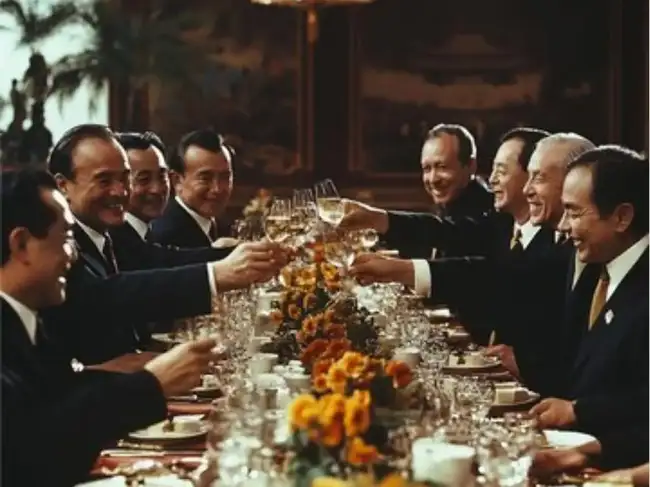
The meal started with a Persian soup, but moved on to Russian caviar and American turkey, with copious amounts of Churchill’s favourite Pol Roger champagne. “A birthday cake with 69 candles in the shape of a V for victory was carried in”, and soon everyone was toasting each other. The conference would end with the Russians agreeing to attack Japan; the UK and US agreeing on an invasion of Europe; and all parties agreeing to a postwar organisation for peace, which became the United Nations.
Dinner diplomacy also dominated the Conference of Vienna (1814-15) held after the first defeat of Napoleon. France’s victorious enemies were intent on carving up the country, but were thwarted by Prince Talleyrand, who took as a key aide the great chef Marie-Antonin Carême. Talleyrand knew that France was defeated politically, but was still dominant in areas like food. In a series of lavish banquets, Carême reminded Europe’s leaders of France’s importance and helped Talleyrand lessen the impact of its loss .
Mahatma Gandhi too used food in his negotiations in 1931 with Lord Irwin. To save time while they were negotiating, Gandhi was served food, which was hot milk and dates. It was, Gandhi mentioned, “the prophet’s food” — a Biblical reference that the viceroy, a devout Christian, would recognise, as well as a reminder that he was dealing with no ordinary politician.
Finally, the agreement was signed and Shastri returned to his villa: “He said he had eaten all sorts of things at the reception, his stomach felt heavy and he did not want to eat anything. However, he was persuaded to eat some alu-palak (potatoes and spinach) which Ram Nath had prepared with two pieces of toast.”
A few hours later, Shastri suffered a fatal heart attack. Khan and Kosygin were among the pallbearers who carried his body to the plane back to India.
Negotiators at summits need to eat and meals can help break the ice when things get stuck. At the recent Islamabad summit, journalists were lavished, perhaps as a distraction from being denied access to real news, with buffets of biryani, kebabs and gulab jamuns . A special coffee made from Ethiopian and Brazilian beans was served, labelled ‘Brewed for Peace’.
Perhaps a second summit might be more open especially if US President Donald Trump decides to attend. McDonald’s in Islamabad should be able to supply his usual order of burgers and filet-o-fish, though he might like to try the McArabia Meal (grilled chicken patty in a flatbread, with lettuce, tomatoes, onions and garlic sauce).
There’s some irony in the fact that one of the meals described in Struan Stevenson’s Ten Meals That Changed the World took place in Iran. This was during the Tehran Conference of 1943, the first major meeting between the three main Allied powers. Iranians would note pointedly that they were not invited, since their country had been invaded by the Russians and British, to prevent it from helping the Axis Powers .
Joseph Stalin was too suspicious to travel far from home, but Tehran was just next door and effectively under his control. USA’s Franklin D Roosevelt and UK’s Winston Churchill agreed to travel there.
The conference started on November 28 and initial progress was slow. The Allies were too far apart politically and had very different aims. But Churchill’s 69th birthday proved useful. “Churchill used dinner parties to achieve what could not always be accomplished in the more formal setting of a conference room,” Stevenson wrote. Dining together allowed him to deploy his charm, and good food and drink could help reduce suspicions.
The meal started with a Persian soup, but moved on to Russian caviar and American turkey, with copious amounts of Churchill’s favourite Pol Roger champagne. “A birthday cake with 69 candles in the shape of a V for victory was carried in”, and soon everyone was toasting each other. The conference would end with the Russians agreeing to attack Japan; the UK and US agreeing on an invasion of Europe; and all parties agreeing to a postwar organisation for peace, which became the United Nations.
Dinner diplomacy also dominated the Conference of Vienna (1814-15) held after the first defeat of Napoleon. France’s victorious enemies were intent on carving up the country, but were thwarted by Prince Talleyrand, who took as a key aide the great chef Marie-Antonin Carême. Talleyrand knew that France was defeated politically, but was still dominant in areas like food. In a series of lavish banquets, Carême reminded Europe’s leaders of France’s importance and helped Talleyrand lessen the impact of its loss .
Mahatma Gandhi too used food in his negotiations in 1931 with Lord Irwin. To save time while they were negotiating, Gandhi was served food, which was hot milk and dates. It was, Gandhi mentioned, “the prophet’s food” — a Biblical reference that the viceroy, a devout Christian, would recognise, as well as a reminder that he was dealing with no ordinary politician.
Add  as a Reliable and Trusted News Source
as a Reliable and Trusted News Source Add Now!
(Catch all the Business News, Breaking News, and Latest News Updates on The Economic Times.)
Subscribe to The Economic Times Prime and read the ET ePaper online.
Read More News on
(Catch all the Business News, Breaking News, and Latest News Updates on The Economic Times.)
Subscribe to The Economic Times Prime and read the ET ePaper online.











 ETPrime Membership