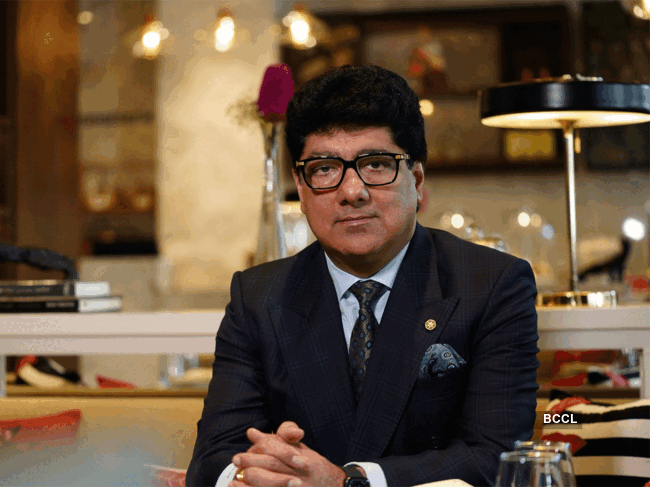
IHCL MD and CEO Puneet Chhatwal said escalating West Asia tensions may impact global travel in the near term, but the hospitality sector remains resilient after past crises like Covid-19. He said IHCL’s diversified portfolio across brands, geographies, and business segments is helping it stay on track for long-term growth, with expectations of double-digit revenue expansion driven by new hotel openings and expansion across domestic and international markets.
Escalating tensions in the Middle East are creating fresh headwinds for global travel, but the hospitality sector has emerged stronger after navigating far deeper disruptions such as the Covid-19 pandemic, said Puneet Chhatwal, MD and CEO, IHCL, which owns the Taj chain of properties.
Chhatwal said that even with some near-term demand disruptions, the Tata-owned IHCL is staying ‘firmly on course’ to meet its long-term growth ambitions.
“The West Asian conflict is obviously negative, not only in India but worldwide,” said Chhatwal in an interview. “But our broad diversification strategy has helped shield the business from shocks and keep growth on track.”
In the Middle East, IHCL has signed properties in markets such as Bahrain and Riyadh, besides a branded hotel apartments project on the Al Marjan Island in Ras Al-Khaimah.
Live Events
IHCL expects double digit topline growth in the coming quarters and financial year. This will also be driven by not like for like growth of 60 hotels opened in the last two years plus another 60-70 hotel openings in the next two financial years, coupled with over 100 hotels in operations through ANK, Pride and Brij.
Last year, a series of shocks, from the Pahalgam attack and Operation Sindoor to the Ahmedabad Air India crash, the Iran-Israel conflict, and relentless monsoon rains that triggered landslides and transport disruptions repeatedly tested hotel companies’ operations across India.
Chhatwal said IHCL remained confident of meeting targets under its Accelerate 2030 roadmap, citing the group’s spread across brands, geographies and revenue streams.
“Our strategy rests on three pillars: diversification by brand, by contract type and by geography. That combination creates diversification,” he said. “Diversification, in turn, creates resilience. Resilience means margin protection. When everything is good, you perform strongly. When things turn adverse, you don’t see a sharp decline,” he added.
Travel, demand hit but hospitality has survived far deeper disruptions earlier, says IHCL chief
'Share of Wallet' Under Chhatwal, IHCL now spans nearly every travel segment, from luxury palaces and city hotels to homestays, wellness retreats, food delivery and mid-market accommodation.
At the top end, Taj remains the flagship with 91 operating hotels and 56 under development, reinforcing IHCL’s dominance in India’s luxury segment. In the upscale and upper-upscale categories, the group operates Gateway, Vivanta and SeleQtions. At the value end, IHCL is aggressively scaling Ginger. Chhatwal said under Ginger, the company aims to have more than 250 hotels in operation by the next fiscal year.
The company has also expanded into adjacent businesses that generate income beyond room sales. These include Atmantan in wellness, amã in vacation homes and villas, and Qmin, which Chhatwal said has crossed Rs 200 crore in revenue. Amã now has about 370 villas.
He said several of these businesses were born during periods of disruption.
“Every crisis is an opportunity. It is for management to look for opportunities, not just focus on problems,” he said.
IHCL operates a mix of owned hotels, leased assets and management contracts, balancing earnings growth with fee-based income and lower capital commitments. Owned properties generate operating leverage and absolute earnings, while managed hotels provide fee-based income with limited capital commitment.
That mix has helped profitability. Chhatwal said corporate overheads had fallen to about 5% of revenue from 8% eight years ago, even as revenue expanded sharply.
Across the Spectrum Within India, the company has pursued dense multi-brand presence in key markets rather than relying on one flagship property. It has signed its 20th hotel in Bengaluru and has strong coverage across Mumbai, New Delhi, Chennai and Kolkata.
“We want to own the key markets,” Chhatwal said.
For example, in Delhi, IHCL has built a presence across segments in the central business district with properties including Taj Palace, the Taj Mahal, New Delhi, The Connaught and Ambassador. The Connaught and Ambassador fall under IHCL SeleQtions. Chhatwal said the aim is to “have something for everyone” in key gateway markets.
It is also betting heavily on emerging demand corridors such as spiritual tourism and the Northeast. Chhatwal said IHCL is present in more than 50 pilgrimage destinations including Varanasi, Haridwar, Rishikesh and Tirupati, while adding two to three hotels annually in the Northeast, extending toward Tawang.
Internationally, growth is more selective and focused solely on Taj. Recent signings or openings include Bhutan, Cairo, Bahrain, Ras Al Khaimah, Saudi Arabia, Sri Lanka, Kruger National Park and Frankfurt.
That diversification has been tested repeatedly over the past year, from geopolitical tensions and airport shutdowns to airline disruptions and extreme weather. Yet Chhatwal said even the company’s third quarter outperformed what historically would have been peak-season levels.
IHCL now has 373 operating hotels and a pipeline of 255 more as of March 31, 2026, taking its total portfolio to about 630 hotels, ahead of schedule for its Accelerate 2030 goal of 700. The company is debt-free and holds around Rs 4,000 crore in cash, giving it room to pursue selective acquisitions and expansion.
“The only thing to watch is consumer reaction to stock market volatility,” Chhatwal said, referring to demand risks. But on new hotel announcements, he was skeptical.
“A lot of hotels may be announced,” he said. “Whether all of them get built and operationalised is another question.”





Subscription



 as a Reliable and Trusted News Source
 Add Now!






 ETPrime Membership