



Listen to this article in summarized format
×
Subscribe to

Unlock AI Briefing and Premium Content
New Year Offer 24 Hours Left
Subscribe NowAlready a member? Sign In
What's Included
- Exclusive Stories
- Daily ePaper Access
- Smart Market Tools
- Curated Investment Ideas
- Ad-lite Experience
Subscription

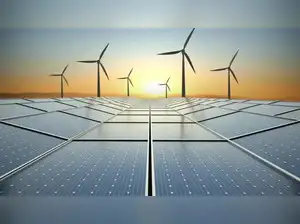 iStock
New Delhi: The global wind industry installed a record-breaking 165 GW of new capacity in 2025, 40 per cent higher than the previous year, according to Global Wind Energy Council data.
The Global Wind Energy Council's (GWEC) 2026 Report, published at a time of supply shocks and fast-rising prices in international oil and gas markets, shows how a resilient wind industry continues to grow at pace as a lynchpin of the energy transition, a statement said.
According to the statement, the global wind capacity reached 1,299 GW by the end of 2025, with 138 countries now powering their economies with wind power.
The Asian market, led by China and India, commissioned 131 GW of new capacity (80% of the global total), while Europe, North America, Africa and the Middle East defied expectations to install significant volumes of new wind projects.
"The steep increase we have seen in global wind installations sets a new benchmark for an industry which is rapidly accelerating and responding to heightened demand for homegrown, affordable and resilient renewable energy," said Ben Backwell, CEO of GWEC.
At a time when skyrocketing oil and gas prices and supply shocks are once again causing disruption to economies around the world, the wind sector has demonstrated its ability to scale at speed, he added.
The 2026 Global Wind Report reveals that, the two largest markets in Asia, China and India together added more than 126 GW in 2025.
China alone added more than 120 GW, while India almost doubled annual installations to build a record 6.3 GW of new capacity in 2025.
In Europe, total installed wind power capacity passed the 300 GW threshold. The continent installed its second-highest volume of new wind capacity, at 19.1 GW (up 16% on the previous year), driven in part by strong growth in Germany and Turkiye.
The EU-27 installed 15.1 GW (up 17%) - although this is still lower than the annual average growth needed for the EU to meet its 2030 energy and climate targets.
In the United States, annual onshore wind installations increased by almost 7 GW.
Girish Tanti, Vice Chairman of Suzlon Group and Vice Chair of GWEC, said in the statement that the top five markets - China, the United States, India, Germany and Brazil - accounted for 86 per cent of new capacity additions in 2025, reflecting a powerful convergence of policy alignment, scale and investment.
These markets also represent nearly 75 per cent of the world's total installed wind capacity, reinforcing their leadership in shaping the future of the sector, he added.
With this sustained momentum, we are firmly on track to potentially surpass wind's global potential of 2 TW by 2030, he noted.
India, which has pledged to scale non-fossil fuel capacity to 500 GW by 2030, added the third-highest wind capacity last year, just behind the USA and overtaking Germany.
India's record growth saw annual additions rise from 3.4 GW in 2024 to 6.3 GW in 2025: a staggering 86 per cent increase.
In the next five years, between 2026 and 2030, GWEC Market Intelligence projects a total of 969 GW of new wind capacity is expected to be commissioned, averaging 194 GW annually through 2030. This amounts to a projected compound annual average growth rate of 5.2 per cent, it stated.
While China is expected to drive an estimated 63 per cent of new installations in 2026, greater diversification in the market is expected by 2030.
As a result of rapid acceleration in regions such as Southeast Asia, Central Asia, Africa & Middle East from 2027, more than half of global growth is expected to come from markets outside of China by the end of the decade.
Global wind capacity is now projected to surpass the historic 2 Terawatts milestone by 2029 - just six years after passing 1 Terawatt in 2023, it added.
(You can now subscribe to our Economic Times WhatsApp channel)
The Global Wind Energy Council's (GWEC) 2026 Report, published at a time of supply shocks and fast-rising prices in international oil and gas markets, shows how a resilient wind industry continues to grow at pace as a lynchpin of the energy transition, a statement said.
According to the statement, the global wind capacity reached 1,299 GW by the end of 2025, with 138 countries now powering their economies with wind power.
The Asian market, led by China and India, commissioned 131 GW of new capacity (80% of the global total), while Europe, North America, Africa and the Middle East defied expectations to install significant volumes of new wind projects.
"The steep increase we have seen in global wind installations sets a new benchmark for an industry which is rapidly accelerating and responding to heightened demand for homegrown, affordable and resilient renewable energy," said Ben Backwell, CEO of GWEC.

At a time when skyrocketing oil and gas prices and supply shocks are once again causing disruption to economies around the world, the wind sector has demonstrated its ability to scale at speed, he added.
The 2026 Global Wind Report reveals that, the two largest markets in Asia, China and India together added more than 126 GW in 2025.
China alone added more than 120 GW, while India almost doubled annual installations to build a record 6.3 GW of new capacity in 2025.
In Europe, total installed wind power capacity passed the 300 GW threshold. The continent installed its second-highest volume of new wind capacity, at 19.1 GW (up 16% on the previous year), driven in part by strong growth in Germany and Turkiye.
The EU-27 installed 15.1 GW (up 17%) - although this is still lower than the annual average growth needed for the EU to meet its 2030 energy and climate targets.
In the United States, annual onshore wind installations increased by almost 7 GW.
Girish Tanti, Vice Chairman of Suzlon Group and Vice Chair of GWEC, said in the statement that the top five markets - China, the United States, India, Germany and Brazil - accounted for 86 per cent of new capacity additions in 2025, reflecting a powerful convergence of policy alignment, scale and investment.
These markets also represent nearly 75 per cent of the world's total installed wind capacity, reinforcing their leadership in shaping the future of the sector, he added.
With this sustained momentum, we are firmly on track to potentially surpass wind's global potential of 2 TW by 2030, he noted.
India, which has pledged to scale non-fossil fuel capacity to 500 GW by 2030, added the third-highest wind capacity last year, just behind the USA and overtaking Germany.
India's record growth saw annual additions rise from 3.4 GW in 2024 to 6.3 GW in 2025: a staggering 86 per cent increase.
In the next five years, between 2026 and 2030, GWEC Market Intelligence projects a total of 969 GW of new wind capacity is expected to be commissioned, averaging 194 GW annually through 2030. This amounts to a projected compound annual average growth rate of 5.2 per cent, it stated.
While China is expected to drive an estimated 63 per cent of new installations in 2026, greater diversification in the market is expected by 2030.
As a result of rapid acceleration in regions such as Southeast Asia, Central Asia, Africa & Middle East from 2027, more than half of global growth is expected to come from markets outside of China by the end of the decade.
Global wind capacity is now projected to surpass the historic 2 Terawatts milestone by 2029 - just six years after passing 1 Terawatt in 2023, it added.
Add  as a Reliable and Trusted News Source
as a Reliable and Trusted News Source Add Now!
(You can now subscribe to our Economic Times WhatsApp channel)
(Catch all the Business News, Breaking News and Latest News Updates on The Economic Times.)
Subscribe to The Economic Times Prime and read the ET ePaper online.
Read More News on
(Catch all the Business News, Breaking News and Latest News Updates on The Economic Times.)
Subscribe to The Economic Times Prime and read the ET ePaper online.

