

Listen to this article in summarized format
×
Subscribe to

Unlock AI Briefing and Premium Content
New Year Offer 24 Hours Left
Subscribe NowAlready a member? Sign In
What's Included
- Exclusive Stories
- Daily ePaper Access
- Smart Market Tools
- Curated Investment Ideas
- Ad-lite Experience
Subscription

 ET Online
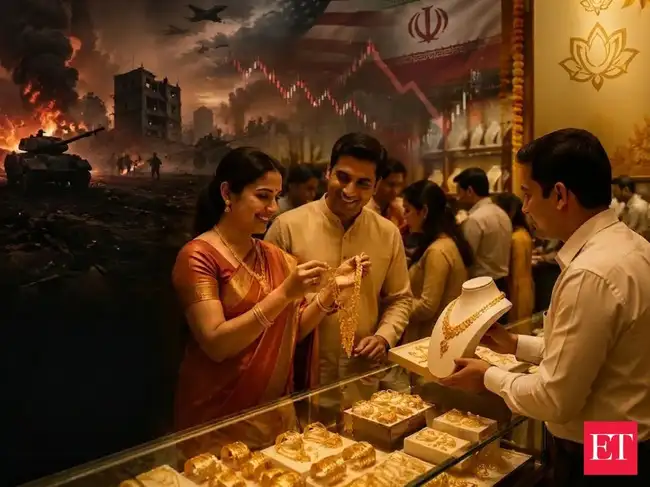
In Indian houses, some guests need invitations, others just show up. Gold falls in the latter, especially during Akshaya Tritiya. The darling of desi households is the only one that no one minds overspending on.
Even after being declared a “barbarous relic” by the economics profession a century ago, the yellow metal never really lost its shine, because in India, relics rarely retire.
And nowhere is that more visible than during Akshaya Tritiya, which falls on April 19 this year and remains one of the most important buying windows for the Indian gold market. It is widely regarded as a favourable day to invest, with gold purchases tied to the idea of lasting wealth.
ALSO READ | Indian banks halt gold, silver imports amid delay in government clearance
The period typically accounts for 15 to 20% of annual retail sales, and with prices correcting in recent weeks, it is turning into an opportunity for those looking to buy on the occasion, as per Aamir Makda, Commodity & Currency Analyst, Choice Broking.
The gold price has seen a significant correction in the past couple of weeks, making it an “ideal opportunity” for those looking to buy on this occasion, Makda told The Economic Times. “Currently, 24K gold is priced in the range of Rs 1,51,000 to Rs 1,54,000 (per 10 grams), down by nearly 15% from its peak levels.”
ALSO READ: Iran war should be ending 'pretty soon', claims Trump
Influenced by the shaky ground beneath the US-Iran ceasefire talks and currency movements, the gold market is experiencing significant fluctuations. This month, the tensions created a war premium, though recent peace signals have led to a price correction from historic highs of over $5,600 per ounce to around $4,700–$4,800 per ounce.
That correction is now feeding directly into retail sentiment in India, with jewellers expecting it to support demand ahead of Akshaya Tritiya.
The cultural significance of Akshaya Tritiya usually “outweighs short-term market fluctuations”, Ramesh Kalyanaraman, Executive Director of Kalyan Jewellers, told ET Online in an email response.
While global volatility and geopolitical factors often cause fluctuations, gold is viewed as a symbol of prosperity and tradition in the Indian context, he noted. Rather than deterring buyers, price volatility often encourages consumers to move toward organised players who offer transparency and high delivery standards, Kalyanaraman said.
Early buying and advance bookings have also picked up ahead of the festival, according to Kalyan Jewellers, as customers move to complete purchases earlier, particularly for weddings and other major occasions.
The sentiment is not isolated, with other retail players broadly reporting the same shift in behaviour, where price corrections are being read as an entry point rather than a deterrent.
Consumers expect prices to move up anytime, as they have corrected from March, Suvankar Sen, MD, Senco, told ET Online in an interview. “They are seeing this as a good opportunity to buy for savings and weddings. I would be very positive about the outlook, and demand has been very good.”
He said geopolitical volatility had affected sentiment earlier in the year, but buyers are adapting. “Geopolitical tensions impacted sentiment in January, when gold prices were very volatile, and to some extent in February. But now consumers are more or less used to the uncertainty. What matters is that if prices are attractive and within reach, they will come and buy.”
Pointing to a shift in buying patterns after a surge in prices, Sen said, “Over the last year, gold prices have gone up by 70% due to geopolitical factors, while volumes have declined by 14–15%. In value terms, however, there has been a growth of 30–35%. Consumers are buying lighter-weight, lower-carat jewellery to adjust to higher prices.”
“Unless India is directly affected, consumers will continue to buy as and when they can afford to,” he added.
This pattern is also captured in the outlook shared by Arun Narayan, Chief Executive Officer, Jewellery Division, Titan Company, who said the festival continues to see strong consumer sentiment, with gold retaining its position as an essential and auspicious purchase. He highlighted a growing preference for exchange-led buying, alongside steady demand for everyday jewellery such as earrings, chains and rings, and sustained interest in gold coins and bars as a store of value.
Not everyone in the industry is convinced that price corrections and festive sentiment will translate into stronger demand. Some caution that the outlook remains fragile amid the global uncertainty and stretched household priorities.
India Bullion and Jewellers Association Ltd (IBJA) National Secretary, Surendra Mehta said the current environment may not be enough to lift consumption meaningfully. “Most people in the current uncertain war situation prefer to sit on cash rather than buying gold. Basic needs are more important than gold,” he told ET Online.
Mehta added that India’s position as a price taker in global markets leaves it vulnerable to external shocks. “We are net importers of gold and only price takers, not price discoverers. Prolonged war can lead to recession in the economy, which would affect India too and could push prices higher but also weaken demand,” he said.
On the festive outlook, he was blunt. “Akshaya Tritiya demand will be much less compared to last year,” he said.
Meanwhile, as retail bigwigs line up for a strong festive push, smaller jewellers are increasingly finding themselves competing on price as much as design. The festive season, once driven largely by sentiment, is now equally a test of pricing power for them.
Delhi-based Swastik Jewels’ Nitin Gupta told ET Online that the pressure from big chains is forcing tactical changes on the ground. “Large jewellery chains are definitely putting pressure on retailers. To stay competitive, we are offering discounts and schemes such as waivers on making charges, gold rate protection plans and old gold exchange offers,” he said.
The uncertainty is impacting both smaller and larger players, according to Senco’s Sen, who feels that once conditions stabilise and the next phase of growth begins, larger players are likely to benefit more than smaller ones.
But not all smaller players see the festive squeeze as one-sided. Some say the ground reality is more layered, with local jewellers still holding their own on trust and relationships even as pricing pressure rises.
Bharat Jewels, run by fourth-generation jeweller Sanjay Saraf, said organised chains may have scale, but local players continue to draw strength from familiarity and long-standing customer ties.
“While large jewellery chains are present in the market, local jewellers continue to hold a strong position due to deep-rooted customer trust and long-standing relationships. Customers often value the personalised service, flexibility, and credibility that local jewellers offer, especially for high-value purchases like gold. So, while competition exists, our strength lies in loyalty and reputation built over generations,” he said.
It added that if gold prices moderate, a pickup in volumes could help offset lower realisations, keeping value growth steady. Profitability, it said, is also expected to improve, supported by elevated gold prices and better absorption of fixed costs through operating leverage and scale.
As per IBJA’s Mehta, a global slowdown could push gold higher even as demand weakens. He projected gold at $6,100–$6,200 in the next three to six months, which could translate to nearly ₹1,95,000 in domestic terms.
(You can now subscribe to our Economic Times WhatsApp channel)
Even after being declared a “barbarous relic” by the economics profession a century ago, the yellow metal never really lost its shine, because in India, relics rarely retire.
And nowhere is that more visible than during Akshaya Tritiya, which falls on April 19 this year and remains one of the most important buying windows for the Indian gold market. It is widely regarded as a favourable day to invest, with gold purchases tied to the idea of lasting wealth.
ALSO READ | Indian banks halt gold, silver imports amid delay in government clearance
The period typically accounts for 15 to 20% of annual retail sales, and with prices correcting in recent weeks, it is turning into an opportunity for those looking to buy on the occasion, as per Aamir Makda, Commodity & Currency Analyst, Choice Broking.

The gold price has seen a significant correction in the past couple of weeks, making it an “ideal opportunity” for those looking to buy on this occasion, Makda told The Economic Times. “Currently, 24K gold is priced in the range of Rs 1,51,000 to Rs 1,54,000 (per 10 grams), down by nearly 15% from its peak levels.”
ALSO READ: Iran war should be ending 'pretty soon', claims Trump
A glimmer of hope
Influenced by the shaky ground beneath the US-Iran ceasefire talks and currency movements, the gold market is experiencing significant fluctuations. This month, the tensions created a war premium, though recent peace signals have led to a price correction from historic highs of over $5,600 per ounce to around $4,700–$4,800 per ounce.That correction is now feeding directly into retail sentiment in India, with jewellers expecting it to support demand ahead of Akshaya Tritiya.
The cultural significance of Akshaya Tritiya usually “outweighs short-term market fluctuations”, Ramesh Kalyanaraman, Executive Director of Kalyan Jewellers, told ET Online in an email response.
While global volatility and geopolitical factors often cause fluctuations, gold is viewed as a symbol of prosperity and tradition in the Indian context, he noted. Rather than deterring buyers, price volatility often encourages consumers to move toward organised players who offer transparency and high delivery standards, Kalyanaraman said.
Early buying and advance bookings have also picked up ahead of the festival, according to Kalyan Jewellers, as customers move to complete purchases earlier, particularly for weddings and other major occasions.
The sentiment is not isolated, with other retail players broadly reporting the same shift in behaviour, where price corrections are being read as an entry point rather than a deterrent.
Consumers expect prices to move up anytime, as they have corrected from March, Suvankar Sen, MD, Senco, told ET Online in an interview. “They are seeing this as a good opportunity to buy for savings and weddings. I would be very positive about the outlook, and demand has been very good.”
He said geopolitical volatility had affected sentiment earlier in the year, but buyers are adapting. “Geopolitical tensions impacted sentiment in January, when gold prices were very volatile, and to some extent in February. But now consumers are more or less used to the uncertainty. What matters is that if prices are attractive and within reach, they will come and buy.”
Pointing to a shift in buying patterns after a surge in prices, Sen said, “Over the last year, gold prices have gone up by 70% due to geopolitical factors, while volumes have declined by 14–15%. In value terms, however, there has been a growth of 30–35%. Consumers are buying lighter-weight, lower-carat jewellery to adjust to higher prices.”
“Unless India is directly affected, consumers will continue to buy as and when they can afford to,” he added.
This pattern is also captured in the outlook shared by Arun Narayan, Chief Executive Officer, Jewellery Division, Titan Company, who said the festival continues to see strong consumer sentiment, with gold retaining its position as an essential and auspicious purchase. He highlighted a growing preference for exchange-led buying, alongside steady demand for everyday jewellery such as earrings, chains and rings, and sustained interest in gold coins and bars as a store of value.
But…all that glitters is not gold
Not everyone in the industry is convinced that price corrections and festive sentiment will translate into stronger demand. Some caution that the outlook remains fragile amid the global uncertainty and stretched household priorities.India Bullion and Jewellers Association Ltd (IBJA) National Secretary, Surendra Mehta said the current environment may not be enough to lift consumption meaningfully. “Most people in the current uncertain war situation prefer to sit on cash rather than buying gold. Basic needs are more important than gold,” he told ET Online.
Mehta added that India’s position as a price taker in global markets leaves it vulnerable to external shocks. “We are net importers of gold and only price takers, not price discoverers. Prolonged war can lead to recession in the economy, which would affect India too and could push prices higher but also weaken demand,” he said.
On the festive outlook, he was blunt. “Akshaya Tritiya demand will be much less compared to last year,” he said.
Small jewellers, big pressure
Meanwhile, as retail bigwigs line up for a strong festive push, smaller jewellers are increasingly finding themselves competing on price as much as design. The festive season, once driven largely by sentiment, is now equally a test of pricing power for them.Delhi-based Swastik Jewels’ Nitin Gupta told ET Online that the pressure from big chains is forcing tactical changes on the ground. “Large jewellery chains are definitely putting pressure on retailers. To stay competitive, we are offering discounts and schemes such as waivers on making charges, gold rate protection plans and old gold exchange offers,” he said.
The uncertainty is impacting both smaller and larger players, according to Senco’s Sen, who feels that once conditions stabilise and the next phase of growth begins, larger players are likely to benefit more than smaller ones.
But not all smaller players see the festive squeeze as one-sided. Some say the ground reality is more layered, with local jewellers still holding their own on trust and relationships even as pricing pressure rises.
Bharat Jewels, run by fourth-generation jeweller Sanjay Saraf, said organised chains may have scale, but local players continue to draw strength from familiarity and long-standing customer ties.
“While large jewellery chains are present in the market, local jewellers continue to hold a strong position due to deep-rooted customer trust and long-standing relationships. Customers often value the personalised service, flexibility, and credibility that local jewellers offer, especially for high-value purchases like gold. So, while competition exists, our strength lies in loyalty and reputation built over generations,” he said.
What’s ahead?
The broader industry forecast remains more measured. ICRA expects value growth of around 10–11% for the gold jewellery industry in FY2027, driven primarily by higher realisations and store expansion, while volumes are unlikely to see any meaningful increase.It added that if gold prices moderate, a pickup in volumes could help offset lower realisations, keeping value growth steady. Profitability, it said, is also expected to improve, supported by elevated gold prices and better absorption of fixed costs through operating leverage and scale.
As per IBJA’s Mehta, a global slowdown could push gold higher even as demand weakens. He projected gold at $6,100–$6,200 in the next three to six months, which could translate to nearly ₹1,95,000 in domestic terms.
Add  as a Reliable and Trusted News Source
as a Reliable and Trusted News Source Add Now!
(You can now subscribe to our Economic Times WhatsApp channel)
(Catch all the Business News, Breaking News and Latest News Updates on The Economic Times.)
Subscribe to The Economic Times Prime and read the ET ePaper online.
Read More News on
(Catch all the Business News, Breaking News and Latest News Updates on The Economic Times.)
Subscribe to The Economic Times Prime and read the ET ePaper online.






 ETPrime Membership