
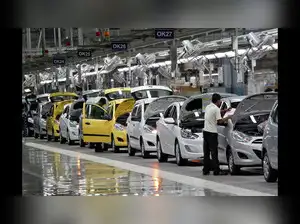
 Reuters
Government may defer CAFE 3.0 norms amid auto industry push
The government may defer the rollout of Corporate Average Fuel Efficiency (CAFE) 3.0 norms beyond April 2027 amid lobbying by carmakers, according to a report by The Times of India.
The Prime Minister’s Office (PMO) has held two meetings over the past three weeks on the issue, with more deliberations planned to arrive at a framework that balances industry concerns with fuel efficiency and emission goals.
At a meeting on Monday, the power ministry made a detailed presentation on the proposed norms and stressed the “urgent” need to notify them. It also presented, for the first time, an assessment of how major automakers would perform under the new regime.
Also Read: India may take middle path for car companies under CAFE III: What it means for small and large players
As per the analysis, only Tata Motors is expected to meet the targets consistently between 2027-28 and 2031-32, while Maruti Suzuki and Hyundai Motor India may fall short. Toyota Kirloskar Motor is likely to meet targets in the initial three years (2027-28 to 2029-30), while Mahindra & Mahindra may miss the goals during that period.
Officials indicated that the proposed framework could result in significant penalties for companies failing to meet efficiency targets.
The CAFE 3.0 norms propose removing derogation benefits for small carmakers and introducing Range-Extended Electric Vehicles (REEVs), which would be given the same Volume Derogation Factor (VDF) of 3 as electric vehicles. VDF is a policy tool aimed at promoting the adoption of less polluting vehicles such as EVs, REEVs and hybrids.
Also Read: Automakers may get to trade fuel-efficiency credits to meet stricter CAFE norms
Sources told The Times of India that notifying the norms could take a couple of months, with the industry likely to require at least a year to implement the changes.
With inputs from TOI
(You can now subscribe to our Economic Times WhatsApp channel)
The Prime Minister’s Office (PMO) has held two meetings over the past three weeks on the issue, with more deliberations planned to arrive at a framework that balances industry concerns with fuel efficiency and emission goals.
At a meeting on Monday, the power ministry made a detailed presentation on the proposed norms and stressed the “urgent” need to notify them. It also presented, for the first time, an assessment of how major automakers would perform under the new regime.
Also Read: India may take middle path for car companies under CAFE III: What it means for small and large players
As per the analysis, only Tata Motors is expected to meet the targets consistently between 2027-28 and 2031-32, while Maruti Suzuki and Hyundai Motor India may fall short. Toyota Kirloskar Motor is likely to meet targets in the initial three years (2027-28 to 2029-30), while Mahindra & Mahindra may miss the goals during that period.

Officials indicated that the proposed framework could result in significant penalties for companies failing to meet efficiency targets.
The CAFE 3.0 norms propose removing derogation benefits for small carmakers and introducing Range-Extended Electric Vehicles (REEVs), which would be given the same Volume Derogation Factor (VDF) of 3 as electric vehicles. VDF is a policy tool aimed at promoting the adoption of less polluting vehicles such as EVs, REEVs and hybrids.
Also Read: Automakers may get to trade fuel-efficiency credits to meet stricter CAFE norms
Sources told The Times of India that notifying the norms could take a couple of months, with the industry likely to require at least a year to implement the changes.
With inputs from TOI
Add  as a Reliable and Trusted News Source
as a Reliable and Trusted News Source Add Now!
(You can now subscribe to our Economic Times WhatsApp channel)
(Catch all the Business News, Breaking News and Latest News Updates on The Economic Times.)
Subscribe to The Economic Times Prime and read the ET ePaper online.
Read More News on
(Catch all the Business News, Breaking News and Latest News Updates on The Economic Times.)
Subscribe to The Economic Times Prime and read the ET ePaper online.






 ETPrime Membership