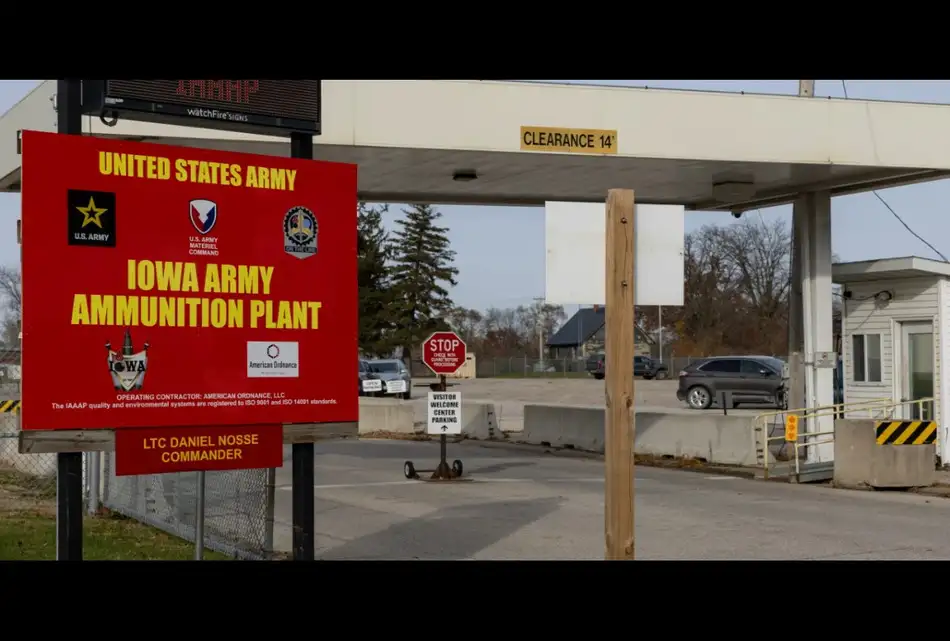
 AP
At 9:00 a.m. (CST), the US Army will conduct a controlled, mitigated detonation at the Iowa Army Ammunition Plant (IAAAP) to eliminate the risk of an uncontrolled explosion. To ensure the safety of our technicians, the Army will update the public on the status of the operation no later than 11:00 a.m. (CST), US Army posted on 'X'.
The U.S. Army, in coordination with the Environmental Protection Agency (EPA), is planning a coordinated, controlled detonation of degraded lead azide at the Iowa Army Ammunition Plant (IAAAP) in Middletown, Iowa, Homeland Security posted on 'X'.
U.S. Army personnel are on site in Middletown, Iowa, and have worked around the clock to mitigate the impacts of the planned controlled detonation later this morning.This includes a water wall filled with more than 100,000 gallons of water, earth berms, sand filled blocks, expert dispersion modeling, and temperature-regulating tarps.Our foremost priority is public health and safety, so take a look at how we’re protecting the community ⬇️
— U.S. Army (@USArmy) November 25, 2026
Iowa Detonation Live Stream

The U.S. Army said it will film Wednesday morning’s controlled detonation of lead azide and make the footage and photos available as soon as possible. It has been providing updates on its social media accounts. The Army has kept media outlets and others more than 4 miles away from the blast site.
Assistant Secretary of the Army Jordan Gillis explains the decision behind the operation at the Iowa Army Ammunition Plant and the measures the Army is taking to protect surrounding communities and minimize environmental impacts. https://t.co/wNM7M7A5CX
— U.S. Army (@USArmy) November 25, 2026
The Environmental Protection Agency said it collected more than 1,200 air, land and water samples ahead of the controlled detonation to test for lead levels around the Iowa Army Ammunition Plant.
The EPA will also test lead levels during and after the detonation, it said Wednesday. The agency will monitor the air and report data every five minutes. No lead was detected in the air before the detonation, and the EPA said it expects only a brief increase after the blast.
Check Detonation Plume Map
Latest information on the Iowa Ammunition Plant Detonation. Continue to check back for updates as they become available.https://t.co/DIV9jUlV2S
— U.S. Army (@USArmy) November 25, 2026
In March, during a routine monitoring inspection, staff at the Iowa Army Ammunition Plant found that the lead azide had partially crystallized, making it sensitive to friction and cold temperatures and creating the risk of spontaneous detonation.
The Army assembled experts to formulate a plan but found that alternative solutions like thermal treatment and neutralizing the drums’ contents were not as safe as a controlled detonation.
 as a Reliable and Trusted News Source
 Add Now!