


Listen to this article in summarized format
×
Subscribe to

Unlock AI Briefing and Premium Content
New Year Offer 24 Hours Left
Subscribe NowAlready a member? Sign In
What's Included
- Exclusive Stories
- Daily ePaper Access
- Smart Market Tools
- Curated Investment Ideas
- Ad-lite Experience
Subscription

 ET Online
8th Pay Commission salary calculator for Level 5-7 employees
The growth in the basic salary of central government employees is determined by two key factors: the fitment factor and the annual increment rate. A high increment rate and a high fitment factor can considerably increase their basic pay in a commission. But what can happen if the 8th Pay Commission delivers a low fitment factor and increases the annual increment rate?
To see the difference, first know the fitment factor and the increment rate under the 7th Pay Commission and how they compare with a high increment rate and a high fitment factor.
In the 7th Pay Commission, the fitment factor is 2.57, and the annual increment rate is 3%. For the 8th Pay Commission, central government employee associations have been demanding a fitment factor of up to 4.38, while their demand for the annual increment rate is to increase it up to 7%.
Also Read: 8th Pay Commission news: Notified a year ago, 5 biggest 8th CPC developments since November 3, 2025
Fitment factor recommendations for 8th Pay Commission
Most employees and pensioners organisations, including the National Council of the Joint Consultative Machinery (NC-JCM), have recommended a 3.833 fitment factor for employees. If that happens, a Rs 18,000 minimum salary under the 7th Pay Commission would rise to Rs 69,000 under the 8th Pay Commission.
However, many experts say the 8th CPC may decide on a fitment factor of up to 2.5. However, it will be known only when the government notifies the 8th Pay Commission report.
Increment rate recommendations for 8th Pay Commission
Recommendations to the 8th Pay Commission about the fitment factor also vary. The popular demand is a 6% annual increment from the NC-JCM, the All India Defence Employees’ Federation (AIDEF), the Federation of National Postal Organisations (FNPO), among others. Some organisations such as the All India New Pension Scheme Employees Federation (AINPSEF) have recommended a 7% increment rate.
Also Read: Higher EPS pension: Pensioners request Labour Ministry to withdraw EPFO circular rejecting exempted employees' higher pension claims
High fitment factor vs high increment rate: Salary estimates for Level 5-7 employees
The basic argument behind recommending a high increment rate is that it will reduce the dependency on the 10-yearly basic salary revision through a pay commission. The AINPSEF says that with a 7% increment rate, the gross salary of a central government employee will double in 7-8 years.
Also Read: 8th Pay Commission: 6 key demands by Railway employee's body; better pay, merging of pay scales, hardship allowance and more
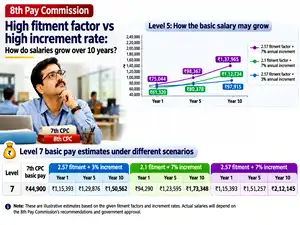
Here, through estimates, we will show the difference in salaries of Level 5-7 employees’ basic pay in 1, 5 and 10 years at different increment rates and fitment factors. For calculations, we are assuming three conditions.
Level 5 basic pay as per the 7th Pay Commission= Rs 29,200
Level 6 salary estimates under high increment rate vs high fitment factor
Level 6 basic pay as per the 7th Pay Commission= Rs 35,400
Level 7 salary estimates under high increment rate vs high fitment factor
Level 7 basic pay as per the 7th Pay Commission= Rs 44,900
In the estimates, you can see that at a high increment rate, the salary growth may not be as high as with a high fitment factor and a 3% growth rate. But the gap narrows in 5 years, while in 10 years, a high annual increment rate leaves the payout of a high fitment factor way behind.
But how a high increment rate or the fitment factor impacts the payouts of employees will be known when the 8th Pay Commission report is implemented.
To see the difference, first know the fitment factor and the increment rate under the 7th Pay Commission and how they compare with a high increment rate and a high fitment factor.
In the 7th Pay Commission, the fitment factor is 2.57, and the annual increment rate is 3%. For the 8th Pay Commission, central government employee associations have been demanding a fitment factor of up to 4.38, while their demand for the annual increment rate is to increase it up to 7%.
Also Read: 8th Pay Commission news: Notified a year ago, 5 biggest 8th CPC developments since November 3, 2025
Fitment factor recommendations for 8th Pay Commission

Most employees and pensioners organisations, including the National Council of the Joint Consultative Machinery (NC-JCM), have recommended a 3.833 fitment factor for employees. If that happens, a Rs 18,000 minimum salary under the 7th Pay Commission would rise to Rs 69,000 under the 8th Pay Commission.
However, many experts say the 8th CPC may decide on a fitment factor of up to 2.5. However, it will be known only when the government notifies the 8th Pay Commission report.
| Organisation | Proposed minimum pay for 8th CPC | Proposed fitment factor for 8th CPC |
| National Council of the Joint Consultative Machinery (NC-JCM) | Rs 69,000 | 3.833 |
| All India Defence Employees' Federation (AIDEF) | Rs 69,000 | 3.833 |
| Federation of National Postal Organisations (FNPO) | Rs 69,000 | 3.833 |
| All India New Pension Scheme Employees Federation (AINPSEF) | Rs 69,000 | 3.833 |
| Indian Railways' Technical Supervisors' Association (IRTSA) | Multiple with minimum at Rs 52,560 | 2.92, 3.50, 3.80, 4.09, 4.38 |
| Delhi government school teachers | Rs 47,210 | 2.62 |
| Chennai GPO Pensioners | Rs 68,000 | 3.77 |
| Bharat Pensioners Samaj (BPS) | Rs 69,000 | 3.833 |
Recommendations to the 8th Pay Commission about the fitment factor also vary. The popular demand is a 6% annual increment from the NC-JCM, the All India Defence Employees’ Federation (AIDEF), the Federation of National Postal Organisations (FNPO), among others. Some organisations such as the All India New Pension Scheme Employees Federation (AINPSEF) have recommended a 7% increment rate.
Also Read: Higher EPS pension: Pensioners request Labour Ministry to withdraw EPFO circular rejecting exempted employees' higher pension claims
| Organisation | Proposed annual increment |
| National Council of the Joint Consultative Machinery (NC-JCM) | 6% |
| All India Defence Employees' Federation (AIDEF) | 6% |
| Federation of National Postal Organisations (FNPO) | 6% |
| All India New Pension Scheme Employees Federation (AINPSEF) | 7% |
| Indian Railways' Technical Supervisors' Association (IRTSA) | 5% |
The basic argument behind recommending a high increment rate is that it will reduce the dependency on the 10-yearly basic salary revision through a pay commission. The AINPSEF says that with a 7% increment rate, the gross salary of a central government employee will double in 7-8 years.
Also Read: 8th Pay Commission: 6 key demands by Railway employee's body; better pay, merging of pay scales, hardship allowance and more
Here, through estimates, we will show the difference in salaries of Level 5-7 employees’ basic pay in 1, 5 and 10 years at different increment rates and fitment factors. For calculations, we are assuming three conditions.
- 2.57 fitment factor, 3% increment rate
- 2.1 fitment factor, 7% increment rate
- 2.57 fitment factor, 7% increment rate
Level 5 basic pay as per the 7th Pay Commission= Rs 29,200
| Path | Year 1 basic | Year 5 basic | Year 10 basic |
| 2.57 fitment factor, 3%/yr increment | ₹ 75,044 | ₹ 84,463 | ₹ 97,915 |
| 2.1 fitment factor, 7%/yr increment | ₹ 61,320 | ₹ 80,378 | ₹ 1,12,734 |
| 2.57 fitment factor, 7%/yr increment | ₹ 75,044 | ₹ 98,367 | ₹ 1,37,965 |
Level 6 basic pay as per the 7th Pay Commission= Rs 35,400
| Path | Year 1 basic | Year 5 basic | Year 10 basic |
| 2.57 fitment factor, 3%/yr increment | ₹ 90,978 | ₹ 1,02,397 | ₹ 1,18,706 |
| 2.1 fitment factor, 7%/yr increment | ₹ 74,340 | ₹ 97,445 | ₹ 1,36,671 |
| 2.57 fitment factor, 7%/yr increment | ₹ 90,978 | ₹ 1,19,254 | ₹ 1,67,259 |
Level 7 basic pay as per the 7th Pay Commission= Rs 44,900
| Path | Year 1 basic | Year 5 basic | Year 10 basic |
| 2.57 fitment factor, 3%/yr increment | ₹ 1,15,393 | ₹ 1,29,876 | ₹ 1,50,562 |
| 2.1 fitment factor, 7%/yr increment | ₹ 94,290 | ₹ 1,23,595 | ₹ 1,73,348 |
| 2.57 fitment factor, 7%/yr increment | ₹ 1,15,393 | ₹ 1,51,257 | ₹ 2,12,145 |
But how a high increment rate or the fitment factor impacts the payouts of employees will be known when the 8th Pay Commission report is implemented.
Add  as a Reliable and Trusted News Source
 Add Now!
Read More News on
8th Pay Commission news8th Pay Commission latest news8th Pay Commission fitment factor8th Pay Commission calculator8th Pay Commission employees salary8th Pay Commission salary calculatorfitment factor for 8th pay commission8th pay commission approval latest newsexpected fitment factor in 8th pay commission
(Catch all the Personal Finance News, Breaking News, Budget 2025 Events and Latest News Updates on The Economic Times.)






 ETPrime Membership