

Business News›Tech›Newsletters›Tech Top 5›Flipkart alumni seek Esop buyout; Local sourcing for ISM 2.0
 Daily Top 5 Daily Top 5 |
Flipkart alumni seek Esop buyout; Local sourcing for ISM 2.0
Want this newsletter delivered to your inbox?
I agree to receive newsletters and marketing communications via e-mail

Thank you for subscribing to Daily Top 5
We'll soon meet in your inbox.
Former Flipkart executives are seeking a full cash-out of vested Esops. This and more in today’s ETtech Top 5.
Also in the letter:
■ ETtech done deals
■ Quick comm market set to soar
■ Apple, LG team up for home devices

A group of former senior Flipkart executives, including ex-CEO Mukesh Bansal, ex-CFO Sanjay Baweja, and ex-CBO Ankit Nagori, has asked Walmart to buy out their vested employee stock options (Esops) as the company’s India IPO remains without a confirmed timeline.
The letter: The October 1 letter, which ET has seen, is addressed to all 11 members of Walmart’s board, including chairman Gregory B Penner and Flipkart CEO Kalyan Krishnamurthy. It seeks "fair treatment" for the vested stock options that were given out 10-15 years back.
ESOP buyback: This comes as Flipkart recently completed a partial buyback of stock options from current employees. The former executives are seeking a similar opportunity to fully cash out their options.
Walmart says: "We appreciate the perspective of all employees — current and former — and value their feedback. As with anything raised, we take it seriously and look into the matter," a spokesperson told ET in an email.
IPO delay: Flipkart has said an IPO remains part of its strategic roadmap but has no confirmed timeline. Last year, the company had shifted its domicile from Singapore to India as a precursor to its India listing, but those plans remain ambiguous.
Leadership exits: Recently, the Bengaluru-headquartered company has seen the departure of senior leaders, including Myntra CEO Nandita Sinha, who left after more than a decade with the online retailer following a management rejig.
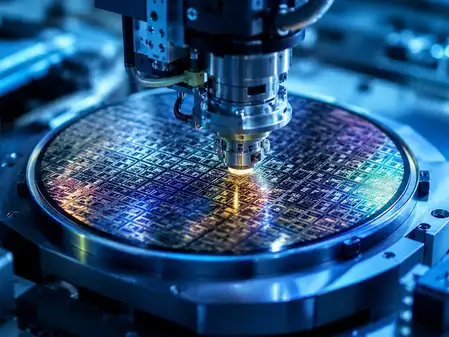
The Ministry of Electronics and Information Technology (MeitY) has said companies applying for projects under the government’s India Semiconductor Mission (ISM) 2.0 scheme must source components and raw materials from Indian suppliers wherever they are available, industry executives and officials told us.
Local sourcing: Applicants under ISM 2.0’s machines and materials pillar, which covers semiconductor equipment and materials, must submit certified declarations from domestic vendors verifying that the components have actually been manufactured in India.
Tracking: Guidelines for ISM 2.0 mandate that from the second instalment of fund disbursement, approved companies shall submit a report which includes the itemised list of capital goods and equipment suppliers, alongside purchase orders, invoices, and payments.
Growing demand: Demand for semiconductor products in India is expected to reach $110 billion by FY30 and exceed $200 billion by FY35.
Quote, unquote: "At the recently concluded Semicon India 2026 Summit, we have seen interest from a wide range of global firms producing semiconductor capital equipment, electronic-grade speciality chemicals, and photoresists, as well as ultra-high purity industrial and specialty gases. Manufacturers of silicon wafers and specialised substrates are also interested in the machines and materials pillars of ISM 2.0," an official said.

Bengaluru-based deeptech startup Quanfluence has raised $10 million in a round led by Chiratae Ventures, as it looks to build a full-stack photonic quantum computer that combines photonic chips, control electronics, and software into a single system.
Fund use: The company plans to use the fresh capital to develop and launch a four-qubit quantum computer in the near term, while targeting a larger prototype with around 100 qubits by 2029, cofounder and CEO Sujoy Chakravarty told ET.
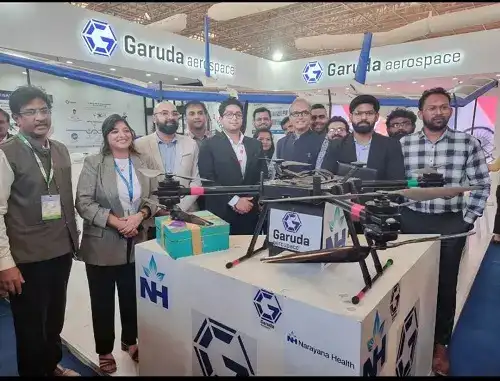
Chennai-based drone technology company Garuda Aerospace has raised about $10 million in a pre-IPO round at a $320 million pre-money valuation. The round was led by the Motherson family office and Dubai-based Aditum Investment Group.
IPO plans: Garuda Aerospace is looking to go public in the first quarter of 2027, according to people in the know. The company filed its draft IPO papers through the confidential route in April, and received market regulator Sebi’s observations on August 5, allowing it to proceed with the IPO.

Hyderabad-based B2B edtech startup ByteXL raised $9 million in a series B round led by Elevar Equity, with existing investors Kalaari Capital and the Michael and Susan Dell Foundation also participating. The company is looking to expand its presence across India and invest in AI-led learning tools.
Growth targets: The company currently works with about 60 colleges in 10 states and has 200,000 students on its platform, cofounder and chief executive Karun Tadepalli told ET. It aims to increase this to 500,000 students and 120 colleges in 15 states over the next two years.

India's quick commerce market is projected to expand nearly sevenfold to $90 billion by FY31 from about $13 billion in FY26, driven by deeper penetration in metro households and rapid user growth across non-metro markets, according to a Google and Redseer Strategy Consultants report.
Metro share: Metros are expected to account for about 60% of incremental growth during the period, while the share of quick commerce in metro retail spending could rise from around 6 per cent to 20-23%.
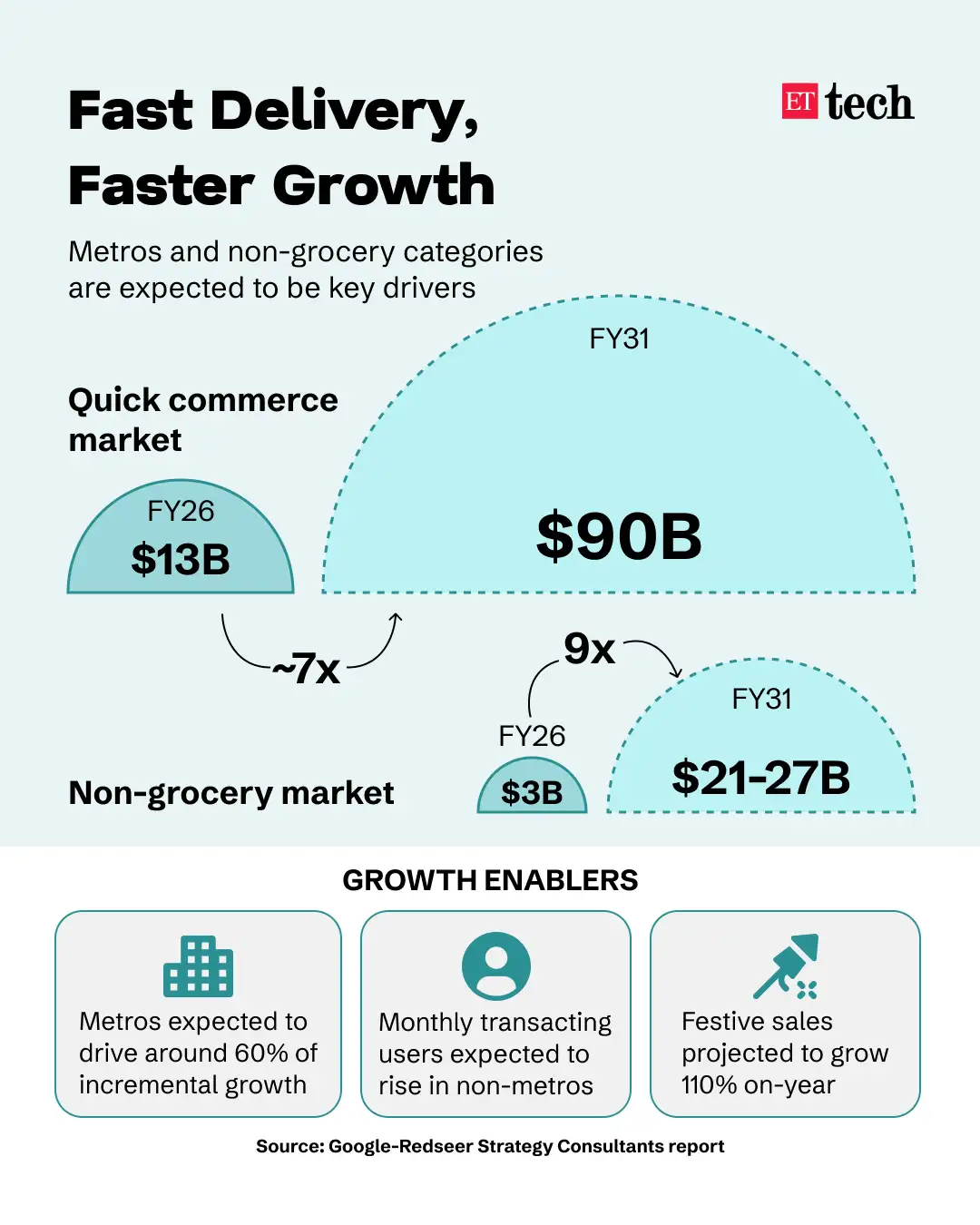
Festive boost: Sales are projected to grow 110% on-year during the festive season and account for around 18% of total online festive spending.
Beyond groceries: Non-grocery categories such as beauty, personal care, home essentials, and electronics are projected to grow from around $3 billion in FY26 to $21-27 billion by FY31.
Non-metro push: The addressable market includes around 200 million online shoppers across 300-plus cities, with monthly transacting users expected to reach 55-60 million by FY31.

Apple’s upcoming push into smart home devices will include a doorbell, thermostat, and other accessories developed through an unusual partnership with LG Electronics.
New lineup: The products will also include a smart deadbolt lock, indoor security camera, outdoor security camera, and floodlight camera.
LG branding: Though the two companies worked together to develop the accessories, the products will carry the LG brand. The South Korean firm is handling manufacturing and product support.
Apple ecosystem: The products will be part of an ecosystem of devices that work with Apple’s new smart home hub, as well as an upgraded HomePod mini and fresh TV set-top box.
Also in the letter:
■ ETtech done deals
■ Quick comm market set to soar
■ Apple, LG team up for home devices
ET Exclusive: Former Flipkart honchos write to Walmart board, seek vested Esop buyout
A group of former senior Flipkart executives, including ex-CEO Mukesh Bansal, ex-CFO Sanjay Baweja, and ex-CBO Ankit Nagori, has asked Walmart to buy out their vested employee stock options (Esops) as the company’s India IPO remains without a confirmed timeline.
The letter: The October 1 letter, which ET has seen, is addressed to all 11 members of Walmart’s board, including chairman Gregory B Penner and Flipkart CEO Kalyan Krishnamurthy. It seeks "fair treatment" for the vested stock options that were given out 10-15 years back.
ESOP buyback: This comes as Flipkart recently completed a partial buyback of stock options from current employees. The former executives are seeking a similar opportunity to fully cash out their options.
Walmart says: "We appreciate the perspective of all employees — current and former — and value their feedback. As with anything raised, we take it seriously and look into the matter," a spokesperson told ET in an email.
IPO delay: Flipkart has said an IPO remains part of its strategic roadmap but has no confirmed timeline. Last year, the company had shifted its domicile from Singapore to India as a precursor to its India listing, but those plans remain ambiguous.
Leadership exits: Recently, the Bengaluru-headquartered company has seen the departure of senior leaders, including Myntra CEO Nandita Sinha, who left after more than a decade with the online retailer following a management rejig.
Local sourcing must for ISM 2.0 subsidy: MeitY tells chip companies
The Ministry of Electronics and Information Technology (MeitY) has said companies applying for projects under the government’s India Semiconductor Mission (ISM) 2.0 scheme must source components and raw materials from Indian suppliers wherever they are available, industry executives and officials told us.
Local sourcing: Applicants under ISM 2.0’s machines and materials pillar, which covers semiconductor equipment and materials, must submit certified declarations from domestic vendors verifying that the components have actually been manufactured in India.
Tracking: Guidelines for ISM 2.0 mandate that from the second instalment of fund disbursement, approved companies shall submit a report which includes the itemised list of capital goods and equipment suppliers, alongside purchase orders, invoices, and payments.
Growing demand: Demand for semiconductor products in India is expected to reach $110 billion by FY30 and exceed $200 billion by FY35.
Quote, unquote: "At the recently concluded Semicon India 2026 Summit, we have seen interest from a wide range of global firms producing semiconductor capital equipment, electronic-grade speciality chemicals, and photoresists, as well as ultra-high purity industrial and specialty gases. Manufacturers of silicon wafers and specialised substrates are also interested in the machines and materials pillars of ISM 2.0," an official said.
Quanfluence raises $10 million to build full-stack photonic quantum computer
Bengaluru-based deeptech startup Quanfluence has raised $10 million in a round led by Chiratae Ventures, as it looks to build a full-stack photonic quantum computer that combines photonic chips, control electronics, and software into a single system.
Fund use: The company plans to use the fresh capital to develop and launch a four-qubit quantum computer in the near term, while targeting a larger prototype with around 100 qubits by 2029, cofounder and CEO Sujoy Chakravarty told ET.
Garuda Aerospace lands $10 million pre-IPO funding at $320 million valuation
Chennai-based drone technology company Garuda Aerospace has raised about $10 million in a pre-IPO round at a $320 million pre-money valuation. The round was led by the Motherson family office and Dubai-based Aditum Investment Group.
IPO plans: Garuda Aerospace is looking to go public in the first quarter of 2027, according to people in the know. The company filed its draft IPO papers through the confidential route in April, and received market regulator Sebi’s observations on August 5, allowing it to proceed with the IPO.
Edtech firm ByteXL raises $9 million led by Elevar Equity
Hyderabad-based B2B edtech startup ByteXL raised $9 million in a series B round led by Elevar Equity, with existing investors Kalaari Capital and the Michael and Susan Dell Foundation also participating. The company is looking to expand its presence across India and invest in AI-led learning tools.
Growth targets: The company currently works with about 60 colleges in 10 states and has 200,000 students on its platform, cofounder and chief executive Karun Tadepalli told ET. It aims to increase this to 500,000 students and 120 colleges in 15 states over the next two years.
India's quick commerce market poised to grow sevenfold to $90 billion by FY31: Report
India's quick commerce market is projected to expand nearly sevenfold to $90 billion by FY31 from about $13 billion in FY26, driven by deeper penetration in metro households and rapid user growth across non-metro markets, according to a Google and Redseer Strategy Consultants report.
Metro share: Metros are expected to account for about 60% of incremental growth during the period, while the share of quick commerce in metro retail spending could rise from around 6 per cent to 20-23%.
Festive boost: Sales are projected to grow 110% on-year during the festive season and account for around 18% of total online festive spending.
Beyond groceries: Non-grocery categories such as beauty, personal care, home essentials, and electronics are projected to grow from around $3 billion in FY26 to $21-27 billion by FY31.
Non-metro push: The addressable market includes around 200 million online shoppers across 300-plus cities, with monthly transacting users expected to reach 55-60 million by FY31.
Apple to launch doorbell, lock, thermostat developed with LG
Apple’s upcoming push into smart home devices will include a doorbell, thermostat, and other accessories developed through an unusual partnership with LG Electronics.
New lineup: The products will also include a smart deadbolt lock, indoor security camera, outdoor security camera, and floodlight camera.
LG branding: Though the two companies worked together to develop the accessories, the products will carry the LG brand. The South Korean firm is handling manufacturing and product support.
Apple ecosystem: The products will be part of an ecosystem of devices that work with Apple’s new smart home hub, as well as an upgraded HomePod mini and fresh TV set-top box.
Want this newsletter delivered to your inbox?
I agree to receive newsletters and marketing communications via e-mail
Thank you for subscribing to Daily Top 5
We'll soon meet in your inbox.

