


Business News›Tech›Newsletters›Morning Dispatch›EV startups attract funding; InsuranceDekho cuts jobs
 Morning Dispatch |
EV startups attract funding; InsuranceDekho cuts jobs
Want this newsletter delivered to your inbox?
I agree to receive newsletters and marketing communications via e-mail

Thank you for subscribing to Morning Dispatch
We'll soon meet in your inbox.
Rising EV demand and higher oil prices are driving fresh investor interest in electric two-wheeler startups. This and more in today’s ETtech Morning Dispatch.
Also in the letter:
■ Alok Bansal to exit PB Fintech
■ Centre tightens cloud data rules
■ Sarvam clarifies GPU usage
Ather Energy’s fivefold share price surge since its market debut last May has rekindled investor interest in India’s electric two-wheeler startups, with rising consumer adoption and higher oil prices aiding the sector.
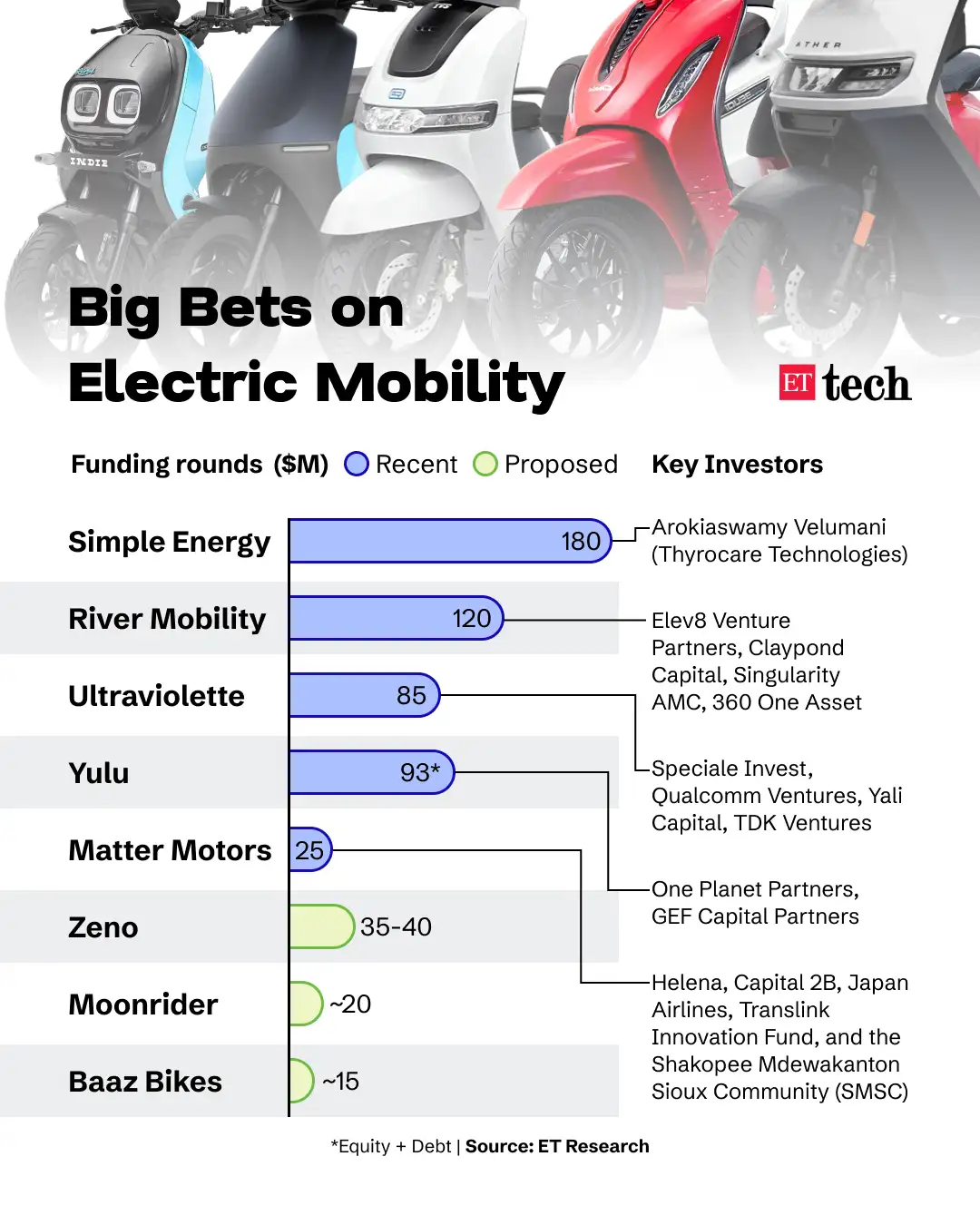
Driving the news: Electric motorcycle startup Zeno is in talks to raise $35-40 million and enter India. This follows large funding rounds at Simple Energy ($180 million), River Mobility ($120 million) and Ultraviolette ($85 million).
By the numbers: Electric two-wheeler registrations surged 48% year-on-year to a record 224,064 units in October, while penetration nearly doubled to 9.9% in FY27 so far from 5.5% in FY24.
The bigger picture: With investors increasingly convinced about the market opportunity, competition is shifting towards manufacturing scale, product differentiation and distribution. Smaller manufacturers face a crucial 18-24-month window to scale up as incumbents such as TVS Motor and Bajaj Auto strengthen their market positions.
 InsuranceDekho founder and CEO Ankit Agrawal
InsuranceDekho has seen 400-500 employees leave following its merger with rival RenewBuy in September. The insurance distribution startup has also put its initial public offering (IPO) plans on hold, sources told us.
Driving the news: The company is eliminating overlapping roles following the merger and looking at further workforce reductions ahead of the insurance regulator’s proposed caps on distribution commissions. The combined entity had around 3,700 employees before the restructuring.
Why it matters: Unlike Policybazaar, InsuranceDekho relies heavily on adviser-led distribution. The proposed commission caps could squeeze its margins and affect the earnings of its distribution partners.
IPO plans: InsuranceDekho was targeting a Rs 2,500-3,000 crore public issue at a valuation of around Rs 9,500 crore by March 2027.
Company response: InsuranceDekho denied reports of layoffs, saying it was looking to fill around 500 roles across the country and continued to work on its IPO.

Alok Bansal, who cofounded digital insurance distribution platform Policybazaar with Yashish Dahiya, is stepping down from his executive role, according to a regulatory filing.
The transition: Bansal will relinquish his role with effect from March 31, 2027. He is currently the executive vice chairman and a wholetime director of the company, and will become a non-executive director retaining his seat on Policybazaar parent Fintech's board.
What he said: In his resignation letter, Bansal cited his “desire to step back from executive responsibilities” as the reason for his decision.
Dahiya’s response: “PB Fintech and Policybazaar would not have been possible without Alok. He first shared his wish to step back five years ago, and I persuaded him to stay because I needed his support. I still do, and I am glad he will remain on our Board, while I understand his wish to step away from the day-to-day,” Dahiya said.

The Centre is discussing ways to tighten the conditions under which all citizen-centric data managed by the government is hosted on the cloud, officials told ET. It is also in talks with industry stakeholders to establish the criteria for picking sovereign cloud service providers.
What’s changing: Existing Ministry of Electronics and Information Technology (MeitY) guidelines allow departments to classify their systems by risk before choosing where to host their data according to an indicative framework. This may be modified to bring in clear, mandatory directions spelling out which government data can be hosted where, officials said.
Why it matters: “There are obvious risks such as leakage and disruption when it comes to such vast quantities of data, much of which may not be anonymized, personal data. There have been inter-ministerial discussions to outline a larger policy on cloud sovereignty. The existing categories for classifying data are large, and may be further detailed,” an official said.
Sovereign cloud: The Centre defines another category of data, as those whose unauthorised disclosure or disruption could seriously harm national security or disrupt government operations. Such workloads may be hosted with government and specified public-sector providers, as well as with sovereign cloud providers “as and when notified by MeitY”.
 Vivek Raghavan (left) and Pratyush Kumar, founders, Sarvam AI
Sarvam responds to criticism: Sarvam AI on Wednesday said its new ‘Token factory’ is running entirely on privately procured graphics processing units (GPUs) and does not use government-subsidised GPUs, following social media backlash over its decision to host Chinese AI models on the commercial inference platform.
Humyn Labs raises $47 million: Humyn Labs, a physical AI startup founded by former Nazara Technologies chief executive Manish Agarwal and Ishank Gupta, has raised $47 million as it looks to expand its data infrastructure and build capabilities to deploy robots in real-world environments.
Cognizant wins $175 million UK deal: IT services firm Cognizant won a 133.2 million pounds (about $175 million) contract from UK Network Rail Infrastructure to provide data centre infrastructure services, beating HCLTech, Tata Consultancy Services, DXC Technology and Atos IT.
■ Low-profile VCs set for $100bn windfall from Anthropic IPO (FT)
■ The seven Anthropic founders who are about to become multi-billionaires (BBC)
■ This smell startup says its AI nose is as good as a human’s (MIT Technology Review)
Also in the letter:
■ Alok Bansal to exit PB Fintech
■ Centre tightens cloud data rules
■ Sarvam clarifies GPU usage
A new set of EV two-wheeler startups is raising big money after Ather's rally, oil shock
Ather Energy’s fivefold share price surge since its market debut last May has rekindled investor interest in India’s electric two-wheeler startups, with rising consumer adoption and higher oil prices aiding the sector.
Driving the news: Electric motorcycle startup Zeno is in talks to raise $35-40 million and enter India. This follows large funding rounds at Simple Energy ($180 million), River Mobility ($120 million) and Ultraviolette ($85 million).
By the numbers: Electric two-wheeler registrations surged 48% year-on-year to a record 224,064 units in October, while penetration nearly doubled to 9.9% in FY27 so far from 5.5% in FY24.
The bigger picture: With investors increasingly convinced about the market opportunity, competition is shifting towards manufacturing scale, product differentiation and distribution. Smaller manufacturers face a crucial 18-24-month window to scale up as incumbents such as TVS Motor and Bajaj Auto strengthen their market positions.
InsuranceDekho sees 500 employee exits post Renewbuy merger; IPO put on hold
InsuranceDekho has seen 400-500 employees leave following its merger with rival RenewBuy in September. The insurance distribution startup has also put its initial public offering (IPO) plans on hold, sources told us.
Driving the news: The company is eliminating overlapping roles following the merger and looking at further workforce reductions ahead of the insurance regulator’s proposed caps on distribution commissions. The combined entity had around 3,700 employees before the restructuring.
Why it matters: Unlike Policybazaar, InsuranceDekho relies heavily on adviser-led distribution. The proposed commission caps could squeeze its margins and affect the earnings of its distribution partners.
IPO plans: InsuranceDekho was targeting a Rs 2,500-3,000 crore public issue at a valuation of around Rs 9,500 crore by March 2027.
Company response: InsuranceDekho denied reports of layoffs, saying it was looking to fill around 500 roles across the country and continued to work on its IPO.
PB Fintech cofounder Alok Bansal to step down from executive role
Alok Bansal, who cofounded digital insurance distribution platform Policybazaar with Yashish Dahiya, is stepping down from his executive role, according to a regulatory filing.
The transition: Bansal will relinquish his role with effect from March 31, 2027. He is currently the executive vice chairman and a wholetime director of the company, and will become a non-executive director retaining his seat on Policybazaar parent Fintech's board.
What he said: In his resignation letter, Bansal cited his “desire to step back from executive responsibilities” as the reason for his decision.
Dahiya’s response: “PB Fintech and Policybazaar would not have been possible without Alok. He first shared his wish to step back five years ago, and I persuaded him to stay because I needed his support. I still do, and I am glad he will remain on our Board, while I understand his wish to step away from the day-to-day,” Dahiya said.
Government plans stricter rules for hosting citizen-centric data on cloud
The Centre is discussing ways to tighten the conditions under which all citizen-centric data managed by the government is hosted on the cloud, officials told ET. It is also in talks with industry stakeholders to establish the criteria for picking sovereign cloud service providers.
What’s changing: Existing Ministry of Electronics and Information Technology (MeitY) guidelines allow departments to classify their systems by risk before choosing where to host their data according to an indicative framework. This may be modified to bring in clear, mandatory directions spelling out which government data can be hosted where, officials said.
Why it matters: “There are obvious risks such as leakage and disruption when it comes to such vast quantities of data, much of which may not be anonymized, personal data. There have been inter-ministerial discussions to outline a larger policy on cloud sovereignty. The existing categories for classifying data are large, and may be further detailed,” an official said.
Sovereign cloud: The Centre defines another category of data, as those whose unauthorised disclosure or disruption could seriously harm national security or disrupt government operations. Such workloads may be hosted with government and specified public-sector providers, as well as with sovereign cloud providers “as and when notified by MeitY”.
Other Top Stories By Our Reporters
Sarvam responds to criticism: Sarvam AI on Wednesday said its new ‘Token factory’ is running entirely on privately procured graphics processing units (GPUs) and does not use government-subsidised GPUs, following social media backlash over its decision to host Chinese AI models on the commercial inference platform.
Humyn Labs raises $47 million: Humyn Labs, a physical AI startup founded by former Nazara Technologies chief executive Manish Agarwal and Ishank Gupta, has raised $47 million as it looks to expand its data infrastructure and build capabilities to deploy robots in real-world environments.
Cognizant wins $175 million UK deal: IT services firm Cognizant won a 133.2 million pounds (about $175 million) contract from UK Network Rail Infrastructure to provide data centre infrastructure services, beating HCLTech, Tata Consultancy Services, DXC Technology and Atos IT.
Global Picks We Are Reading
■ Low-profile VCs set for $100bn windfall from Anthropic IPO (FT)
■ The seven Anthropic founders who are about to become multi-billionaires (BBC)
■ This smell startup says its AI nose is as good as a human’s (MIT Technology Review)
Want this newsletter delivered to your inbox?
I agree to receive newsletters and marketing communications via e-mail
Thank you for subscribing to Morning Dispatch
We'll soon meet in your inbox.

