Business News›Science›New study discovers Van Gogh's 'The Starry Night' is based on a real night in 1889, not his imagination: How did researchers date the sky in the iconic painting?
The Economic Times daily newspaper is available online now.
New study discovers Van Gogh's 'The Starry Night' is based on a real night in 1889, not his imagination: How did researchers date the sky in the iconic painting?
SECTIONS
New study discovers Van Gogh's 'The Starry Night' is based on a real night in 1889, not his imagination: How did researchers date the sky in the iconic painting?
Challenging long-standing notions, researchers from South Korea have uncovered new insights regarding Van Gogh's 'The Starry Night'. They propose that the painting depicts a unique sky seen in July 1889, not June. Through geometric analysis, they accurately matched the star patterns in the artwork with their real counterparts from that era. This finding may inspire a fresh perspective on the artwork's historical importance and context.
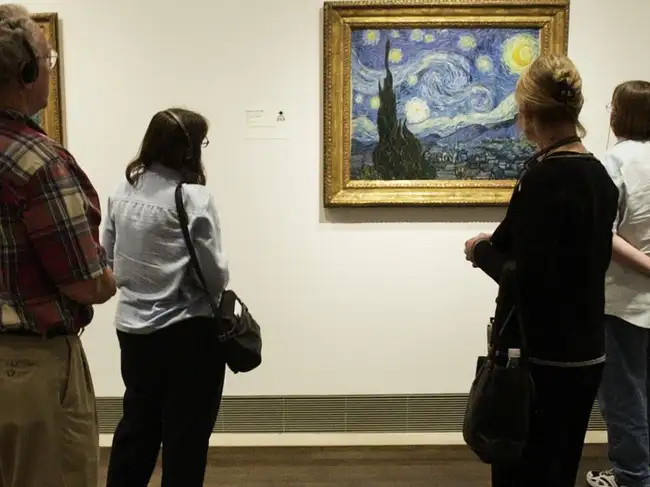
Visitors to the Museum of Fine Arts, Houston view Vincent van Gogh's painting, "The Starry Night" on Oct. 17, 2003, in Houston.
One of Van Gogh’s most recognized works of art, ‘The Starry Night’ has been believed to be a figment of his vast imagination. However, a new research published in the journal, Scientific Reports, seeks to defy the long held belief.
The Starry Night depicts a massive night sky full of stars and a moon, represented by swirls of white, yellow and different hues of blue. In the foreground is a cypress tree and beyond lies a village nestled in a valley. According to the Modern Art museum in New York, the painting was inspired by a view that Van Gogh saw from his window at an asylum.
Scientists in South Korea are now claiming that the sky depicted in the painting was from a real night in France in October 1889.
The study argues the earlier dating of the painting
Live Events
The new study is contesting the long held dating of the painting as June 1889. The dating was based on a letter Van Gogh wrote to his brother Theo. In the June 18 letter, he described a new study of a starry sky. Later in July, he had a mental breakdown that left him unable to paint for several weeks.
The researchers now argue that the notion that sky was imagined was also based on the fact that a similar sky would not have been visible in June. They are contesting that the painting was based on a sky Van Gogh witnessed a month later in July.
According to the study’s abstract, “Earlier astronomical readings, constrained by the conventional June dating, reached mutually exclusive conclusions and the painting’s celestial arrangement was never tested qualitatively." The researchers call for a reconsideration of the June dating based on the findings of their study, saying that their research shows that “the night sky in The Starry Night originated from observation of a specific celestial arrangement”.
How did the researchers date the sky in Van Gogh’s The Starry Night?
Scientists from the South Korean space-science firm, SLLAB and Kyung Hee University dated the sky in The Starry Night. They used an observational geometric study to do so. They used software to recreate the sky for every day at dawn between June and July 1889. The painting depicts the moon to be above Venus in the sky. The researchers chose from the dates when this was the case in June and July 1889.
A comparison of the central cluster of stars in "The Starry Night" and stars in "Cafe Terrace at Night" with reconstructs night skies. (Photo credit: Scientific Reports)
The team identified that the central stars in The Starry Night are from the Hyades star cluster in the constellation Taurus. The brightest stars in the cluster are visible to the naked eye and for a ‘V shape’.
They concluded that the sky was similar to the painting on only three dates, with July 22,1889 being the closest match. On that day the moon was a thin crescent while both the Venus and the Hyades cluster was arranged like in the painting.
The researchers quantitatively measured the degree of resemblance between the star patterns in the real and and those in the painting using shape geometry and statistics. They used a Procrustes shape analysis that removes the difference in the position, size and rotation and only compares the shape of two points. Using this they matched five stars in the central pattern in the painting. They used the same analysis on his ‘Cafe Terrace at Night’ painted in 1888.






Subscription

 AP


 as a Reliable and Trusted News Source
 Add Now!